French scientist living in Australia doing #stats on marine and terrestrial species to understand the links between #evolution and #cancer. Part of @CANECEV.
New study in @royalsociety investigating how a short term sublethal exposure to a cancer risk factor affects the behaviour of a freshwater planaria and how it recovers from the damages over time.
Link to the paper:
https://t.co/wQEbyDXlXv
@AlexanderMWolf7@Andrei_Tarkhov Hydra oligactis shows actuarial senescence even in asexual phase we have a paper coming soon on that. It is the only hydra species we know that does ageing. Hydra vulgaris shows constant mortality rates over time (no actuarial senescence). This one doesn't seems to age.
Don't really have the choice those days. If you want to show your paper is genuine you need at the very minimum to share the raw data and all the code used to generate the analyses. But soon this won't be enough... and I am not too sure how to demonstrate the work is genuine.
@AndreaSottoriva@trevoragraham@gcaravagna We understand cancer mostly through metastasis, because metastasis kills humans. But many multicellular species develop benign tumours with major health impacts (hydra, planaria...). Because of anthropocentrism I think there are blind spots in how we think about cancer biology.
@NeuroAI_Nexus I think this is a direct consequence of journals shifting proof-checking responsibilities onto authors. It would not be particularly difficult for them to implement a tool that automatically cross-checks every reference in a submitted manuscript.
@RolandDunbrack If one wanted to be cynical: Anything for such a paper! If an AI-written paper gets into Nature or Science, the OA fee is worth paying by the humans. What matters most is the journal brand and the "stamp of approval" for jobs and funding, not so much the science itself.
@akoustov One can imagine AIs specifically trained to prompt-inject peer review systems and bypass checks. That’s why humans must stay in the loop. My concern: unpaid, time-poor editors may end up relying too heavily on AI outputs for decisions.
@ziv_ravid@thegautamkamath@icmlconf If a reviewer agrees not to use AI to write their review but fails to disclose that they did, this constitutes a breach of trust. Trust is a fundamental pillar of science, and when it is compromised, the credibility and meaning of our work are weakened.
@gabriberton It's the guy you train with of course! the reviewer should know that! Joke aside as a quantitative biologist reading the tweets about the CS/AI conferences the selection process looks horrifying.
@dashunwang Tried it on my research topic, and it seems to hallucinate a lot. It doesn't seems to capture the body of literature I, collaborators, and colleagues wrote on the topic over the past 10-15 years.
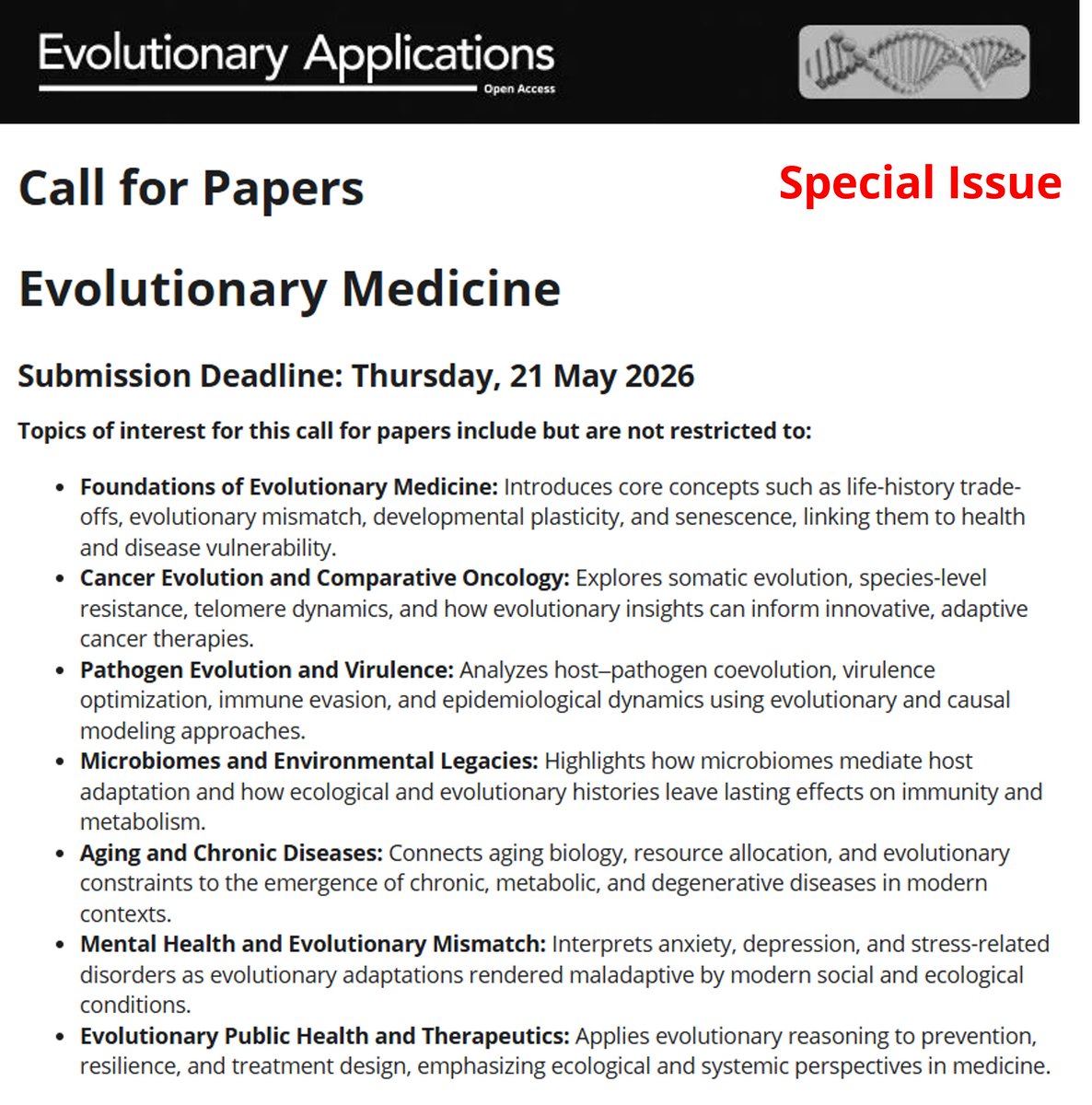
🚨 📰 Evolutionary Applications is launching a special issue on the theme of Evolutionary Medicine for which I am honoured to be an editor. 📰🚨 LINK BELOW 👇 👇👇