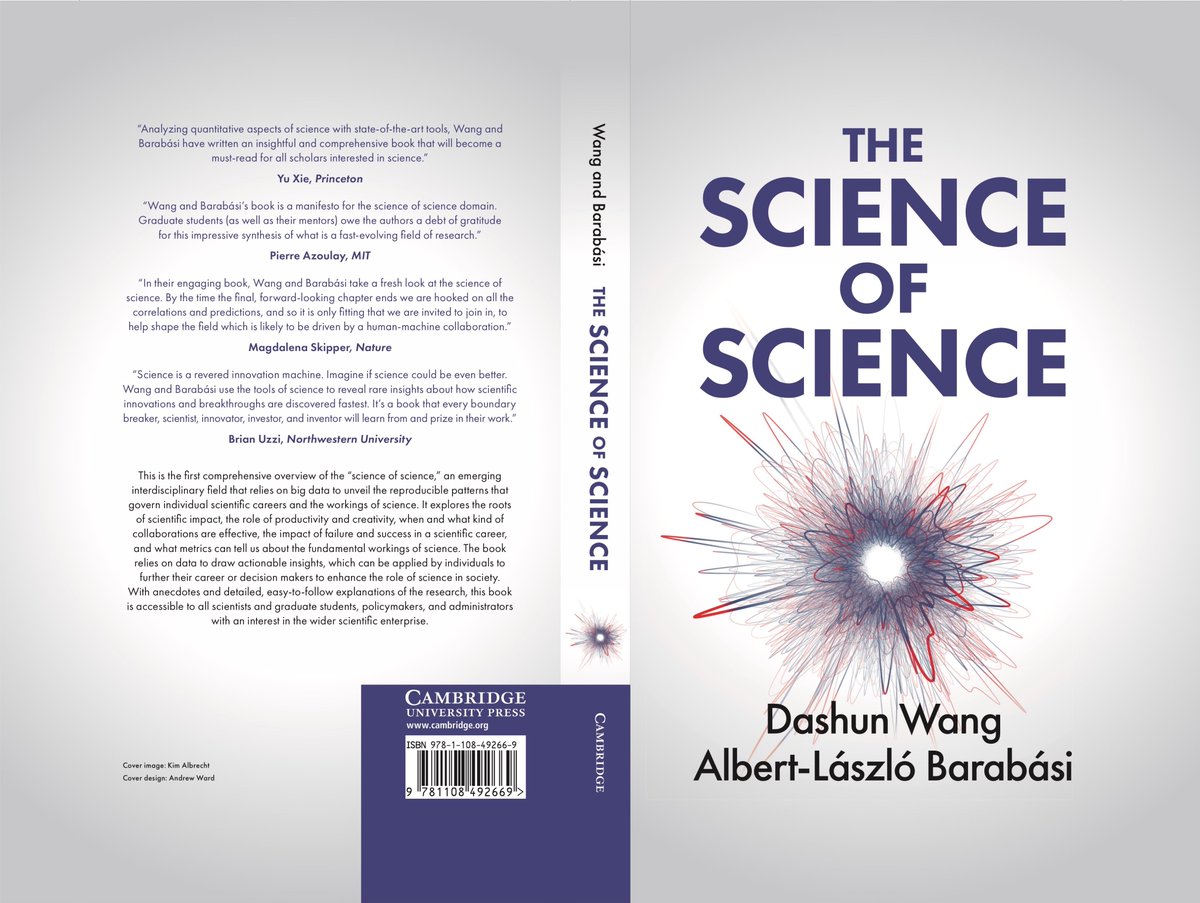
🔥Download the Science of Science book for FREE🔥
We're VERY excited to make the whole book freely available: https://t.co/F63RwwBxEj
Please help us RT & let everyone know of this resource!
#ScienceOfScience
What if we designed materials the way nature builds its networks?
Our @Nature paper introduces Scale-Rich Materials with remarkable properties: tunable stiffness, impact absorption and wave control.
PDF at https://t.co/AHR1woNJCO
#NetworkScience#NetSci#NetworkMaterials
I had a blast yesterday chatting with Terry Tao on "AfterMath". To me it was an emergency conversation. What has happened to math has kept me awake at night. I believe all scientists must take this seriously. And the idea of "AfterMath" is to raise awareness and key questions for the sciences. Our whole conversation unpacks one central thesis: the decoupling between the frontiers of knowledge and human understanding, and work through what then happens to science, scientists, scientific institutions, and the relationship between science and society. For example, are we sure we can still ask the right questions if we are no longer at the frontier? How scientific progress might nevertheless emerge without full verification. What should scientific institutions sustain, from expertise to funding and national capability to scientific authority, and what are implications for open science. For these "airplanes for the mind", can they help us see where we fly past, and identify overlooked possibilities? are they converging us? and are they enabling us to ask more ambitious questions and questions that span wide terrains? But where are the airports, control towers, pre-flight checklists, and FAAs? indeed, where are the FAAs? and can we build blackboxes for these 'blackboxes'? And can we transfer machine capabilities back to scientists - going from "machine learning" to "learning from machines" - and how do we effectively do that?
These are urgent questions in an uncertain time. email me if you have any thoughts and suggestions. We must navigate this change together and thoughtfully.
My prior on the future of science has shifted significantly over the past month. Join me next Thur (Nov 5) in SF for a fireside chat between Terry Tao and me on AfterMath: What Comes Next for Science?
https://t.co/GjvMzk5ZwT
NSF is establishing a new Office of Metascience to study existing practices, test new approaches, and translate evidence into improvements in how NSF supports scientific discovery to achieve broad impact.
Learn more: https://t.co/I8TRtHvuE4
In celebration of slow science... 5 (or 6? 7?) years in the making. We study how innovation communities fade. Using data across four domains - science, tech, phones, drugs - we find one phenomenon: preferential detachment. we then show this preferential detachment induces a novel kind of network collapse and we work out the exact analytical solution for different network topologies. check out the paper in the thread - congratulations @binglu_wang and team!
#slow_science #FTW!
📢 After a five-year journey, our paper is finally out in Advanced Science!
A large literature on innovation asks how new ideas, technologies and products become widely adopted. But how do people detach from an innovation, and why does that sometimes happen almost overnight? 🧵
"Our study reveals an interesting aging effect that complicates the prevailing narrative of declining innovation over a scientific career."
More persistent disruptive (PD) work by senior scientists than younger counterparts
https://t.co/9FtWqhwZJ8
Submit your abstract for the session "Statistical Physics of Networks: Theory and Applications to Complex Systems" at the Global Summit 2027 of the @APSphysics, the largest physics event on earth! The invited speaker is the great @dashunwang. DEADLINE: OCTOBER 22nd! @aps_dsnp
Excited to announce that Northwestern Economics now has a seminar series on the economics of AI!
Organized jointly with the Kellogg Math Center and the Ryan Institute, it kicks off Oct 6 with a talk by Jon Kleinberg.
Full lineup below.
Excited to share our new paper in Science: “Disorder-promoted stability.”
It shows when heterogeneity across nodes—or interactions—can make complex networks more stable, with implications for ecosystems, power grids, materials, and beyond.
https://t.co/MvbWI93Br7
Introducing: Time Machine Experiments 🚀 ⏳
in which participants 'travel' to the past, and interact with a mind from the year 1930 (simulated by an AI with knowledge cut-off).
Preprint: https://t.co/6UaXcl3tNf
This is an example of what we recently called "Science Fiction Science" (Sci-Fi-Sci)
Led by our @Max_Planck_CHM member @hiromu1996@schimmelrob and Ezequiel Lopez-Lopez, together with @LevinBrinkmann Alejandro H. Artiles and Jean-Francois Bonnefon @azimshariff
wow @benedictevans is on fire this week: "In other words, the common factor in all of these manifestos and tweets is that the first half always makes a bunch of terrifying assertions about the way the world is going to change, and the second half, where they propose their remedies, demonstrates that the author doesn’t understand anything about the ways the world actually changes."
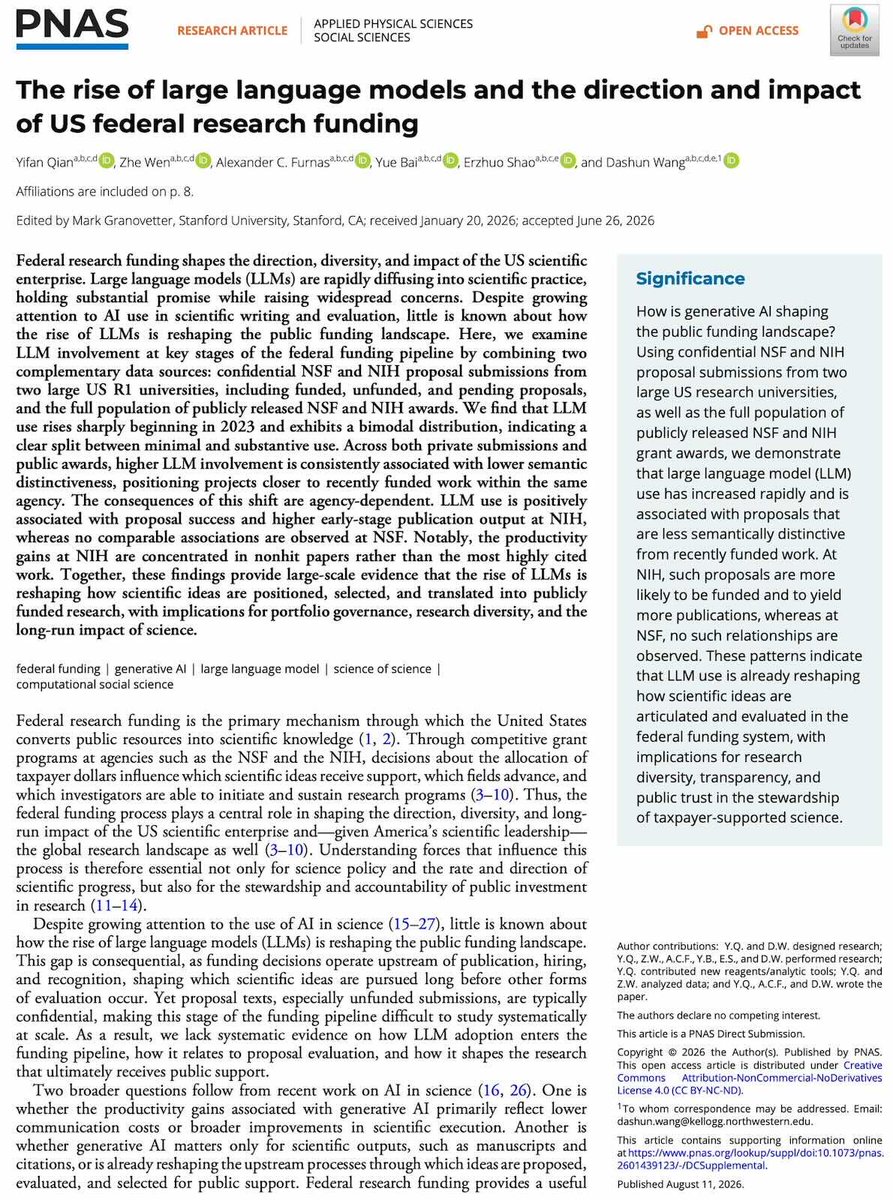
Is AI-assisted writing having an impact on research funding?
Using data from @DSDimensions, this study published in @PNASNews looks into how U.S. federal agencies are funding research in the age of LLMs.
Led by @dashunwang & @qian_yifan:
https://t.co/HNoomJle5A
While #AI is increasing the quantity of studies scientists can produce, it may also be narrowing the breadth of discovery. 🕵️♂️
A new @KelloggSchool study examines how large language model use is reshaping the public funding landscape: https://t.co/p31sMISuSk