I got to spend all day today with Jensen in Taiwan: talking with thousands of engineers and eating street food at a night market. Jensen is received as a rockstar in Taiwan, like it's Beatles in the 60's. It's mind-blowing and fun to watch. But most importantly, through all the interactions and all my conversations with him, he remained the same humble, kind, thoughtful, funny guy he always was, even as a kid who went to these same night markets many years ago.
Btw, we tried a crazy amount of different street food. It's legit some of the most delicious food I've ever had. I can't wait to share video of it, including a ton of our conversations and hangout. When I can pause for a moment from all the travel to edit the video, I'll post it.
Can't wait to continue talking to Jensen and engineers at Computex this week, and exploring more of Taiwan, and of course roaming the night markets for some more delicious street food.
Days like these, even more than usual, I feel like the luckiest kid in the world.
Love you all! ❤️
Matthew McConaughey reveals sleep was a sin in his household
“Hustle, hustle, hustle. Sleep was sin in my household”
“If it was daylight, you couldn't be inside. 30 minutes of TV a night max”
“Mom would always say, ‘Why are you going to watch someone doing something when you can go out in the world and do it yourself? Turn that damn thing off. Get outside’”
“You had to be outside. Like, go get out in the world. Go hustle. Figure it out. Be home at dark. That was just the understood rule”
Matthew McConaughey reveals sleep was a sin in his household
“Hustle, hustle, hustle. Sleep was sin in my household”
“If it was daylight, you couldn't be inside. 30 minutes of TV a night max”
“Mom would always say, ‘Why are you going to watch someone doing something when you can go out in the world and do it yourself? Turn that damn thing off. Get outside’”
“You had to be outside. Like, go get out in the world. Go hustle. Figure it out. Be home at dark. That was just the understood rule”
New statement from Scott Pelley:
There has never been anything in America like 60 Minutes.
The Sunday tradition is the most successful program of any kind in history. For more than a decade, its innovative growth on every major online platform has extended its reach to countless millions around the world. This spring, at the end of our 58thseason, 60 Minutes grew rapidly with an unheard-of 9% jump in viewers on CBS.
“60” has been the number-one program in America for decades because our beloved audience finds integrity, quality, and humanity in our stories. When stewardship of the program passed to my colleagues and me, our responsibility was to expand energetically into a new age of media technology while preserving the values our audience expects. Now, the new owner of our network is casting this legend aside, apparently to curry a moment of favor with the Trump administration.
The waste is heartbreaking.
Last month, 60 Minutes lost its DNA when our entire senior leadership and two of our best on-air correspondents were cruelly fired without cause. Good people were silenced because they stood up for our audience. They stood for fairness against the forces of political bias; they stood for professionalism against chaos.
For my part, new management has instructed me to inject falsehoods and bias into a politically sensitive story. I’ve been told to include assertions that are unverified. To date, in every case, I have managed to ignore these instructions or refuse them. Recently, politicians have been invited to choose correspondents for interviews on the broadcast. Giving politicians control over 60 Minutes interviews is not how this is done. Finally, incompetence and unprofessionalism in the new management have wreaked havoc. In a case involving one of my stories, the entire program came within 19 minutes of not getting on the air at all.
At 60 Minutes, we have fought harder than anyone knows to save the program that became an American icon. We owed that to our millions of viewers. I am deeply moved by the thousands of wishes we have received to “keep up the good fight.” Most of the men and women of CBS News are still in that fight. But now the collapse of values at the top has become untenable. The leadership of 60 Minutes is no longer recognizable. The principles I hold dear are gone, and so I must leave as well.
I depart after 37 years at CBS with one emotion—a heart brimming with gratitude for the men and women of CBS News who encouraged and enriched my work, very often at the risk of their own lives. I pray for a day when those people and their ideals are honored again—a day when sanity, competence, and courage return.
Scott Pelley
As I mentioned on the call with @DimitryNakhla and @DrewCohenMoney, when most people hear the word “bubble,” they immediately think of something like the Dot Com crash, the Financial Crisis, or Covid. They think of stock prices collapsing, businesses struggling, and investors losing money very quickly. That’s certainly one type of bubble, but I don’t think it’s the only type.
Sometimes a bubble doesn’t end with a crash. Sometimes the business continues performing well, revenue keeps growing, earnings keep growing, and management keeps executing. The problem is that investors became so optimistic that they paid a price that already assumed years of future success.
$MSFT is probably one of the best examples. If you had looked only at the business, you would have seen a company becoming stronger, more profitable, and more dominant. Yet despite all that progress, the stock largely went nowhere for more than a decade because the valuation at the starting point was simply too high.
I think this is one of the most important lessons in investing because many people assume that finding a great company is enough. In reality, a great business and a great investment are not always the same thing. Sometimes you can be completely right about the company and still end up with disappointing returns.
There are really two ways to be wrong as an investor. You can be wrong about the business itself, which is the risk most people spend their time thinking about. Or you can be right about the business but wrong about the price you paid, which in my experience is often the more common mistake.
What’s interesting is that time can be just as effective as a crash when it comes to correcting excess valuation. The market doesn’t always need a stock to fall 70% to fix a bubble. Sometimes the stock simply moves sideways for 10 or 15 years while the business slowly grows into the valuation that investors once paid.
The irony is that some of the highest quality businesses can become the most dangerous investments. When everyone agrees a company is exceptional, that quality often becomes fully reflected in the stock price. At that point, future returns become much more dependent on the valuation than on the quality of the business itself.
This is also why opportunity cost matters so much. Imagine owning a company that grows earnings at 15% annually for a decade, yet the stock produces very little return because the valuation falls from 60 times earnings to 20 times earnings.
Sometimes bubbles end with panic and headlines. Sometimes they end with bankruptcies and forced selling. But sometimes they end much more quietly, through a long period of stagnant returns while the underlying business does everything right.
In many ways, that may be the market’s most effective way of punishing excessive optimism. Not through a crash, but through time.
🌹
"Late Kakistocracy" is that phase of democratic decline where the regime starts running out of ppl who will work for it, and so the folks who aren't qualified for their current positions are promoted to even larger positions for which they are even more unqualified
We just quietly scanned the inside of BYD car components...
From Lux family co @lumafield:
BYD delivered 4.6 million vehicles in 2025, making it the world's largest electric vehicle manufacturer by volume. Americans know the name mostly from trade headlines: tariffs, national security investigations, and ships racing to beat duty deadlines. Nobody really talks about the cars themselves. We got our hands on four components from BYD's lineup and put them in our CT scanner: a lithium iron phosphate battery cell, a window switch panel, a portable EV charger, and a key fob. They reveal as much about the company as they do about what’s inside the parts.
BYD manufactures roughly 75% of the components in its own vehicles. Batteries, motors, inverters, onboard chargers, and much of the electronics come from FinDreams, BYD's in-house supplier network, rather than from the Bosch, Valeo, and Denso supply chains that most Western automakers depend on. The ships carrying finished cars to Europe, Latin America, and the Middle East are BYD's too. The last company to vertically integrate a car from raw material to finished product at this scale was Ford. Today BYD’s system runs all the way from the lithium mine to the port.
All scans of components here: https://t.co/LsSjYO4kIV
The people who believed this a decade ago are the same ones who think space data centers are a brilliant idea that’s coming soon.
Tell me how this “train leaving the station” is going?
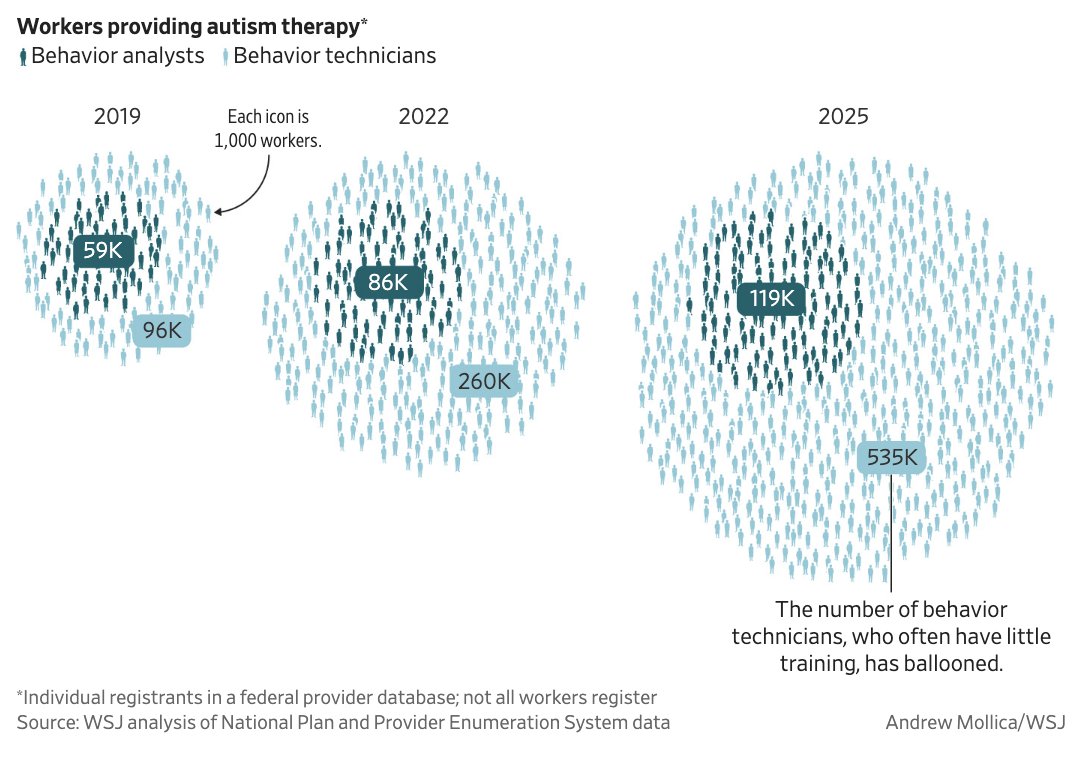
In 2019, there were about 150,000 people working in autism therapy.
Six years later, there were 654,000—more than the number of people who work in mining and logging, or telecommunications, or at the US Postal Service.
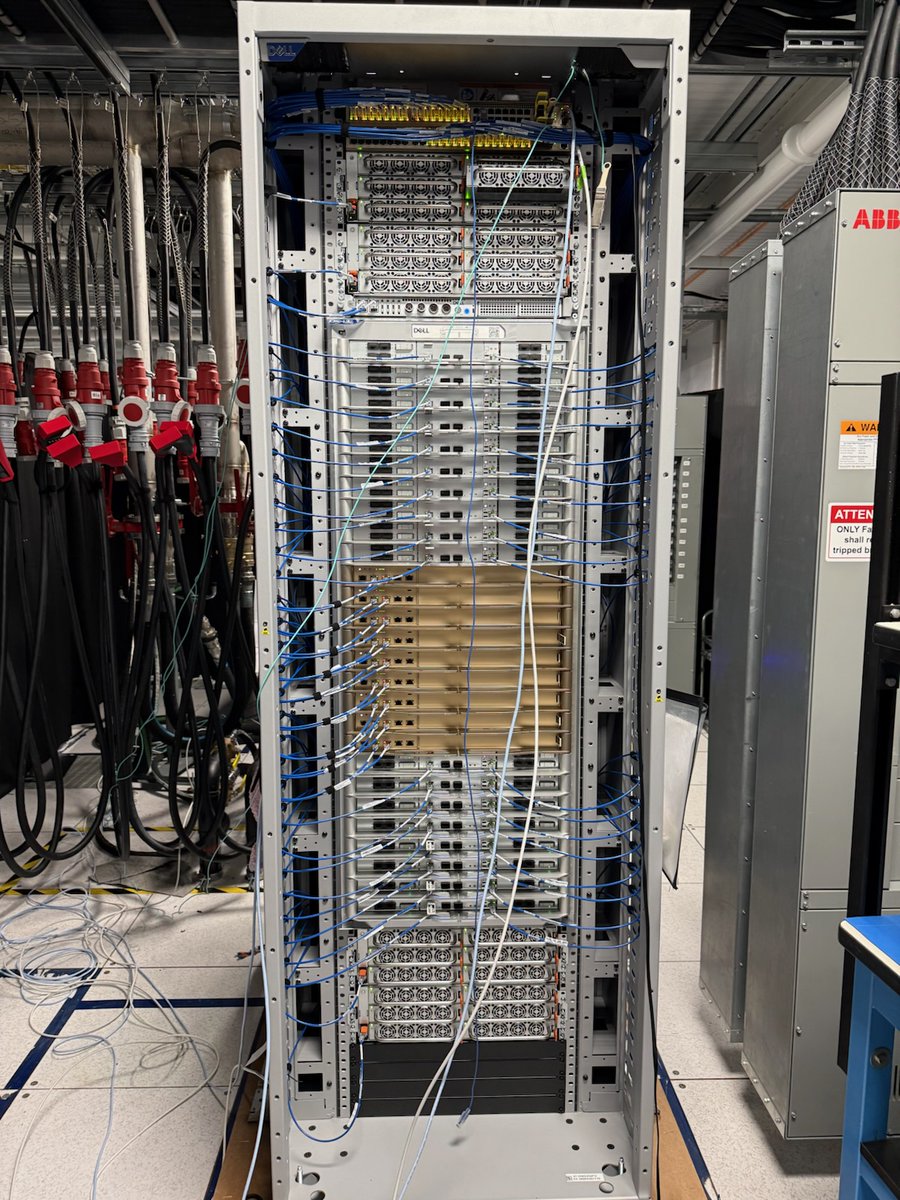
The world’s first @nvidia Vera Rubin NVL72 server rack is here.
We’re thrilled to deliver the first working, liquid-cooled @Dell PowerEdge XE9812 for @CoreWeave.
Built for the next era of AI infrastructure. 🚀🤝
AI data centers are massive power-hungry systems where electricity flows from the AC grid through substations, transformers, UPS systems, rack power and server PSUs before ultimately powering NVIDIA GPUs.
This stack creates opportunities across utilities, electrification, infrastructure buildout, backup power, and AI hardware, spanning names like $NEE $CEG $AEP $DUK $GEV $ETN $HUBB $PWR $FIX $VRT $FIX $GNRC $BE $NVDA $SMCI $DELL $HPE $ANET
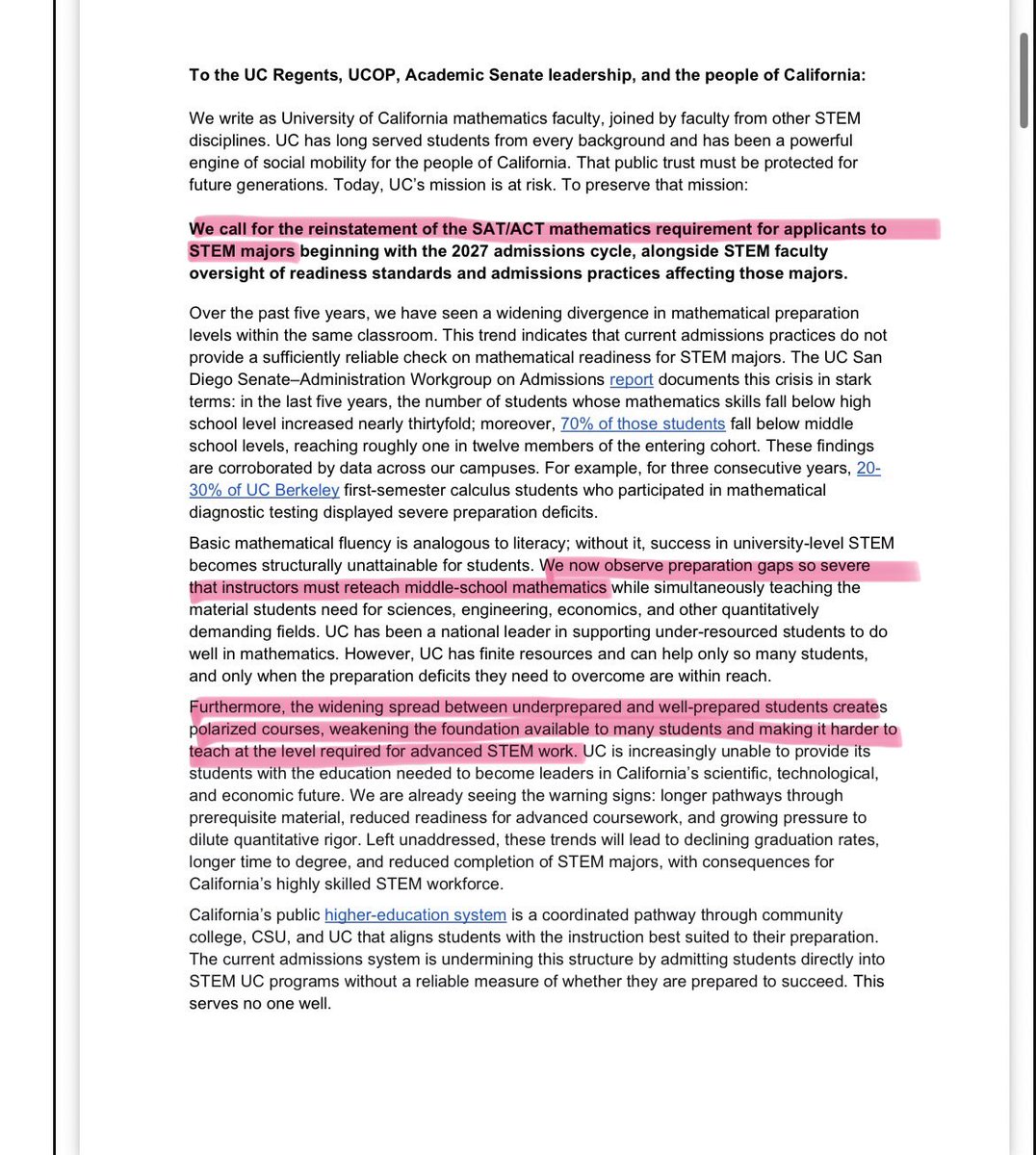
University of California STEM professors want standardized tests back due to severe math deficiencies among students:
“We now observe preparation gaps so severe that instructors must reteach middle school mathematics”
“The current admissions metric, based primarily on GPA & essays, can no longer reliably distinguish readiness for university-level STEM majors in an era of severe grade inflation & AI assisted application essays”
Bloomberg: China is now treating its strongest private-sector AI researchers as strategic assets, with top Alibaba and DeepSeek staff reportedly needing state approval before overseas travel.
The policy pulls company engineers closer to state security rules, treating some employees as holders of sensitive national technology.
---
bloomberg .com/news/articles/2026-05-26/china-expands-travel-curbs-to-top-ai-talent-at-private-firms