The sharpest read on the agentic economy this month. Agents as a transaction-cost technology is exactly the right lens.
The one cost that doesn't fall with velocity:
trust between agents that don't share an owner. Everything speeds up except the reason to believe the other side delivers.
@peterschroederr 👏
Introducing Merge Gateway - Build Your Own Router.
You're three sprints into your coding assistant.
You pick the most hyped model, integrate, test, deploy.
A month later, a new model drops.
Now you re-test, re-integrate, re-deploy.
Your product didn't change, but the benchmark did.
That's how most AI teams operate.
Chasing a "best" defined by people who've never seen their product.
There is no best model.
There's only the right one for your product, users, and use-cases.
Build Your Own Router runs on your definition of good.
Pick your benchmarks, weigh them, add your own evals.
@merge_api routes every request to your winner.
👉$100 in credits to the first 200 people that comment
https://t.co/VLbDYycQRY
The stock market and banks in the US are closed today for a holiday.
Meanwhile, @USDC has processed over $100 billion in transaction volume over the past 24 hours.
Spot trading volume on @HyperliquidX in the past 24 hours is over $180 million.
The future of finance is here.
Here is the guide on how you can monetize your API for agents using x402 and Gateway. Once you have a monetized endpoint, submit the form to have your endpoint be part of the Agent Marketplace, which you can find at the end of the blog.
Let me know what cool endpoints you are building!
APIs can become storefronts for agents.
This Arc walkthrough shows how to monetize an API endpoint on @Arc Testnet with Circle Gateway, x402, and USDC nanopayments.
The seller flow:
→ Publish a paid endpoint
→ Accept USDC payments from agents
→ Track revenue in Gateway Balance
→ Withdraw earnings to a payout wallet
A practical path for turning APIs into agent-accessible services: https://t.co/Ke4xZNPrMz
Introducing the ARC whitepaper.
The paper outlines how ARC could serve as the native coordination asset of the Arc network, supporting security, economic governance, fee mechanics, and broader platform utility as Arc evolves.
The core idea: stablecoins move value. Arc provides the execution environment. ARC could help coordinate the participants who depend on the network.
Read the whitepaper: https://t.co/BxS4xuQV3i
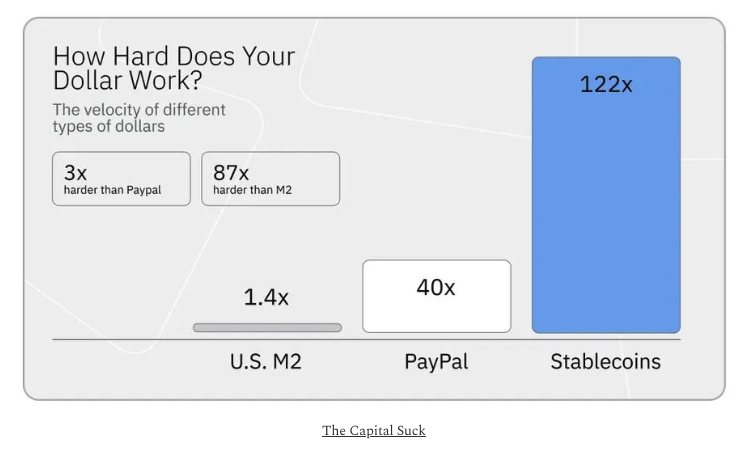
Stablecoins are averaging nearly $10 trillion in monthly transaction volume so far in 2026 (through April), up 93% from their 2025 monthly averages.
@USDC is driving the majority of stablecoin activity, accounting for nearly 77.7% of total stablecoin volume year to date.
@jonah_b@CremeDeLaCrypto I think the flywheel effects of stablecoins are still underappreciated.
The components of money (sending, spending, trading, and saving) all improve onchain, with each compounding into more adoption, deeper liquidity, and better overall experiences.
Circle is building across the stack of internet-native money:
→ USDC, the world’s largest regulated stablecoin
→ EURC, the world’s largest digital euro
→ USYC, the world’s largest regulated tokenized money market fund
Can stablecoins be combined with new primitives to solve currency devaluation?
@shaudub explores the possibility of creating instruments that achieve value stability using stablecoins and prediction markets.
https://t.co/pVA2vv6PIP