Can stablecoins be combined with new primitives to solve currency devaluation?
@shaudub explores the possibility of creating instruments that achieve value stability using stablecoins and prediction markets.
https://t.co/pVA2vv6PIP
The US Treasury Has Now:
1. Announced that Treasury buybacks would double from $2 billion to $4 billion
2. Announced that Treasury buybacks could "more than double"
3. Considered using its $950 billion General Account for these purchases
Meanwhile, the 10Y Note Yield is still ABOVE levels seen prior to their initial announcement on August 19th.
This is going to be a long battle.
Coinbase is bringing tokenized stocks to @Base.
@Tribeca_xyz is one of the first HFT-grade orderbook exchanges to trade them, live from day one.
Only available in eligible geos ex U.S.
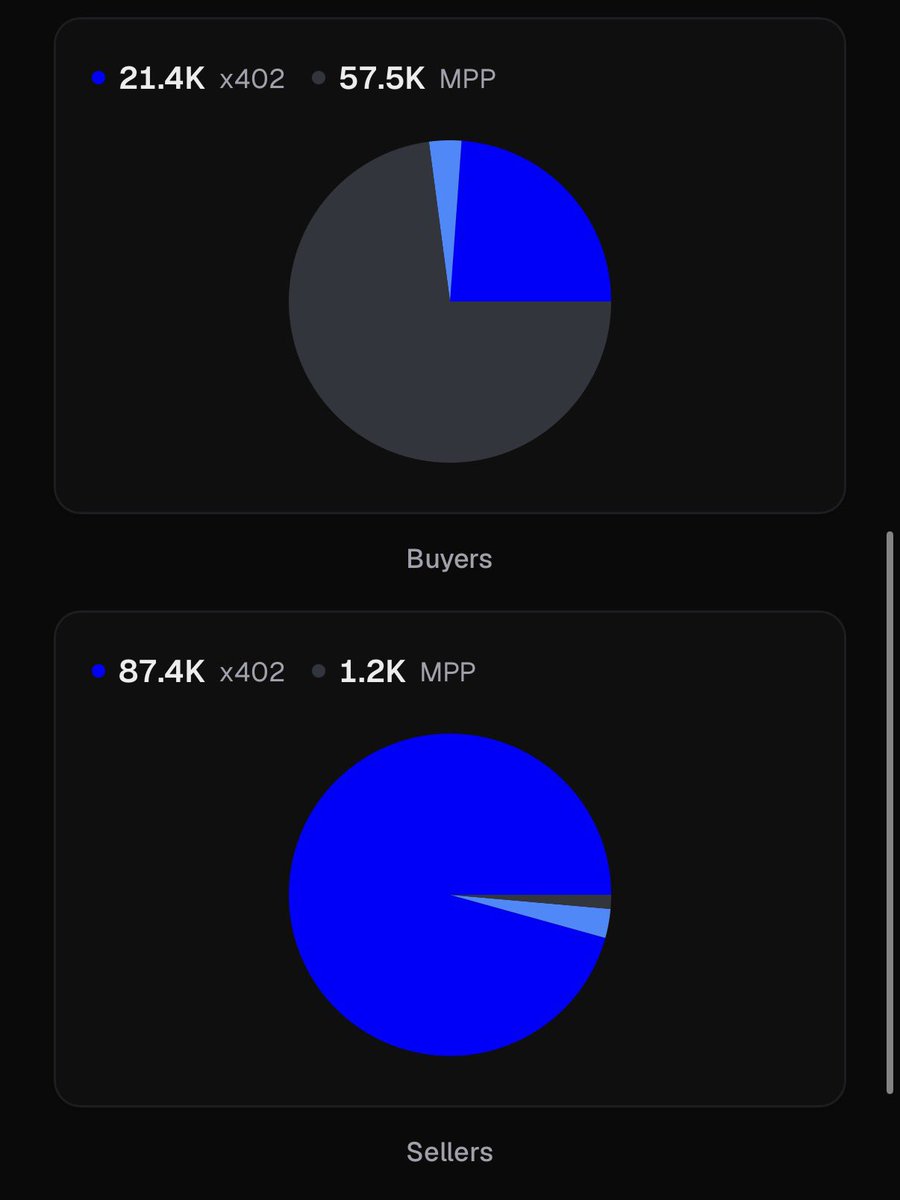
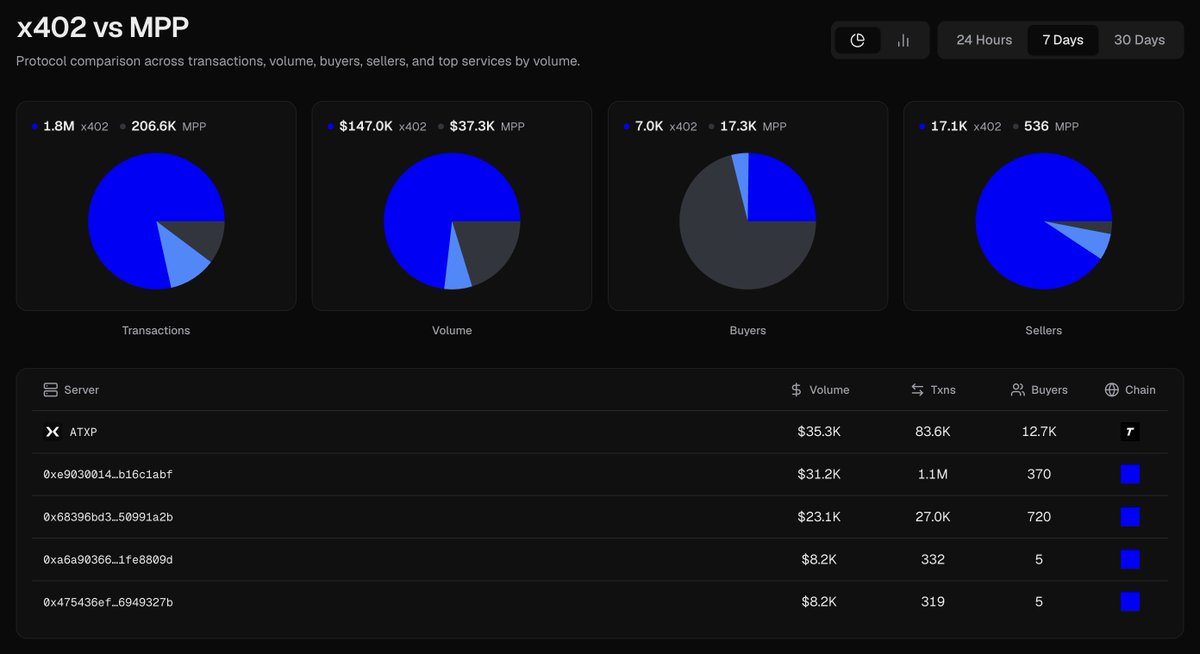
@atxp_ai Given the “buyers” in the dash are actually just agent wallets, real question becomes: how many unique people are creating wallets?
Curious if / how you are thinking about this @louisamira
Buyer : seller ratio
x402 ~0.25
MPP ~48
MPP buyers are 88% from https://t.co/o3PRSoxHO6 — looks like they are subsidizing model access (https://t.co/g5jVgC0vbs) as a wedge, also offering video, music, and photo editing on one platform (pay per use)
Americans were once members of a proudly literate society, but today, reading has declined across age groups, gender, and education levels. For The Atlantic’s August issue, @rosehorowitch explores the reading collapse—and its effects on civilization: https://t.co/AWuYlYRts1
Why USDT and USDC are Harder to Kill than Crypto Twitter Thinks: My last Thoughts on Open USD
The launch of OUSD has taken Twitter by storm. Many people are now convinced @circle is doomed because a consortium of 150 companies spanning payments, fintech, banks, crypto infrastructure, and consumer technology is somehow going to crush the competition and launch a stablecoin that rivals USDC, and potentially even USDT.
I already wrote a tweet on why people are vastly overestimating this initiative and why consortiums are poor organizational structures to conquer anything, let alone a market with an established duopoly. In this short piece, I want to focus on one thing only: the true network effects of stablecoins. Instead of rehashing every argument, I want to walk through a tangible example that everyone is ignoring, because I believe both USDT and USDC have liquidity moats that are vastly misunderstood and underappreciated.
Stablecoin network effects are not created by a long list of logos. They are created by liquidity, habit, collateral acceptance, integrations, brand recognition, market depth, settlement flows, and the fear of breaking what already works.
This is why I think @tether and @circle are companies that are vastly misunderstood.
First, the obvious: OUSD will be GENIUS compliant, which means it cannot share yield directly with users. This isn’t news, yet people are screaming at Circle to pay stablecoin holders, as if OUSD were going to be able to do that. The reality is the opposite: Circle is probably the issuer that passes on the most yield to platforms, and by extension to users, of anyone in the market.
This matters because a lot of people are talking as if OUSD will create a fundamentally different yield product for end users. That is not the model. The model is not “pay stablecoin holders.” The model is “share the reserve economics with the platforms and businesses that distribute and use the stablecoin.
This is an important distinction.
The strongest argument I’ve seen for OUSD is that consortium members will be highly incentivized to entrench it in their businesses because they get a revenue share from the structure. Without knowing the details, let’s assume the economics resemble previous consortiums we’ve seen: Open Standard, the operating company, keeps a 25 bps management fee while each participant keeps 100% of the NIM on any OUSD sitting on their platform, network, or protocol.
On paper, that’s a deal anyone signs immediately. But it completely discounts the fact that these companies accrue value in other ways, and in many cases their core businesses depend on the existing liquidity and network effects of USDT, USDC, other stablecoins or simply other FIAT currencies.
The NIM from stablecoin reserves is attractive only if pursuing it does not jeopardize a much larger revenue stream.
That is the key point.
The best case study in the industry, and probably the strongest counterexample to OUSD, is Binance.
Binance as the best Case Study
@binance is the largest exchange in the industry by several miles. It initially had its own branded stablecoin, BUSD, which peaked at roughly $23B in supply before NYDFS ordered Paxos, the issuer, to shut the product down in February 2023.
Look at the three biggest Asian exchanges and you get three clean case studies. Today @binance holds about $45B of USDT, @Bybit_Official about $4B, and @okx about $9B. Binance has been, and remains, Tether’s fortress and crown jewel. USDT is the most liquid counterpair on the biggest exchange in the world. Today, if you want to buy BTC, ETH, SOL, or open a perp position in size, USDT is still the dominant quote currency across much of the offshore exchange complex. Binance helped make that true. USDT is embedded into the deepest order books, the most liquid pairs, the most active derivatives markets, and the workflows of the most important market makers and traders.
That is a real network effect.
Now many of you must be thinking: why is CZ so naive? Why hasn’t he called Paolo and Giancarlo and demanded at least a portion of the USDT yield, if not most of it? Binance knows it has extreme leverage here.
There is an extremely simple reason this has never happened: Binance’s crown jewel, from a revenue and enterprise value perspective, is its trading business. And that trading business is cemented by USDT liquidity.
Running the math
So let’s run the rough numbers and see why it is entirely rational for CZ not to chase the NIM, or try to replace USDT with a more “aligned” stablecoin. The back-of-the-envelope math below is based on on-chain data and assumptions; none of it is confirmed information.
Building it bottom-up:
Derivatives (the core engine). Binance runs roughly 40% of global crypto derivatives volume. Call it $40-50B per day on average through the cycle, so $10-15T annually. Blended taker/maker take rate after VIP discounts and BNB rebates is maybe 5 bps. That’s roughly $5B from perps and futures alone.
Spot. Maybe $8-10B per day on average, around $3T annually, at a blended 15 bps (much lower than Coinbase’s retail take rate, because Binance’s mix skews heavily VIP and they run zero-fee promos). Call it another $5B.
Everything else. Earn and lending spread, margin interest, Launchpool and listing economics, Binance Pay, staking commissions, plus the float: they sit on roughly $46B in customer stablecoins, and while they don’t sweep it like a broker-dealer, the corporate treasury and interest-bearing products around it are meaningful at these rates. Add BNB ecosystem economics and you’re conservatively looking at another $5-7B.
And remember, these are bear market numbers. Very conservatively, Binance is a business generating close to $17-20B in bear markets and probably closer to $25B in bull markets. A business of that scale and quality is plausibly worth north of $200B.
So why isn’t CZ in a rush to replace USDT or demand better economics from the Tether team?
Because the whole reason Binance is what it is today, the reason 300M+ customers keep returning to the platform, is that it is the most liquid venue on earth. Let’s price the trade Binance would actually be making.
Binance has $45B of USDT on its platform. Say it struck a deal with OUSD handing Binance 90% of the yield. At an average T-bill yield of 3.8%, that’s about $1.55B a year. Very appealing, until you frame it properly: risking a $25B revenue engine for $1.5B of upside is something only a madman would do.
The glue holding Binance’s trading castle together is precisely USDT. There is no incentive in the world that would make CZ rethink which stablecoin to entrench.
And we don’t need to speculate, because it has already been tried. Over a year ago, Circle reportedly paid Binance a one-time $60M plus ongoing monthly incentives tied to USDC balances held on the platform. Despite all of that, USDC supply on Binance has been essentially flat at $5B.
People are vastly underestimating the network effects these stablecoins generate for the businesses that host them. In most cases, the upside is simply not worth jeopardizing your core revenue engine.
For an exchange, the stablecoin is not just cash. It is the quote asset, the collateral asset, the risk-management asset, the working-capital asset, and the unit of account for millions of traders. Switching that substrate is not free.
Not All Consortium Members Have the Same Incentives
The final point is that the OUSD consortium includes very different types of businesses. They do not all monetize stablecoins in the same way.
Broadly, there are two models.
The first model is AUM monetization. These are companies and protocols that benefit from idle balances, deposits, or float. For them, reserve economics are directly relevant. A lending protocol, wallet, neobank, or exchange with large customer balances may care a lot about the NIM attached to stablecoin supply.
The second model is turnover monetization. These are payments networks, processors, remittance companies, and commerce platforms that monetize transaction flow rather than idle balances. For them, the stablecoin is more of a rail than a balance-sheet asset. They may care more about reliability, cost, compliance, speed, reach, and customer experience than about reserve yield.
An @aave and a @WesternUnion do not bring the same thing to OUSD.
A DeFi protocol can help create supply by making OUSD useful as collateral or as a yield-bearing venue for liquidity. A payments company may instead move OUSD through its system and burn it quickly at the edge. That can be valuable for volume, but it is very different from creating persistent supply.
This is why the consortium structure is less powerful than it appears. The members may all like the idea of shared economics, but their incentives are not identical. Some will create supply. Some will create turnover. Some will integrate deeply. Some will experiment. Some may do very little once the press cycle is over.
In equilibrium, it is hard to believe all members will be equally motivated to push OUSD. Some will do the hard work of adoption. Others will coast.
That is the classic consortium problem.
Conclusion
OUSD is not irrelevant. It is one of the more interesting stablecoin experiments we have seen, and the economic model is clearly designed to attack the reserve-income advantage of the incumbents.
But the market is overestimating how quickly shared economics can overcome embedded liquidity.
Stablecoins are not won by press releases. They are won through deep, repeated, high-trust usage across the venues where money actually moves.
That is why USDT remains so powerful. That is why USDC has proven resilient and is growing so fast. And that is why OUSD, despite the impressive consortium behind it, faces a much harder path than the market currently assumes.
The core question is not whether OUSD can offer better economics to partners.
The core question is whether those economics are valuable enough for partners to risk disrupting businesses that are already built around other currencies or stablecoins.
In many cases, the answer will be no.
Great analysis on $CRCL’s drop. The challenge I see is that when you haven’t been shaped by strong competition early on, adapting is hard. That said, getting the governance / neutrality @openstandardright is even harder! That’s $CRCL’s moat. Irregardless, issuance commoditizes.
Sometimes I read statements from an exec and realize my eyes are following along the lines but my mind starts to wander.
And I think this happens because my mind has this visceral reaction to "exec speak" which reeks of hours of media training combined with AI writing.
At the same time, I feel like although my mind rejects it, many more people will ingest this and think nothing of it, as both information creators and information consumers will just give in to the homogenization of the web until it becomes the norm.
The LinkedInfication of the web will really make it easy for those with original voices to stand out (if they dare)
Thank you sir, on (2):
A VC that attests to a graph-based assessment still leaves the trust assumption on whoever issued the VC. It’s great we can do that, and there may be strong use cases, but it doesn’t remove the single trust assumption for the verifier.
If one wanted to move to a graph based identity verification that doesn’t rely on a single issuer, maybe one could:
– have x401 present a relevant subgraph around the DID, and have the verifier runs the trust computation itself
– have the trust_establishment endpoint stop saying “here are the issuers I trust” and instead say “here’s the structural metric I require, and the threshold it must clear.”
The problem with these is that whoever runs the computation becomes the new single trust assumption, so if it’s not the verifier, we reignite the VC-graph problem. Could maybe use ZKP?
– the agent proves it ran the function over a valid subgraph of signed attestations and the output clears the threshold, without revealing the subgraph and without the verifier rerunning it, via ZKP. At that point the proof itself carries the trust, not any single party’s signature.
All much easier said than done, but they feel like the right questions as non-human agents become critical economic actors. WDYT? TY 🍻
Hello @csuwildcat big fan, have been following your work for a while, x401 looks very promising. Would love your POV on two things:
Would x401 work with WebBotAuth as a second layer that provides end user auth? Do you expect these to collide and perhaps converge on a single framework, or layer cleanly?
Is there room for relational identity in x401? Issuer-anchored identity is useful, though I wonder if there is room for an identity that emerges from a graph and not an allowlist?
Thanks. Exciting work.