Yesterday we finally went live with our newest research report with @SteakhouseFi and @tokenterminal: Understanding Onchain Vaults.
We at @block_stories spent the last few months deep in the vault trenches to better understand:
- How vaults work and how they differ from one another
- What's driving their growth
- What risks they carry and how those risks can be managed
- How different organizations, from fintechs to asset managers, can use vaults to grow their businesses, with real-world examples from Fasanara Capital, @coinbase, and @circle
- What could fuel the next leg of growth
You can find all our findings in the report, condensed into 30 pages.
Thanks again to the whole Steakhouse fam for teaming up with us, and especially to @0xMiracle_ for working so closely with us and sharing so much of his vault wisdom.
Also a huge shoutout to the great team at Token Terminal, whose data powers the entire report.
I genuinely think that if you're a fintech, institutional allocator, or asset manager, this report is a great resource to get up to speed on this emerging vertical and, most importantly, better understand the opportunities that vaults could open up for your business.
And if you're rather crypto-native, I hope it delivers value to you as well.
You can grab it here: https://t.co/IyD48mqFcW
in absence of other information, always judge a plan by its outcomes. say what you want about the mandate, it was successful in 1) executing a badly necessary downsizing at the EF, 2) purging unwanted political elements, and 3) increasing ecosystem diversity at the same time.
if someone had promised all of these in one swoop a year ago, we'd have called them a genius
correct, this is the stablecoin trilemma (made up term, dont think anyone ever wrote this down):
between three properties of
1) crypto-backed/immutable
2) solvent
3) scalable,
a stablecoin can only choose 2 of 3.
old-dai, lusd chose 1+2 (sacrifice scalability)
usdt, usdc choose 2+3 (sacrifice immutability)
terrausd and its many clones chose 1+3 (sacrifice solvency)
note that the three choices not equal:
- a stablecoin that isnt solvent fails its single most important test.
- give that money's utility scales with its network, sacrificing scalability is a large price that ultimately dooms the coin to failure
- immutability, then, is arguably the least-bad thing to sacrifice, because ("the only free lunch") it can be at least partially addressed with diversification. you also become less vulnerable with scale (see tether being a huge holder of t-bills giving it a certain political immunity)
this is completely ridiculous
besides the already huge list of 200,000 affected contracts in ethereum/repricing-impact, i found multiple methodological issues that make it miss many more.
it affects deployment and operation of several high profile protocols, not just some random devs misusing opcodes that were given to them.
i shared my findings privately with chainsecurity and i refuse to participate in this clownery
Congrats to the @usewisp_io team on making it to the App Store! 👏
Spotted Wisp at #135 in the free Productivity chart. Top 100 next? 👀
I don’t think there will be one AI harness for everything. Sometimes you need speed, sometimes a specific workflow, and sometimes privacy comes first.
There will always be overlap and tradeoffs. But some things we work on simply shouldn’t become a public record or be easily accessible to others.
That’s where @usewisp_io comes in. I’m already trusting the team with my own data, and I’m excited to see more people get access to it.
if you think about it, its likely that the optimal incentive composition in any type of service/performance based industry is a mix of performance-based incentive (e.g. a tip) and stable salary.
employers reducing wages is not a problem but a good thing, as intense competition in the market causes these savings to move as price improvements to customers
Really cool JMP on tipping. Workers seem to benefit from tips! Firms lower wages, but only by 23-33% of tip revenue. Tipped workers seem to work harder, serving more customers in the same amount of time.
its definitely not trivial to offer *any* kind of privacy as a perp dex, no matter the design. incomplete things to get right:
- privacy from the sequencer
- privacy from the prover
- post-trade privacy
- orderbooks under privacy
- ticker tape under privacy
- liquidations under privacy
- any type of observable fairness/integrity under privacy
these are in fundamental friction with each other and lighter is no closer to solving any of them than HL or anyone else. its not even clear they can be solved.
It's so easy to get caught up in the FUD, especially if terminally online and caught in the X algo death loop
The reality is, if you zoom out, we got extreme validation with the perp dex usecase via NYSE + Hyperliquid this week
Slow and steady we win
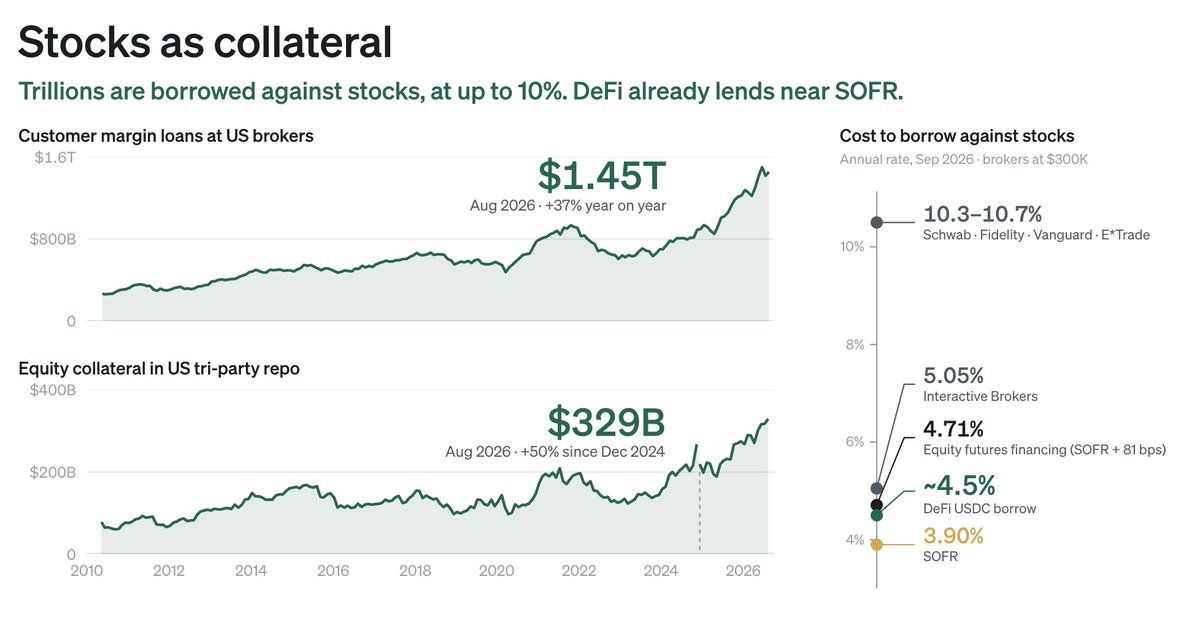
It's Friday midnight, slides for @Blockworks DAS Asia are finished.
This slide needed to be simplified, sad because it's great like that. An earlier (even more arcane) version was sourcing @conksresearch equity repo which you can read here :
https://t.co/4feqwqbfKv
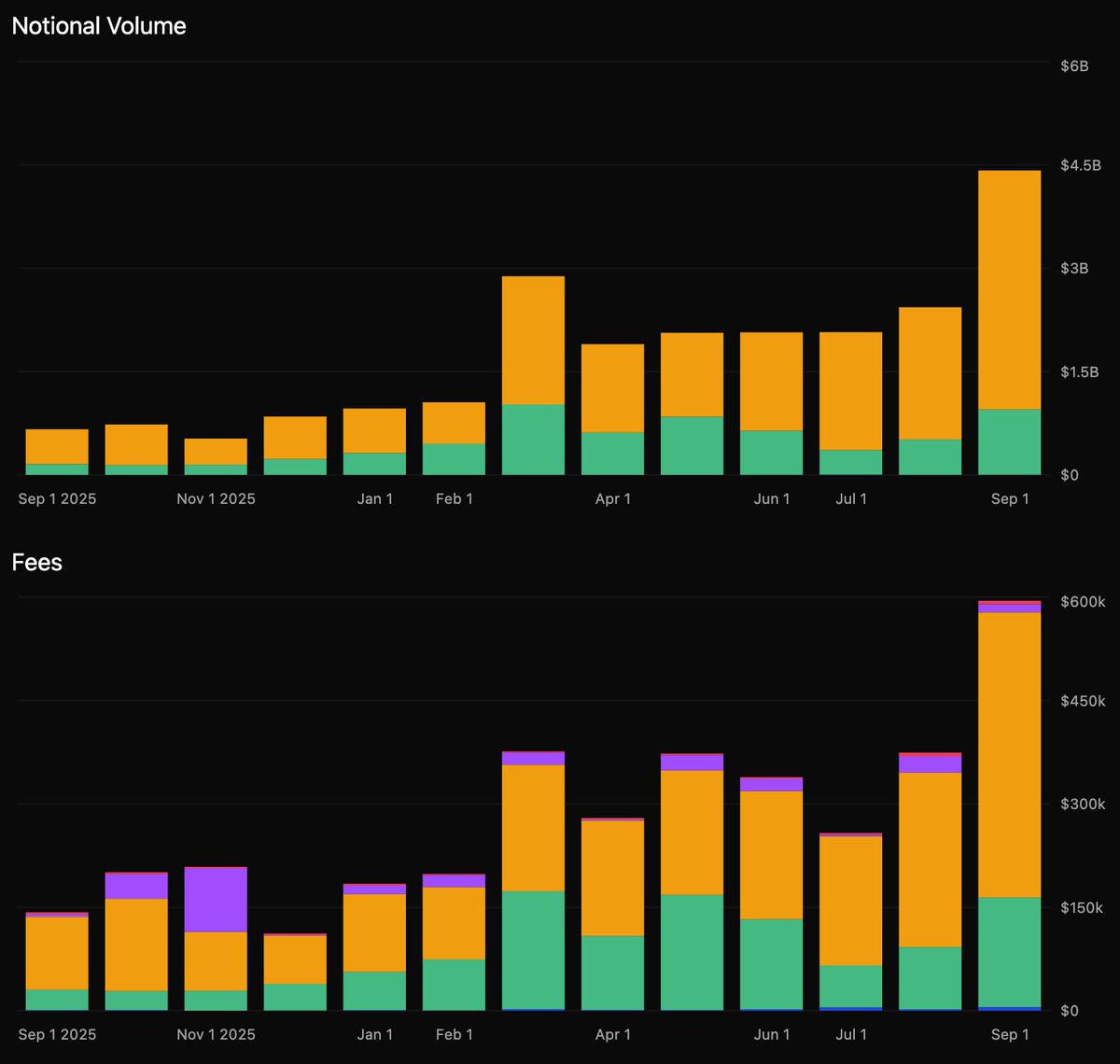
- ATHs in options volumes
- 8x YoY volume growth
- 5x YoY fees growth
- ~90% onchain options market share
Incredible to see people discover Derive v2 after nearly 3 years in production. But v3 is near, and it is lightyears better than v2.
We have taken all of the learnings of 5.5 years operating at the bleeding edge of internet finance and poured it into v3. It incorporates everything we’ve learned from traders, market makers, builders, and the markets themselves. I can't wait to show you what we've built.
In the meantime, please keep the feedback coming (traders, builders and MMs) - we aren't perfect but we will work hard to address issues as quickly as we can.
Grateful to all those who have believed in us to this point, we have much more to prove.
Today I am excited to announce the launch of Senepol.
@Senepol_ky is the latest business to emerge from @SteakhouseFi, sitting alongside our vault curation business and Grove Labs.
At Senepol, we provide directorship and governance services for projects in the digital assets space. I will be leading the initiative from the Cayman Islands with my talented colleague @tavia_te.
Our philosophy is “by builders, for builders,” and that captures how we think. Senepol is the culmination of what we have learned at Steakhouse over the past few years. We know firsthand how quickly the crypto landscape evolves, and how much work it takes to keep pace with new developments at the intersection of tech and finance.
If you are a project team and that sounds like a good fit, let’s talk.
To keep up with our updates and learn more, please follow us at the page below.