APTMA has written to the Governor, State Bank of Pakistan, highlighting a serious financing challenge facing the textile sector.
Due to the closure of the Karachi Cotton Association (KCA), banks are still valuing pledged cotton at outdated rates (~Rs. 15,500/maund) despite current market prices being around Rs. 21,000/maund.
This is increasing margin requirements, constraining working capital, and making cotton procurement more difficult ahead of the new season.
APTMA has requested SBP to introduce an interim benchmark mechanism to ensure cotton financing reflects prevailing market realities.
#APTMA #PakistanTextiles #Cotton #Exports #SBP #TextileIndustry
Cotton Revival Demands Timely Monitoring & Data Sharing
APTMA has formally requested the Agriculture Department Punjab to strengthen cotton crop monitoring and reporting mechanisms amid concerns over lower-than-expected acreage and emerging pest pressures in parts of the province.
Key recommendations include:
• Weekly crop condition reports
• District-wise acreage updates
• Scientific production forecasts
• Enhanced pest surveillance and farmer advisory services
• Regular stakeholder updates on crop health and yield trends
Reliable data and timely interventions are critical for supporting farmers, improving productivity, strengthening the textile value chain, and reducing Pakistan’s dependence on imported cotton.
APTMA remains committed to working closely with all stakeholders for the revival of Pakistan’s cotton sector.
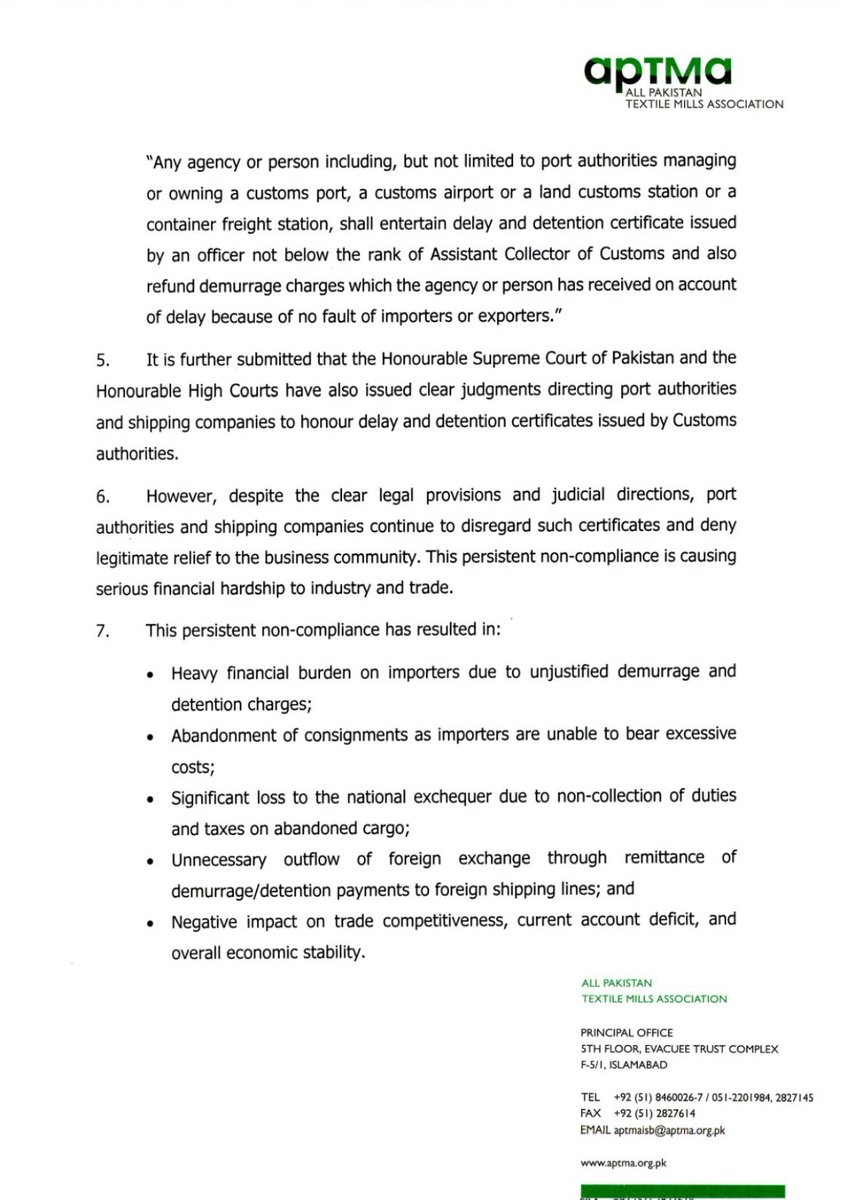
APTMA has formally urged the Prime Minister to immediately intervene in the non-implementation of delay & detention relief under Section 14A(2) of the Customs Act, 1969.
Despite clear legal provisions and repeated court directions, importers and exporters continue facing heavy demurrage & detention charges for delays beyond their control.
APTMA has warned that this persistent non-compliance is causing:
• Severe financial losses to trade & industry
• Abandonment of consignments due to excessive costs
• Loss of government revenue on stranded cargo
• Unnecessary foreign exchange outflows to foreign shipping lines
• Reduced trade competitiveness and pressure on economic stability
APTMA has requested strict enforcement of the law, mandatory compliance by port authorities & shipping lines, and a monitoring mechanism to ensure timely resolution of such cases.
Trade facilitation requires implementation — not just legislation.
#APTMA #PakistanExports #EaseOfDoingBusiness #TradeFacilitation #PakistanTextiles
Pakistan’s cotton and textile sectors must move together for sustainable growth. Chairman Kamran Arshad welcomed Chairman Sham Lal Manglani at APTMA House Lahore for detailed discussions on cotton revival, quality enhancement, farmer profitability, traceability, and stronger industry coordination.
Both sides also emphasized the urgent need to operationalize the Pakistan Cotton Board and agreed to work towards a standardized Cotton Sale Purchase Contract to improve transparency and confidence across the cotton value chain.
A stronger cotton economy is critical for Pakistan’s exports, employment, and industrial sustainability. #APTMA #CottonRevival #PakistanTextiles #CottonEconomy
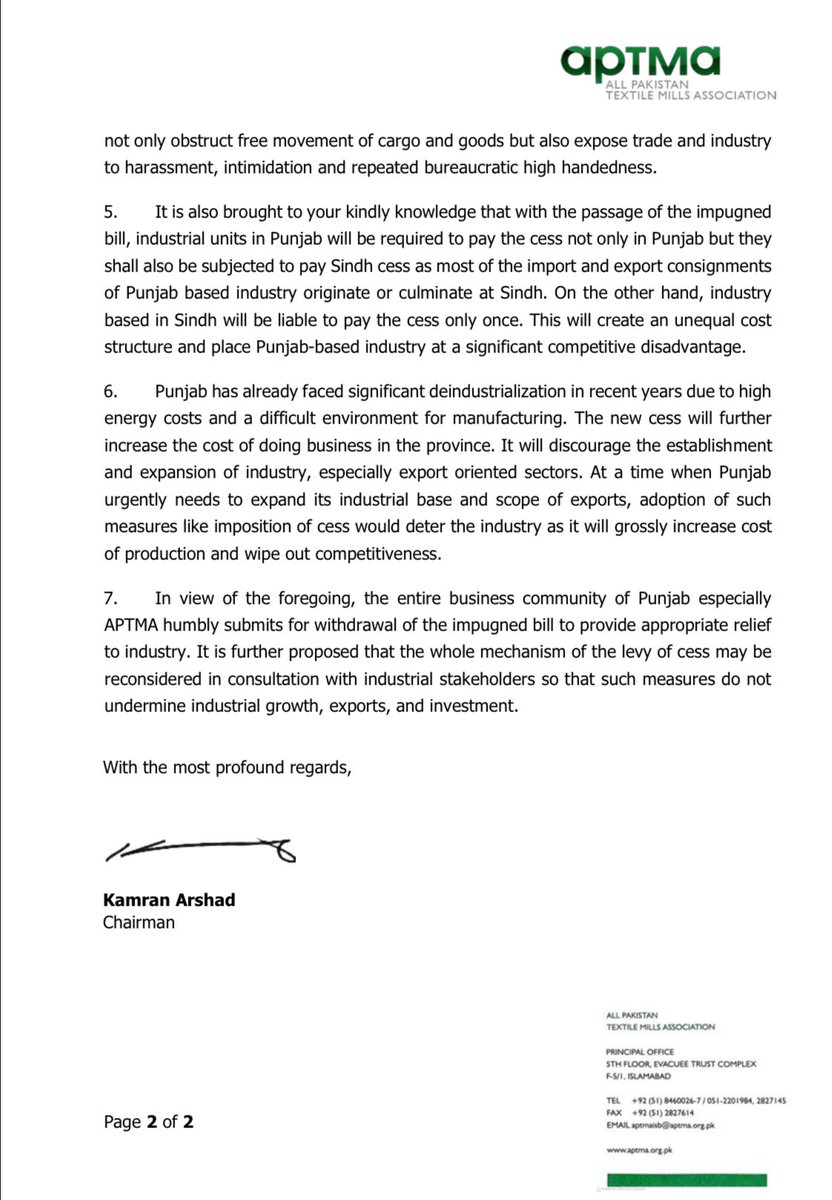
APTMA has expressed serious concerns over the Punjab Infrastructure Development Cess (Amendment) Bill 2026, warning that the proposed 0.90% cess on goods at multiple stages of import, manufacturing and export could severely damage Punjab’s export competitiveness, increase the cost of doing business, and accelerate deindustrialization.
Punjab-based exporters already face high energy and financing costs. Additional cascading levies and enforcement mechanisms risk pushing more industry out of global markets and placing Punjab industry at a disadvantage versus other provinces.
APTMA has urged the Government of Punjab to withdraw the bill and engage industry stakeholders in meaningful consultation to protect exports, investment and employment.
#APTMA #PakistanTextiles #Exports #Industry #Punjab
APTMA appreciates the Government of Pakistan and the Ministry of Energy (Petroleum Division) for successfully engaging with the IMF to rationalize the captive gas levy formula. Moving to a weighted average B-3 tariff is a constructive step toward reducing cost distortions for industry.
To ensure transparency and avoid future disputes, it is essential that industry stakeholders are closely engaged in finalizing the detailed calculation mechanism. A predictable and competitive energy framework remains critical for sustaining exports and industrial growth.
#APTMA #PakistanTextiles #EnergyPolicy
APTMA has formally urged the State Bank of Pakistan to enhance export refinance facilities, highlighting urgent working capital constraints faced by the textile sector. With textiles contributing 60% of exports, 8.5% to GDP, and employing 40% of the manufacturing workforce, timely and adequate financing is critical to sustain operations, fulfill export orders, and maintain Pakistan’s competitiveness in global markets.
APTMA has written to the Honourable Minister for Petroleum, highlighting urgent concerns regarding the rising cost of energy for industry. While appreciating Pakistan’s constructive diplomatic role and improved global standing, the Association emphasized that domestic policy must now align with this opportunity.
Excessive levies—particularly Rs. 80,000/ton on furnace oil—are pushing electricity costs to ~Rs. 75/unit, more than double regional benchmarks. Coupled with load shedding, this is severely impacting industrial competitiveness.
APTMA has urged immediate rationalisation of energy pricing and removal of distortive levies to enable sustainable exports, protect jobs, and support economic growth.
Pakistan's Power Crisis Isn't About Capacity, It's About Management!
It is astonishing that with an installed capacity of 46,605 MW, industry is facing 2 to 4 hours of load-shedding, while domestic and commercial consumers are enduring 7 to 16 hours of darkness every single day. Can anyone please explain the science behind this power management?
Here is what the data tells us as of April 15th 2026 :
- Installed capacity: 46,605 MW
- Peak demand: 20,520 MW
- Generation during peak demand: 13,958 MW
- Shortfall: 4,090 MW
What makes this even more alarming is that summer has not fully arrived, yet today's peak demand stands at 20,520 MW, while June–August routinely crosses 30,000–33,000 MW. If we cannot manage today's load, what happens when the actual season hits?
This is not a capacity problem. This is a power sector governance and management failure.
Hydropower production has taken a significant hit as Neelum Jehlam, a cost-effective hydel project, remains non-operational, reducing the availability of cheap electricity.
Gas plants continue to sit underutilized due to fuel allocation mismanagement.
Solar capacity vanishes at night while demand peaks, with no storage or load-shifting plan in place. Transmission infrastructure cannot carry available power to where it is needed.
And through all of this, the people of Pakistan are being forced to pay for 46,605 MW of installed capacity in their electricity bills, yet the availability of that capacity when they need it most remains unavailable and deeply questionable.
The gap between what we have and what we deliver is not an engineering problem, it is a governance and management problem. Fuel planning, dispatch optimization, grid coordination, and financial discipline are the tools that close this gap.
The capacity is there. The question is: who is managing it — and how?
#Power #Energy #Crisis #Electricity #Pakistan
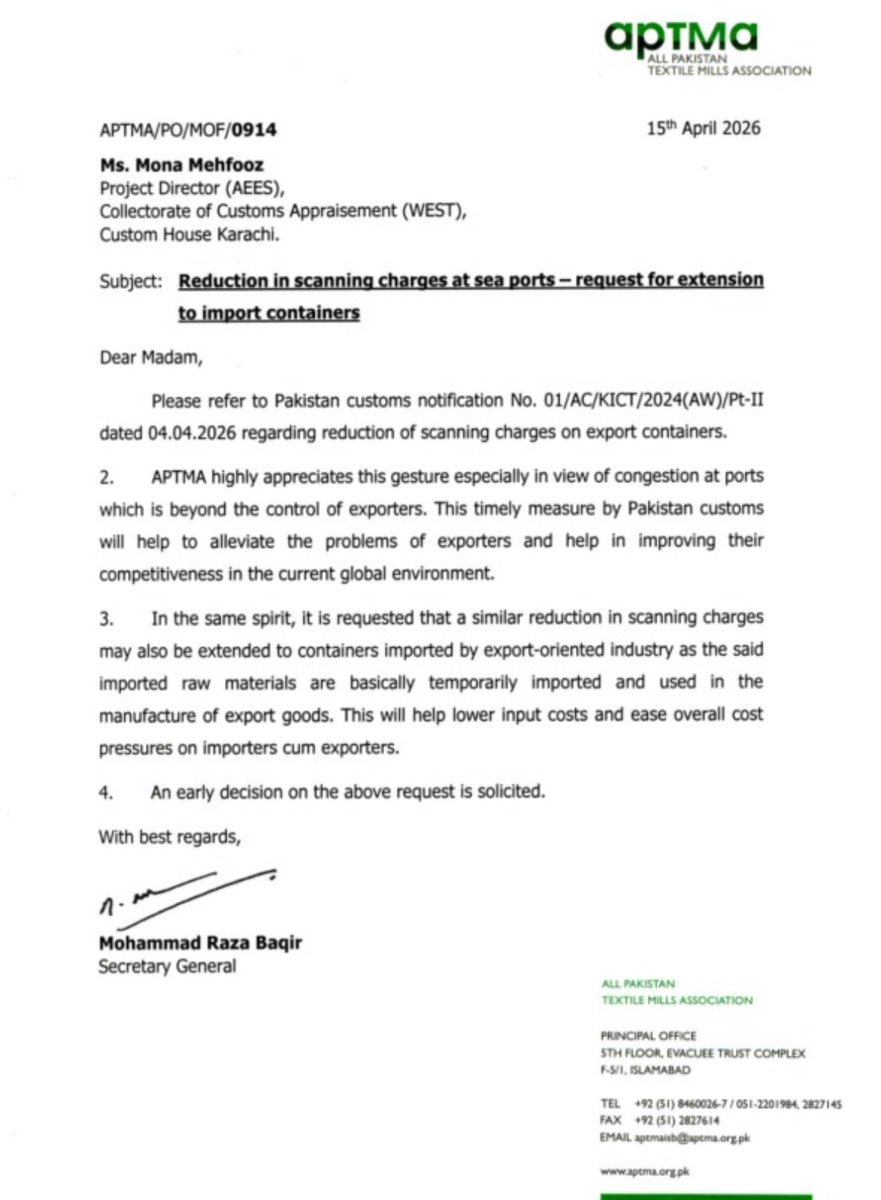
A timely and welcome step by Pakistan Customs to reduce scanning charges on export containers — especially amid ongoing port congestion beyond exporters’ control.
Extending this relief to import containers for export-oriented industries would further ease input costs, improve competitiveness, and support value-added exports.
Industry looks forward to an early decision to strengthen Pakistan’s export ecosystem.
#APTMA #PakistanExports #EaseOfDoingBusiness
Law & order remains fundamental to industrial continuity and export competitiveness. We appreciate the engagement on matters concerning the business environment, particularly the challenges faced by trade and industry. Timely movement of goods, secure industrial zones and operational stability are essential to sustain Pakistan’s export momentum, especially as textiles contribute nearly 60% of national exports.
#APTMAOfficial #PakistanExports #TextileIndustry
Law & order isn’t a side issue, it is an export input — a high-level FPCCI delegation met Muhammad Shamraiz Khan at Rangers HQ Karachi to discuss industry challenges, and the linkage is direct: when cargo movement is delayed, insurance premiums rise, and industrial zones face disruptions, exporters lose pricing power and reliability in the eyes of global buyers; with textiles contributing ~60% of Pakistan’s exports, operational stability is not optional but fundamental, because buyers do not absorb risk, they shift orders — security, continuity and competitiveness are part of the same equation.
#APTMAUncut #PakistanTextiles #ExportCompetitiveness
PRESSER FOOTAGE: APTMA HOUSE LAHORE (via Geo, City42 & others)
Pakistan’s global standing has clearly lifted — credit to the leadership, including the Chief of Defence Forces and the Prime Minister.
Industry acknowledges this moment.
Now the real test begins:
• Convert diplomatic goodwill into economic momentum
• Build synergies across policy, energy & exports
• Get industry back on its feet
• Recognize solarization as support — not a threat to the grid
• Fix cotton. Back the farmer. Restore the base
This is an opportunity. It must not be missed.
Praying for continued stability in the region.
#APTMAUncut #PakistanTextiles #CottonCrisis #EnergyCrisis #Exports
@PakPMO@GovtofPakistan@APTMAofficial
APTMA Chairman Kamran Arshad will address a live press briefing today at 4:00 PM on recent regional developments and their implications.
Watch it live on APTMA’s official YouTube channel:
https://t.co/pp3VxFUC6h
Stay informed.
APTMA appreciates the Government of Pakistan for its diplomatic efforts in facilitating the recent ceasefire, contributing to regional de-escalation and stability.
At a time of heightened tensions, such leadership reinforces Pakistan’s constructive role in promoting dialogue, safeguarding economic interests, and supporting global trade continuity.
Sustainable peace remains essential for regional security and economic resilience.
A timely intervention highlighting the need to align regulatory timelines with crop cycles.
Fast-track approval of high-yield, climate-resilient seed varieties can play an important role in strengthening cotton output and reducing import dependence.
Early implementation will be key to translating policy intent into outcomes.
Cotton decline is often framed as a yield problem — but it’s increasingly a policy timing problem.
Production has moved from ~14M to 5.5M bales. At the same time:
• Seed approval cycle remains ~7 years
• Fast-track (3-year) framework still pending
• ~1 year already lost post policy signal
• Farmers reallocating land to more predictable crops
The question isn’t just which seed, but how fast the system can adapt.
Without aligning regulatory timelines with crop cycles, recovery will lag structural needs of the textile value chain.
Source: The News (Apr 8, 2026)
https://t.co/BcIEO30Ycq
#APTMAUncut #CottonCrisis #PakistanTextiles
#Aptmaofficial
GSP+ has been a cornerstone of Pakistan’s export growth — particularly for the textile sector — enabling scale, employment and foreign exchange stability.
Preserving this status is critical for sustaining momentum in key export markets and supporting the broader economy.
#GSPPlus #PakistanExports #TextileIndustry
Important this is now in the mainstream — but the signal hasn’t changed.
APTMA flagged EFS misuse. The data now validates it.
*Bleached fabric imports: 23 → 1,911 tonnes (+8,200%)
*Mis-declaration still enabling duty-free entry
*Domestic inputs continue facing 18% GST
Appreciate the coverage.
Now the focus must shift to fixing the loophole.
#APTMAUncut #TextileCrisis #PakistanTextiles #EFS #PolicyFailure
Source: Business Recorder
https://t.co/g9Mk07J0X7
APTMA has raised serious concerns over misuse of the Export Facilitation Scheme (EFS), highlighting a sharp and abnormal rise in fabric imports despite prior exclusions.
Imports of bleached fabric under EFS increased from 23 tonnes (Feb 2025) to 1,911 tonnes (Feb 2026), raising concerns of misdeclaration and systemic leakage.
While EFS imports remain sales tax exempt, locally supplied inputs for exports continue to be taxed — creating a clear disadvantage for domestic industry.
APTMA has urged the government to rationalize the scheme to prevent abuse, protect local manufacturing, and safeguard revenue.
Source: APTMA submission to Ministry of Finance (March 26, 2026)
#APTMA #PakistanTextiles #Exports #EFS
Nepra clears 800MW auction framework, sets transparency rules and conditions for market transition under CTBCM; first auction to take place around June or July 2026
Read: https://t.co/ROHApsScyx