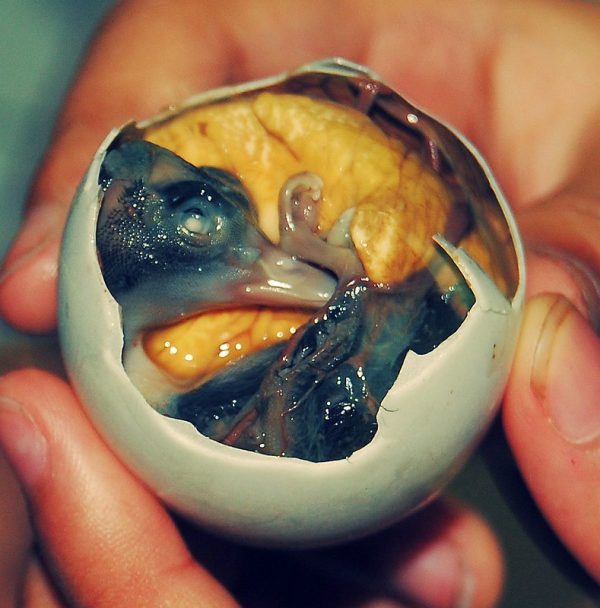
Balut, a traditional street food found in the Philippines, is a fertilized duck embryo that is boiled and eaten from the shell.
The development of the embryo can range from 14 to 21 days before it is cooked. This means that when you crack open the shell, you'll find a partially developed duck embryo, complete with tiny feathers, beak, and bones.
To eat Balut, the shell is first cracked open, and the liquid broth inside is sipped, which is followed by consuming the embryo and yolk. The taste is described as a combination of a savory broth with the textures of both a hard-boiled egg and tender bits from the embryo.
Balut is often enjoyed with a pinch of salt, some chili, and a splash of vinegar. It is considered a high-protein snack and is commonly consumed with beer. While it might be a shocking dish to those unfamiliar with it, Balut is cherished by many Filipinos as a traditional and nourishing food item. It's often enjoyed during gatherings and is known to be an aphrodisiac.
#DidYouKnow #Food #Weird #Disgusting #Philippines #creepy
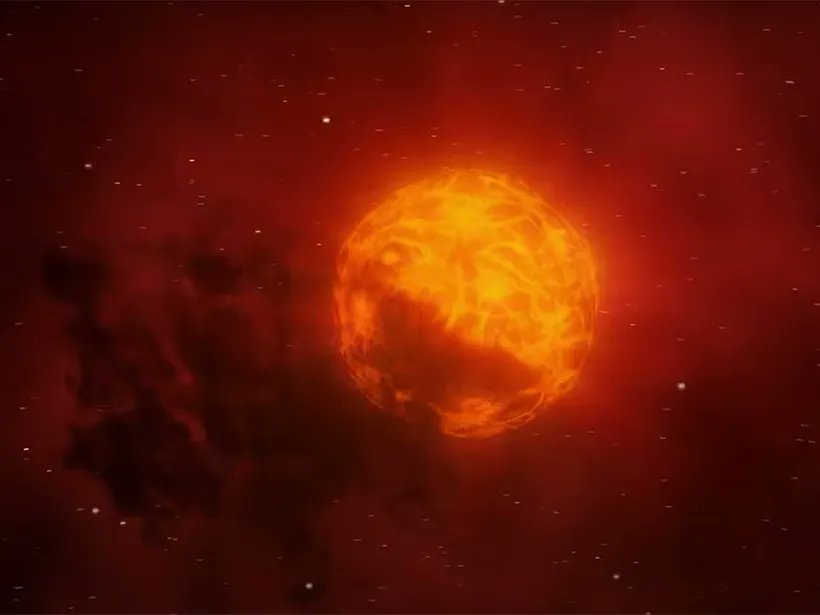
Betelgeuse, also known as Alpha Orionis, is one of the largest and most luminous stars visible to the naked eye in the night sky. It is a red supergiant star situated in the constellation of Orion, and it's one of the brightest stars in Earth's sky. Here are some key points about Betelgeuse:
Betelgeuse is famously part of the Orion constellation, representing the hunter's right shoulder. This constellation is one of the most recognizable in the night sky.
As a red supergiant, Betelgeuse is enormous. If placed in the center of our solar system, it would extend beyond the orbit of Mars. It has a radius about 1,000 times larger than the sun. However, its mass is only about 10-20 times that of the sun, indicating a very low density.
Betelgeuse is a variable star, meaning its brightness changes over time. These changes are believed to be caused by physical pulsations of the star's outer layers. Its apparent magnitude varies between about 0.0 and 1.3, making it usually the tenth-brightest star in the night sky.
Betelgeuse is relatively close to Earth in astronomical terms, at about 700 light-years away. This proximity, combined with its size, makes it a popular subject of study.
Betelgeuse is nearing the end of its life. As a supergiant, it has exhausted the hydrogen in its core and is now burning heavier elements. Astronomers predict that Betelgeuse will eventually explode as a supernova, which will be a spectacular event visible from Earth. However, predicting when this will happen is challenging, and it could be anytime from a few thousand to a million years in the future.
The study of Betelgeuse helps astronomers understand the life cycle of massive stars, particularly the stages leading up to a supernova. Observations of Betelgeuse have provided insights into stellar evolution, mass loss from stars, and the role of supergiants in galactic ecology.
In Japan, there is a hotel which is known to be the oldest continuously operating hotel in the world, according to the Guinness World Records. The Nishiyama Onsen Keiunkan in Yamanashi has been operating since 705 AD. It has been managed by the same family for over fifty generations. The hotel is renowned for its hot spring baths, which are fed by natural hot springs located in the mountainous region where the hotel is situated.
#Didyouknow #Japan #History
Lake Natron in Tanzania has a very high pH, making it extremely alkaline. The lake's unique composition means that animals that die in the lake get calcified, appearing to turn to stone.
The high pH can reach up to 10.5, which is almost as alkaline as ammonia. This makes it inhospitable for most species, except for a few types of fish and the hardy lesser flamingo, which breeds on the lake's salt islands.
Tourmaline crystals, like many other gemstones, are often associated with various health benefits in the realm of alternative medicine and crystal healing. However, it's important to note that these claims are not typically supported by scientific evidence. Here are some of the purported health benefits of tourmaline crystals:
Negative Ion Generation: Tourmaline is believed to produce negative ions, which are thought to contribute to a feeling of well-being. Negative ions are said to improve air quality and counteract the effects of positive ion radiation from electronic devices.
Far Infrared Radiation: Some claim that tourmaline emits far-infrared radiation, which is thought to enhance circulation, relieve stress, increase mental alertness, and strengthen the immune system.
Detoxification: In crystal healing, tourmaline is often used for its purported detoxifying properties. It's said to help cleanse the body and support liver and kidney function.
Emotional and Mental Health: Tourmaline is sometimes used in crystal therapy to help with emotional and mental health issues. It is believed to promote inspiration and happiness, reduce fear, and build self-confidence.
Pain Relief: Some people use tourmaline to alleviate pain. It’s thought to help with reducing muscle tension and supporting the recovery from injuries.
Balancing Chakras: In the context of chakra healing, tourmaline is used to balance and cleanse the chakras, especially the root chakra, which is said to help with grounding and protection.
Despite these claims, it's essential to approach crystal healing with a critical perspective. While some people report subjective improvements in well-being or mood, there is a lack of scientific evidence to conclusively prove the effectiveness of crystals like tourmaline in treating physical or mental health conditions. As always, it's advisable to consult healthcare professionals for medical advice and treatment.
The Pantheon in Rome is an extraordinary example of ancient Roman architecture, renowned for its remarkable state of preservation over nearly two millennia. Originally constructed as a temple dedicated to all the Roman gods, the name "Pantheon" itself derives from the Greek words meaning "all the gods."
The building's history is quite fascinating. It was initially built around 27 BC by Marcus Agrippa, but after suffering destruction by fire, it was rebuilt twice. The structure standing today was completed under Emperor Hadrian around 126 AD.
Perhaps the most striking feature of the Pantheon is its incredible dome, which was the largest in the world for centuries and remains the largest unreinforced concrete dome to this day. The dome's oculus, an open circular hole at the top, is its only source of natural light, creating a unique and almost mystical atmosphere inside, especially when sunlight streams through it. Ingeniously, the oculus also allows rain to enter, with a specially designed floor for drainage.
The interior of the Pantheon is equally impressive, with massive walls and a portico supported by grand columns. Today, the building functions as a church and is accessible to the public, allowing visitors to experience its grandeur first hand. It also serves as the final resting place for several notable figures, including the Renaissance artist Raphael and various Italian kings.
The Pantheon's continuous use throughout history, transitioning from a pagan temple to a Christian church, is a testament to its enduring significance. It has been a source of inspiration for architects and artists throughout the ages.
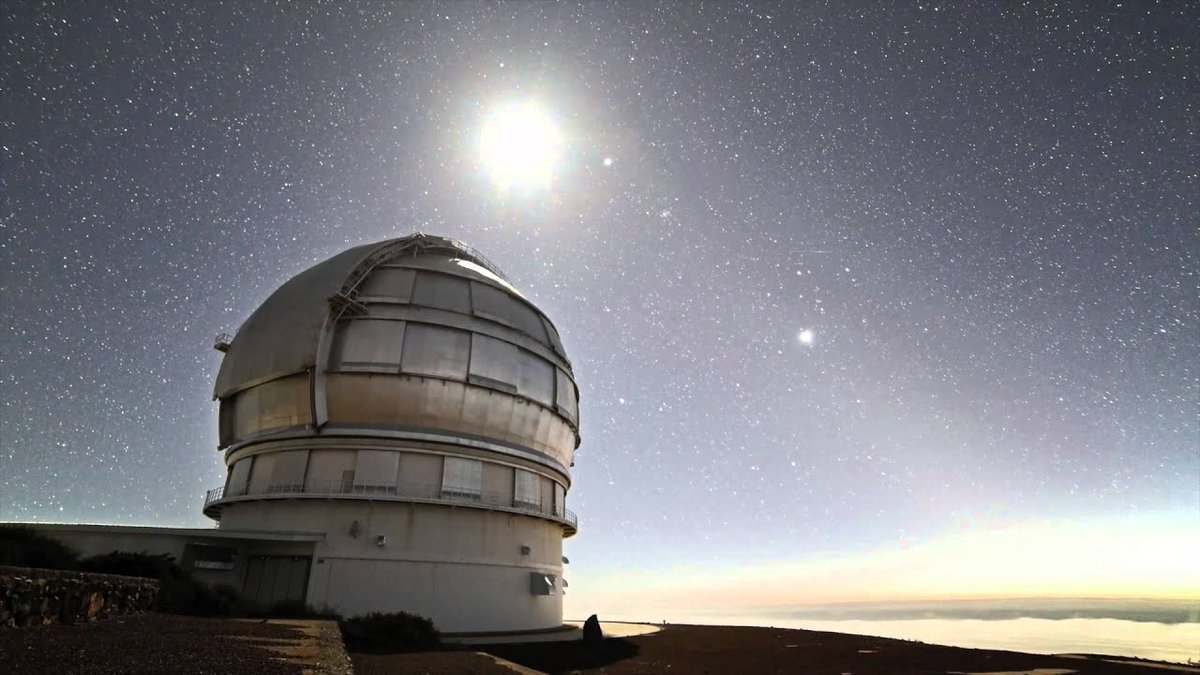
The Gran Telescopio Canarias is a total monster of a telescope – absolutely massive. It's perched up on a mountain on the island of La Palma, which is one of Spain's Canary Islands. The views up there? Incredible!
It's the biggest optical telescope in the world - its primary mirror that's a whopping 10.4 meters in diameter. That's like, "see the sparkle in a distant star's eye" kind of power. It's made up of 36 separate hexagonal segments that work together as one giant mirror.
The location is pretty key, too. It's up there at about 2,267 meters above sea level, on this old volcanic peak called Roque de los Muchachos. The air is super clear, which means the telescope gets a really crisp view of the cosmos. Plus, the Canary Islands have these strict light pollution laws to keep it dark and lovely for stargazing.
Astronomers use the Gran Telescopio Canarias to peek at all sorts of celestial wonders, from stars and planets in our own galaxy to distant galaxies and even the elusive black holes. It's like having a VIP pass to the best show in the universe.
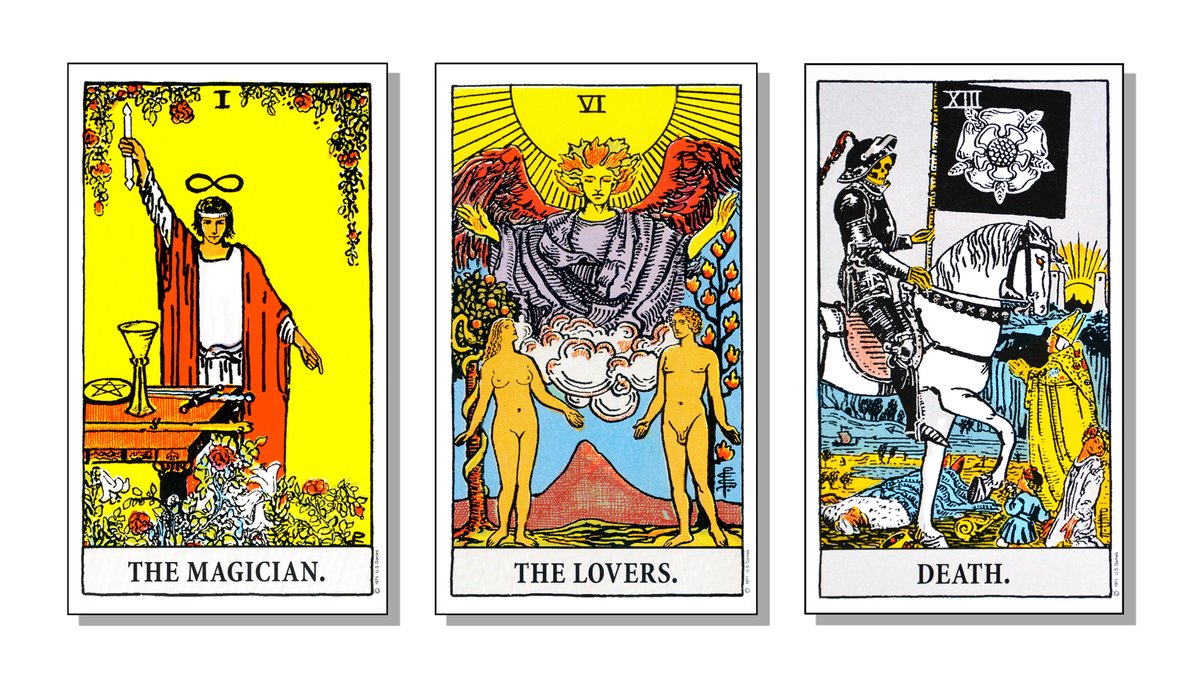
Tarot has a pretty intriguing history that's a mix of fact and mystique. So, tarot cards actually started out as playing cards in the 14th century, believe it or not. They popped up in Europe, particularly Italy, where they were used for a game called tarocchi, which is still played today.
These early decks were hand-painted and super fancy, so they were kind of a luxury item for the rich. The cards as we know them, with the Major and Minor Arcana, started to take shape in the 15th century. The symbolism on the cards was heavily influenced by the culture and iconography of the time, which is why you see a lot of medieval and religious themes in the classic decks.
Now, the leap from card game to mystical tool happened a bit later. It wasn't until the 18th century that people in France and England started using tarot cards for divination. This is when all the associations with ancient Egypt, the Kabbalah, and other mystical traditions started to emerge. A lot of this was thanks to some pretty imaginative writers and occultists who were really into the idea of secret wisdom and hidden knowledge.
One of the most influential figures in tarot was a French dude named Antoine Court de Gébelin. He published a massive study on the cards, claiming they were full of ancient Egyptian secrets. His theories weren't exactly based on solid evidence, but they caught on and really shaped how people thought about tarot.
Then you've got the Rider-Waite-Smith deck, which came out in the early 20th century. This deck, created by A.E. Waite, illustrated by Pamela Colman Smith, and published by the Rider Company, really set the standard for modern tarot decks with its detailed pictures on every card, especially the Minor Arcana. Before this, the Minor Arcana were usually just like regular playing cards with a bunch of cups or swords. But Smith's illustrations told a story, which made the cards way more accessible for divination.
From there, tarot just exploded in popularity, especially in the New Age movement of the 20th century. Today, there are thousands of different tarot decks out there, each with its own theme and artwork, from traditional to cats to steampunk and everything in between.
So, while tarot's origins are pretty down-to-earth as a card game, over the centuries it's become this rich, complex blend of art, psychology, and spirituality. It's a cool example of how something can evolve over time to take on new meanings and significance.
🌍🚨 "FLAT EARTHERS DECLARE: 'GLOBE THEORY TOSSED OVER THE EDGE!'" 🚨🌍
HOLD ON TO YOUR HATS, globe-trotters and conspiracy connoisseurs! The FLAT EARTH movement is shaking the very sphere we call home – or should we say, the very PLANE! 🔍
👀 EYES WIDE, MINDS OPEN: A group of REBEL THINKERS and MYSTERY HUNTERS are challenging centuries of science, claiming that the world is as flat as your average pancake at Sunday brunch! They're tossing out globes and calling for a cosmic rethink, one where horizons are endless and gravity is just a theory. 🥞🌅
🧭 COMPASSES GONE WILD: These modern-day mavericks are navigating a world map that might just have you falling off the edge with curiosity. They're armed with arguments about sea levels, flight paths, and a certain mysterious Antarctic ice wall that might just be the world's biggest secret. ❄️🤫
🚀 NASA, WHO? The Flat Earth Society is launching a crusade against space agencies worldwide, claiming that space travel is a HOAX and that satellites are about as real as unicorns. They're demanding answers and proof, with a side of skepticism. 🛸🦄
🎈 BALLOON EXPERIMENTS AND DIY ROCKETS: Armed with high-altitude balloons and backyard rocketry, these daring individuals are taking matters into their own hands. They're on a mission to snap a pic of the edge of the world, or at least prove that horizon lines are straighter than a ruler. 📏🚀
📚 HISTORY REWRITTEN? With a nod to ancient cosmologies, Flat Earthers are flipping through history books, suggesting that our ancestors knew the real score about our flat planer Earth. They're asking us to look back in order to see the truth ahead. 📜👀
So, whether you're a skeptic or a believer, one thing's for sure: the Flat Earth theory is providing an alternative storyline to our planet's tale. It's a wild ride of exploration and conspiracy that's turning heads and spinning globes – or not spinning them, according to Flat Earthers!
#FlatEarth #ConspiracyUncovered #EdgeOfTheWorld 🌍📡🚨
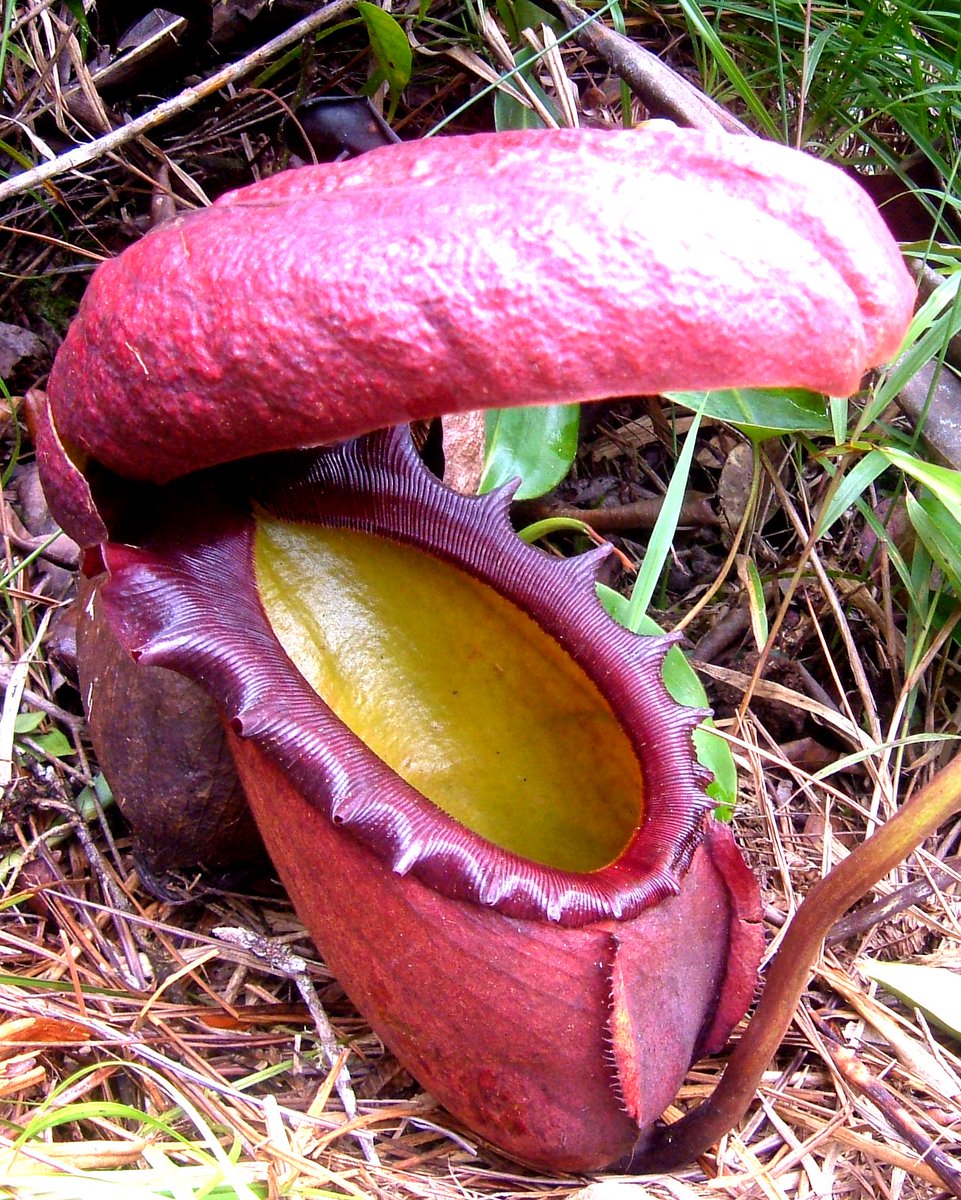
Carnivorous Colossus of the Canopy—The King of Pitchers Exposed!
Deep in the heart-stopping heights of Borneo's misty mountains lurks a GIANT among giants—the legendary Nepenthes rajah! Locals whisper of its mammoth maws, gaping wide like gates to another dimension, where insects check in... but they don't check out! 😱
These aren't your grandma's flytraps! We're talking about the BIG LEAGUES of bug munchers, folks. The king pitcher plant, or as science boffins call it, Nepenthes rajah, is Mother Nature's own mega-jug, slurping up anything that dares to take the plunge.
You won't believe the SIZE of these bad boys—pitchers the size of footballs, packed with a digestive doom-juice that could turn any creepy-crawly into plant pâté!
Perched at 8700 feet, where the air's as thin as the hair on a balding bonobo, these carnivorous chompers are making a KILLING out of, well, killing!
The jaw-dropping jugs double as toilets for tree shrews, in the wildest waste exchange program ever witnessed! Talk about a pot to pee in!
In a TWISTED turn, this royal ravenous relic is itself on the brink! The 'King Pitcher' is endangered, folks—its kingdom shrinking faster than a snow cone in the Sahara.
Conservationists are in a frenzy, eco-warriors on edge, and the black market's going bonkers for these colossal cups of carnivorous chaos.
So, there you have it, folks! The Nepenthes rajah—nature's own voracious vessel, living large and in charge, way up in the clouds! Remember, you heard it here first—where the news is always juicy, and the plants... well, they're just plain hungry!
A culinary craze is LURING ADVENTURERS from all corners of the globe. These aren't your grandma's cookies, folks – they're big, they're hairy, and they're sizzling hot! 🕸️🔥
🕷️ "TASTE THE FEAR" is the unofficial motto where these eight-legged critters are plucked from their burrows and given a one-way ticket to Flavor Town. Fried to a CRISP, seasoned with a SECRET BLEND of sugar, salt, and that oh-so-controversial MSG, these spiders are turning heads and twisting stomachs! 🤤
👀 EYES WIDE, TEETH READY – brave souls chomp down on the crunchy legs, experiencing a CRUNCH that echoes through the ages. But WAIT – there's more! The abdomen offers a gooey surprise, with a taste described as a wild rollercoaster ride from chicken to fish, with a pit stop at nutty town! 🎢
💥 STARTED FROM THE BOTTOM, NOW WE'RE HERE – Born from the desperate times of the Khmer Rouge regime, these tarantulas crawled their way up from survival grub to a sought-after snack. Talk about a food glow-up! 💫
🏆 PACKED WITH PROTEIN and boasting a bevy of vitamins, these spiders are not just a dare – they're a nutritional powerhouse. Who needs a protein shake when you've got a bag of fried tarantulas, right? 💪
📸 INSTA-WORTHY or nightmare fuel? Tourists are flocking, cameras in hand, to capture the moment they lock lips with these crispy critters. It's a food challenge, a history lesson, and a cultural phenomenon all rolled into one deliciously deep-fried package. 🎥
So, whether you're a gourmet globetrotter or just looking for your next wild foodie fix, the FRIED TARANTULA is waiting to jump into your mouth. Bon appétit, or as they say in Cambodia, "Jom reap sour!" 🌐🍽️
#FriedTarantula #FearFactorFood #CambodianCuisineUnleashed 🕷️🌟🍴
Eltz Castle, or Burg Eltz in German, is a stunning medieval castle nestled in the hills above the Moselle River between Koblenz and Trier, Germany. It's like something straight out of a fairy tale, with its picturesque setting, charming towers, and half-timbered sections.
While most castles in Europe have had their fair share of battles and sieges, Eltz Castle is one of the few that's never been destroyed. It's been standing tall for over 850 years and it's been owned by the same family, the Eltz family, for 33 generations.
One of the most famous tales associated with the castle is the story of Agnes Eltz. The story goes back to the 15th century. Agnes was a strong-willed and brave member of the Eltz family. She was betrothed to a young man from a rival family as part of a strategic alliance. However, as medieval tales often go, things didn’t quite work out as planned.
On the day of her wedding, the castle came under attack from another rival faction, intent on claiming the castle for themselves. Agnes, clad in her wedding gown, didn’t shy away. Instead, she donned a suit of armor and stood alongside the men of her family, ready to defend her home.
Tragically, Agnes met her end on that fateful day, struck down by an enemy’s arrow. Her bravery is still remembered, and some say her spirit lingers in the castle, protecting it.
Visitors and staff have reported seeing the apparition of a young woman in a long dress, wandering through the castle’s rooms and hallways. Some believe this is the spirit of Agnes, still keeping watch over her family home. Others have reported hearing the sounds of soft footsteps or the rustling of a dress in the quieter parts of the castle.
#ghosts #history #castles
The Hagia Sophia, a resplendent architectural marvel , located in Istanbul, Turkey, it's like a time capsule of empires, religions, and architectural marvels.
Commissioned by the Byzantine Emperor Justinian I, the Hagia Sophia was constructed in a mere six years, from 532 to 537 AD, under the meticulous direction of the architects Anthemius of Tralles and Isidore of Miletus. The result was a structure of unparalleled grandeur, boasting a majestic dome that seemed to defy the very laws of physics, leaving all who beheld it in awe.
The Hagia Sophia has gracefully navigated the ebb and flow of empires and religions. Initially consecrated as an Eastern Orthodox cathedral, it briefly served as a Roman Catholic cathedral during the Latin Empire, only to be reinstated as an Orthodox cathedral once more. The Ottoman conquest of Constantinople in 1453 marked a pivotal chapter in the Hagia Sophia's story, as it was transformed into a mosque by Mehmed the Conqueror, a role it maintained for nearly five centuries.
The Hagia Sophia is a veritable treasure trove of artistic and cultural heritage. Its interiors are adorned with resplendent mosaics, frescoes, and calligraphy, weaving together the narratives of Christianity and Islam in a visual symphony that captivates the senses.
In the 20th century, the Hagia Sophia found new life as a museum, opening its doors to people from all corners of the globe, regardless of religious affiliation. It served as a beacon of cultural exchange and mutual respect, embodying the confluence of East and West. In recent times, the decision to reconvert it into a mosque has sparked discussions on heritage and preservation, underscoring the Hagia Sophia's enduring significance in the contemporary world.
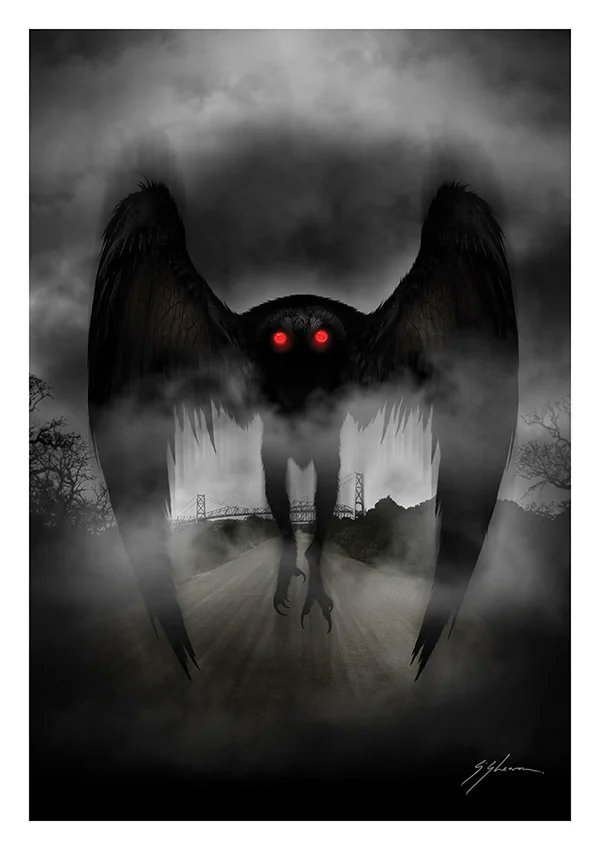
The Mothman is a legendary creature reportedly seen in the Point Pleasant area of West Virginia from November 12, 1966, to December 15, 1967. Described as a winged man-sized creature with glowing red eyes, the Mothman became linked to the collapse of the Silver Bridge on December 15, 1967, which resulted in the deaths of 46 people. Some locals believed that the Mothman sightings were a premonition of the tragic bridge collapse.
The Mothman legend was popularized by John Keel's 1975 book "The Mothman Prophecies," which was later adapted into a 2002 film of the same name. While many explanations have been proposed, ranging from misidentified bird species to mass hysteria, the true nature of the Mothman remains a topic of speculation and intrigue.
#DidYouKnow #scary