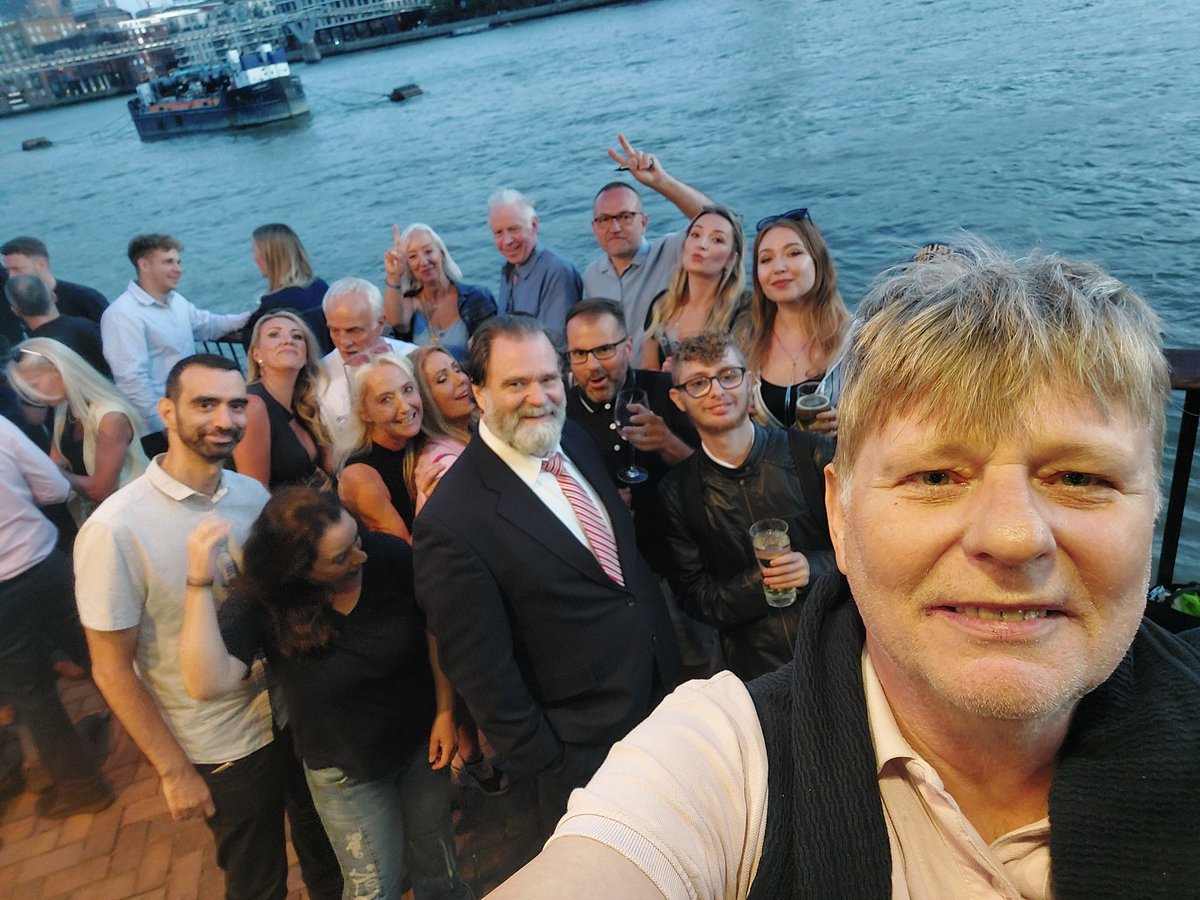
Professor Norman @profnfenton a Mathematics academic for 47 years has a fascinating new book out.
"The Capture of Academia: How Universities Shape Power, Silence Dissent, and Influence Society."
It has thirty 5* ratings so far.
The lady is the lovely Iga @ARTelnativeMara.
https://t.co/p7nu7Z2aB4
We stand on the shoulders of giants. The fact that those giants eventually collapse under our weight should increase rather than decrease how indebted we feel to them. Unfortunately, for those who were not there to experience how it was back then, it is natural to see them only as the mangled corpse they have since become.
We're off to Poland 🇵🇱. We're expecting a 4* hotel, three meals a day, work permits and pocket money 💰
Don't forget the hot and cold running women and men.
Wit provided by Julia Stephenson @Vernia.
I’m not a Tommy Robinson supporter but I intend to go to the march on Saturday. It’s the biggest march of the year, so, as someone who covers protests, I obviously want to be there.
But my face will be recorded and added to the government’s database of march attendees. You’d have to be pretty naive not to realise the government might use this against us down the line. Especially after the confirmation yesterday that digital ID is still on the agenda.
I could go to the pro-Palestine march instead and my face won’t be logged.
Has there ever been a regime that treats its own people with such contempt and suspicion while giving a free pass to those who actively hate the country or support terrorists? This is only the latest incident in a long series of two-tier decisions made concerning protests in recent years.
The kind of people who support Tommy Robinson aren’t even hard-line right wingers. Generally speaking, they’re relatively apolitical civnats who love their country and don’t mind foreigners as long they’re not committing crimes.
It really is quite incredible that proudly flying the national flag is enough to make the government treat you like a dangerous criminal.
Elon Musk avait dit un truc qui m'avait marqué sur l'allocation de ressources. En substance : passé un certain niveau de richesse, l'argent n'est plus de la consommation, c'est de l'allocation de capital.
Cette phrase change tout.
L'économie, dans le fond, c'est juste un problème d'allocation. Tu as des ressources finies et des usages infinis. Qui décide où va quoi ?
Imagine une cour de récré. 100 enfants, des paquets de cartes Pokémon distribués au hasard. Tu laisses faire. Très vite, un ordre émerge. Les bons joueurs accumulent les cartes rares, les collectionneurs trient, les négociateurs trouvent des deals. Personne n'a planifié. Et pourtant chaque carte finit dans les mains de celui qui en tire le plus de valeur. Le système maximise le bonheur total de la cour. C'est ça, la main invisible.
Maintenant fais entrer la maîtresse. Elle trouve ça injuste. Léo a 50 cartes, Tom en a 3. Elle confisque, redistribue, impose l'égalité. Trois effets immédiats. Les bons joueurs arrêtent de jouer, à quoi bon. Les mauvais n'ont plus de raison de progresser, ils auront leur part. Les échanges s'effondrent. La cour est égale, et morte. Elle a maximisé l'égalité, elle a détruit le bonheur.
Le problème de la maîtresse, c'est qu'elle ne peut pas avoir l'information que la cour avait collectivement. C'est le problème du calcul économique de Mises, formulé en 1920. L'URSS a essayé de le résoudre pendant 70 ans avec le Gosplan. Résultat : pénuries, queues, effondrement. Pas parce que les Soviétiques étaient bêtes, parce que le problème est mathématiquement insoluble en mode centralisé.
Quand Musk a 200 milliards, il ne les consomme pas, il les alloue. SpaceX, Starlink, Neuralink, xAI. Chaque dollar est un pari sur le futur. Et lui a un track record. PayPal, Tesla, SpaceX. Il a démontré qu'il sait identifier des problèmes immenses et y allouer des ressources avec un rendement spectaculaire.
L'État aussi a un track record. Hôpitaux qui s'effondrent, éducation qui décline, dette qui explose, services publics qui se dégradent malgré des budgets en hausse constante. Le marché identifie les bons allocateurs, la politique identifie les bons communicants.
Le profit n'est pas une finalité, c'est un signal. Il dit : tu as alloué des ressources rares vers un usage que les gens valorisent suffisamment pour payer. Plus le profit est gros, plus la création de valeur est grande. Quand Starlink est rentable, ça veut dire que des millions de gens dans des zones rurales ont enfin internet. Quand un ministère est en déficit, ça veut dire qu'il consomme plus qu'il ne produit. L'un crée, l'autre détruit, et on appelle ça redistribution.
Dans nos sociétés il y a deux catégories d'acteurs. Les entrepreneurs et les bureaucrates. L'entrepreneur prend un risque personnel pour identifier un problème, mobiliser des ressources, créer une solution. S'il se trompe il perd. S'il a raison, ses clients gagnent, ses employés gagnent, ses fournisseurs gagnent, l'État collecte des impôts. Il est la cellule de base du progrès humain.
Le bureaucrate ne prend aucun risque personnel. Son salaire est garanti. Au mieux il maintient une rente existante. Au pire il la détruit par excès de réglementation, mauvaise allocation forcée, incitations perverses qui découragent ceux qui produisent. Mais dans aucun cas il ne crée.
Regarde les 50 dernières années. iPhone, internet civil, SpaceX, Tesla, Google, Amazon, Stripe, mRNA, ChatGPT. Toutes des inventions privées, portées par des entrepreneurs, financées par du capital risque. Pas un seul ministère n'a inventé quoi que ce soit qui ait changé ta vie au quotidien.
La France est devenue le laboratoire mondial de la dérive bureaucratique. 57% du PIB en dépenses publiques, record absolu. Une administration tentaculaire, une fiscalité qui pénalise la création de richesse. Résultat : décrochage face aux États-Unis, à l'Allemagne, à la Suisse. Fuite des cerveaux. Désindustrialisation. Dette qui explose.
Et le pire c'est que la mauvaise allocation s'auto-renforce. Plus l'État prélève, moins les entrepreneurs créent. Moins ils créent, moins il y a de base fiscale. Plus l'État s'endette et taxe. Boucle de rétroaction négative parfaite. La maîtresse pense qu'elle aide, et chaque année la cour produit moins.
Dans nos sociétés, ce sont les entrepreneurs, toujours, qui font avancer la civilisation. Les bureaucrates au mieux maintiennent une rente, au pire la détruisent. Aucune société n'a jamais progressé en taxant ses créateurs pour subventionner ses gestionnaires.
La question n'est jamais qui a combien. C'est qui alloue le mieux la prochaine unité de ressource pour maximiser le futur de l'humanité. La réponse depuis 200 ans n'a jamais changé. Ce ne sont pas les fonctionnaires.
Great balance of showing compassion while sharing truth as Wes Huff responds to the question of why a good God would allow evil:
"Well, that is arguably the hardest and most pressing apologetic question there is, because ultimately, the very tidy philosophical and theological answer isn't the right answer sometimes. You know, sometimes the right answer to the wrong question is the wrong answer, because I've encountered situations where someone has brought up a variation of the problem of evil to me, and I've just felt uneasy about maybe the tenor that they're coming at with the question...and asking them, 'You know, that's a great question. Why are you asking that question in particular?' and finding out once again (like the previous question related to it), they're personally hurting.
And so, in that sense, I could give a tidy answer about if you're positing that something is good, you're positing that there's an objective good and evil, and if there's an objective good and evil, then you're positing an objective law, and objective law needs an objective lawgiver. So where do we find the groundwork for an objective lawgiver to begin with? Otherwise, you may not like certain things, but to say they ought not to happen is actually an ethical leap to an objective reality that you may or may not have groundwork for.
But if that person is struggling because a family member of theirs has cancer, then that particular, maybe tidy, tied-up-in-a-nice-bow answer is not going to speak to them whatsoever. And so that's why that's the hardest question because there are actually very good answers to it, but often it doesn't speak to the person in front of you, because questions have questioners that sit behind them.
And one of the pitfalls of my chosen field of ministry apologetics is that sometimes we give answers where we talk at people rather than with people. And there's a danger to that because the Christian faith isn't just an intellectual assent, right? It's a personal relationship. And that should also be played out in the answers that we give..."
Beautiful take on faith by Daniel here.
Going through life with any level of awareness makes it clear that human nature cannot be detached from faith. The „religious” instinct is unavoidable-the only question is wether you will let circumstances choose your „God” for you.
I used to think Christians were naive. I thought faith in God was just an emotional crutch for people who could not handle reality.
Now I think the opposite.
The more seriously I looked at life, history, suffering, conscience, beauty, evil, and the limits of human reason, the less convincing atheism became.
Because everyone has faith. Everyone. The only real question is where that faith is placed.
In God, or in man.
I was taught that intelligence means distance from God. But what is so intelligent about believing that matter somehow produced mind, that chaos somehow produced order, that chemistry somehow produced conscience, and that human beings can ground morality by themselves while constantly contradicting even their own standards?
If we are only matter, then human dignity is just a useful story. Love is chemistry. Evil is preference. Sacrifice is irrational. Meaning is self invented. But almost no one actually lives that way. We all live as if truth matters, as if cruelty is really wrong, as if beauty means something, as if love is more than a chemical reaction, and as if justice should exist even when it costs us.
That is not nothing. That points beyond survival.
The Bible understood this long before modern people started pretending they had outgrown it.
Genesis grounds human dignity in the image of God. That means people are not valuable because they are productive, attractive, healthy, or useful. They are valuable because they bear His image.
John 1 does not begin with chaos. It begins with the Logos. Reason, order, meaning. Reality is not random noise. It is intelligible because it comes from a mind greater than ours.
Ecclesiastes says that pleasure, work, success, and achievement collapse into vanity when cut off from God. Anyone who has chased status, money, sex, or recognition long enough knows how true that is.
Romans 1 says creation points beyond itself. And it does. The order of the world, the mathematical beauty of reality, the existence of consciousness, the hunger for meaning, the presence of moral knowledge, these are not small things.
And history teaches the same lesson. The bloodiest experiments of the last century did not come from too much faith in God. They came from man trying to replace God with ideology, state, race, class, or power. When God is removed, something else always takes His place. Usually something crueler.
Christianity also does not begin with a vague spiritual feeling. It makes a historical claim. That Christ entered history, was crucified, and rose again. You can reject that claim, but it is not the same as saying faith is just blind comfort. Christianity stands or falls on what it says actually happened.
So no, I no longer think faith in God is stupid.
I think one of the most shallow ideas modern people were ever sold is that disbelief is automatically intelligent.
Sometimes disbelief is not depth. Sometimes it is pride.
And sometimes faith is not an escape from reality. It is what remains when you look at reality honestly enough and realize that man is not enough, matter is not enough, and this world cannot explain itself.
I used to think Christians were foolish.
Now I think many of them simply saw earlier what I was too proud to see.
The Culture Explorer is a movement rooted in a truth Roger Scruton defended and tradition-minded thinkers understood long before him.
Beauty teaches people what is worth revering. Tradition carries the standards, memory, and moral inheritance that keep a civilization from collapsing into ugliness and amnesia.
The goal of our movement is to focus on the works, ideas, and traditions that gave civilizations their shape.
We cover Gothic cathedrals like Chartres, Hagia Sophia, the Acropolis, the art of Michelangelo, Bernini, and Caravaggio, the moral world of Homer, Shakespeare, and Dostoevsky, and the religious and philosophical traditions that formed the West and the East.
https://t.co/eQ2QMXZkiz
There is no way of knowing how often Parliament votes against what the public actually wants. Until now.
https://t.co/QpJCcn3FBH tracks every bill going through Parliament. You vote. We compare it to how your MP voted. The gap speaks for itself.
The body says "I need security."
The mind says "I need appreciation."
Society says "I need success."
And slowly, the soul becomes silent.
But the soul has its own needs. It needs to express peace, love, wisdom, and creativity. It needs to serve something greater than the temporary desires of the body and mind. It needs to feel connected to its purpose.
When your work gives your soul space to express these qualities naturally, your energy grows. You feel refreshed and supported because you’re moving in harmony with your essential nature. You flow with it.
Think of a river. When water flows in its natural direction, it moves effortlessly, creating beauty and nourishing everything in its path. When you try to force water uphill, it requires enormous effort and creates turbulence.
Your career is either flowing with your soul's natural direction or forcing it uphill.
The soul speaks to us through energy, through joy, through a sense of rightness that cannot be explained logically.
When you're doing work that aligns with your true nature, time passes differently. Challenges feel like opportunities rather than obstacles. You have energy left for your relationships, your health, your growth.
But we've been trained to ignore these signals. We've been taught that work should be difficult, that ease means laziness, that following joy is impractical.
So we choose careers based on fear. Fear of not having enough money. Fear of disappointing others. Fear of being judged as unrealistic. These fears create a wall between us and our inner wisdom.
The mind becomes noisy with calculations like "Will this pay my bills?" "What will people think?" "Is this secure enough?"
And eventually, the soul's quiet voice gets drowned out.
Money is important, yes. Security matters, yes. But when we make decisions from fear, we create exactly what we're trying to avoid. Work becomes a burden. Success feels empty. We earn money but lose vitality.
The soul operates from abundance. When we express our true nature, what we need arrives naturally. This happens through clarity and alignment. And focused work creates stronger results with greater ease. Quality emerges effortlessly when we're working from our center.
But this requires trust. Trust that our inner guidance is reliable. Trust that following joy leads to contribution, not selfishness. Trust that the universe supports authentic expression.
Most os us have lost this trust. We've had experiences where following the heart led to disappointment. So we conclude that practical thinking is safer than soul wisdom.
What we don't realize is that following the heart without understanding how it works leads to confusion. The heart sometimes carries old wounds, conditioning, and desires that aren't from the soul's pure nature.
True soul guidance comes from a place of inner silence, where the noise of wants and fears has been stilled. In that silence, clarity emerges naturally. You know without knowing how you know.
This knowing doesn't come with guarantees about external outcomes. It doesn't promise immediate financial success or social approval. It promises an alignment between your daily actions and your eternal nature.
When this alignment exists, work becomes meditation. Challenges become opportunities for growth. Success becomes a byproduct rather than the goal.
A Harvard professor spent 40 years inside the human brain studying how language works. Wrote 9 books. Taught thousands of students.
And he still thinks most people have no idea why their writing fails.
Steven Pinker stood in front of a room and asked one question. Why is almost all writing academic, corporate, government, even most things you read online so painfully bad to get through?
The room expected him to say laziness. Lack of practice. Poor education.
He said none of those things.
He called it the Curse of Knowledge. And once he explained it, I couldn't unsee it anywhere.
Here's how it works. The moment you understand something deeply, something breaks inside you. You lose access to what it felt like before you knew it. The confusion you once had disappears so completely that you can no longer imagine anyone else feeling it. Your blind spots don't feel like blind spots anymore. They feel like obvious starting points.
He told a story about a molecular biologist presenting at a TED event in front of 400 people. Brilliant man. Spent years on his research. Walked on stage and immediately started speaking in technical language without ever once explaining what problem he was trying to solve or why a single person in that room should care about it. People glazed over within two minutes. He finished his talk having no idea what had just happened. He thought he'd done well.
That is the curse in its purest form. It doesn't announce itself. It disguises itself as competence.
Then Pinker said the thing that stopped me cold.
Bad writing is not about intelligence. It is not about effort. It is a failure of empathy. A writer who cannot imagine what it feels like to not know what they know will always lose their reader. Every time. No exceptions.
His solution was not a writing technique. It was a person.
He gave his drafts to his mother. She was educated, well-read, deeply intelligent. But she was not a cognitive scientist. She had no stake in his field. When she hit a sentence and her eyes slowed down, when she read a paragraph and looked up slightly confused, he didn't think she'd missed something. He went back and fixed the writing. Not her. The writing.
That reframe alone is worth more than most writing advice combined.
Then he moved to the thing almost every writer gets completely wrong.
Words are not the point. Words are just a vehicle. What your reader actually walks away with is not the sentence you wrote. It is the image, the feeling, the physical thing that sentence was supposed to create inside their mind. If no image forms, nothing was communicated. The words passed through and left nothing behind.
He asked his audience what a paradigm looks like. What a framework feels like. What color a concept is.
Total silence.
Because abstractions are invisible. They produce no picture, no texture, no sensation. They are placeholders that feel like meaning but deliver none.
The writers who survived two hundred years did it because they had no choice but to be concrete. There was no jargon to retreat into. So instead of writing about aggression they wrote about the spirit of the hawk tearing into flesh. The reader felt it before they understood it. That is the only writing that actually works.
The last thing he said was about brevity. And he defined it in a way I had never heard before.
Brevity is not a low word count. Brevity is the discipline of cutting every single word that asks something of your reader without giving something back. Every unnecessary word is a small tax. Enough small taxes and the reader stops paying.
He has carried three words with him for forty years. Omit needless words. He said that line does something almost no piece of advice manages to do. It demonstrates what it teaches. It is itself an example of the principle it describes.
The best writing he ever produced came under an 800-word limit an editor refused to negotiate. The pressure of that constraint cut everything that was hiding inside the extra space. It always worked. Without fail.
The Curse of Knowledge will not go away because you are aware of it. Awareness is not enough. The only move that actually works is finding someone outside your world, handing them what you wrote, and watching their face while they read it.
Not reading it for them. Watching them.
The moment their face shows even a flicker of confusion, you have found exactly where your writing failed.
That is the whole masterclass.
Catolicismo, ciencia, interpretación de la Biblia y la caricatura del evangelicalismo.
Este comentario es un ejemplo perfecto de un fenómeno que se repite constantemente en redes y que merece desarrollarse. Gente que cree estar haciendo una crítica demoledora al cristianismo cuando en realidad está criticando una versión del cristianismo que la propia Iglesia católica lleva diecisiete siglos rechazando.
La idea de que la ausencia de Marte o de los dinosaurios en el Génesis supone una contradicción parte de una premisa concreta, que la Biblia es un manual de ciencias naturales que debería describir la totalidad del universo físico, y esa premisa no es católica. Es protestantismo evangélico norteamericano, el literalismo bíblico que arranca con los movimientos fundamentalistas del siglo XIX en Estados Unidos y que ha contaminado la percepción del cristianismo en todo el mundo hasta el punto de que mucha gente que se cree atea lo que realmente rechaza es esa caricatura, no el catolicismo.
La Iglesia católica no ha leído nunca la Biblia así. San Agustín ya advertí en el siglo V en el De Genesi ad litteram que era una vergüenza que un cristiano dijese disparates sobre cuestiones naturales apoyándose en las Escrituras, porque hacía el ridículo ante cualquier pagano con formación y desprestigiaba la fe por ignoranca. Tomás de Aquino enseñó en el siglo XIII que la verdad revelada y la verdad natural no pueden contradecirse porque proceden dl mismo Dios, y que si un dato científico contradice una interpretación bíblica el problema está en la interpretación, no en la ciencia. La Pontificia Comisión Bíblica aclaró en 1909 que los primeros capítulos del Génesis no pretenden enseñar la constitución física del mundo visible, y la Dei Verbum del Concilio Vaticano II (1965) lo formuló al afirmar que la Escritura enseña, cito, "la verdad que Dios quiso consignar en los libros sagrados para nuestra salvación", no geología ni astronomía.
El Génesis utiliza el lenguaje y las categorías csmológicas que sus destinatarios podían comprender (un pueblo del primer milenio antes de Cristo) para transmitir verdades teológicas que trascienden ese marco, que Dios es el origen de todo lo que existe, que la creación tiene orden y sentido, que el ser humano ocupa un lugar singular n ella. Esto lo entendía un niño de catequesis hace medio siglo porque se lo explicaban correctamente, y ahora hay adultos que no lo comprenden porque lo que les ha llegado del cristianismo es una parodia literalista importada del Bible Belt que la Iglesia católica rechaza desde Agustín de Hipona.
Your words should cost something. They need to cost something every single time. It should be expensive to write because you write to gain something, and everyone knows to get something true and rare requires giving up something precious. Write to risk your reputation, your integrity, your friendships, your emotional defenses. Everytime you write it should be a sacrifice. Words that cost nothing mean nothing, and if the writing doesn't give then it takes, and it takes in such a way that everybody who listens to your words loses, including yourself. The words mutate on the page into a tawdry little spell and the world becomes just a little more tainted with the lies pursued by false self interest.
Only blood fuels the engine of truth.
@AttorneyF_ That’s a beautiful take. It’s funny, as I was just trying to explain to someone that action - that “burning”, as you’ve put it - is the most logical and “appropriate” reaction to understanding and fully appreciating the magnitude of love that God has for you.
Paul tells a justified man to work out his salvation with fear and trembling.
For a while I read that as a contradiction.
Why strive if the verdict is settled? Why run if grace is finished?
The answer came through a picture of parenting.
The father or mother who builds wealth, secures their child’s future, removes the existential terror of ruin, and then raises that child to still work hard, take real risks, and build something of their own, is not being contradictory.
The safety net shouldn’t kill the hunger, but it should remove the ceiling on it.
The sensible wealthy parent expects their child not to hustle less but hustle better. To swing bigger, fall harder, and rise faster.
Not because failure doesn’t cost them anything, but cos failure can no longer destroy them. In that sense, the inheritance doesn’t dilute the ambition. It purifies it.
The gospel works exactly the same way.
The fear and trembling Paul describes is not anxiety about losing salvation.
It is the seriousness of a man who grasps what his freedom cost, and finds he cannot be casual about it.
The freed man runs. Not out of fear, but out of clarity. Because liberation doesn’t remove the will, it finally gives it room.
The sweet spot, the one most believers never find, is deep settled peace in the finished work of Christ, and still pursuing holiness with everything you have.
The security doesn’t produce softness. It produces freedom. And freedom, rightly understood, makes the striving more urgent.
Entitlement and freedom look identical from the outside. The entitled believer rests in grace and drifts. The free believer rests in grace and burns.
I find that most people only ever find one side. Rest without striving very easily becomes passivity. Striving without rest becomes exhaustion or quiet pride. Both have missed it, in opposite directions.
The rarest person in any room is the child who knows the inheritance is secure and still builds like everything depends on it. The believer who knows the price is paid and still burns.
That’s not a paradox. That’s the point.
when I graduated with my stats degree I walked across the stage and shook the crusty old department chair’s hand. he pulled me in close and whispered in my ear “correlation is causation a lot of the time”