The loss of 1,300 lives in the recent #EuropeHeatWave is a warning from a world pushed beyond balance.
#Climate#hange is no longer approaching us as a future threat... it is already breaking bodies, systems and the confidence of even the strongest economies.
We cannot continue to wait for each new tragedy to prove what we already know. We Must #ACTNOW
https://t.co/cS6tJp9niW
In trying times love, empathy, fellow feeling should be more and more spread among the people, and be appreciated by the people irrespective of religion caste gender class etc.
I'm running an immersive residency on cinema & storytelling in Goa from 19-21 June
I have curated 9 films from India & the world
Film screenings will be followed by intensive discussions
The idea is to strengthen our capacities for empathy through storytelling
Do join if you can
#যুদ্ধ
https://t.co/1uhYoABKYO
যুদ্ধ দেশগুলোকে পিছিয়ে দেয় এবং পুনরুদ্ধার অত্যন্ত কঠিন হয়ে পড়ে। এটি শুধু অর্থনৈতিক ও মানবিক ক্ষতিই নয়, পরিবেশ ও বাস্তুতন্ত্রের ওপরও গুরুতর প্রভাব ফেলে।
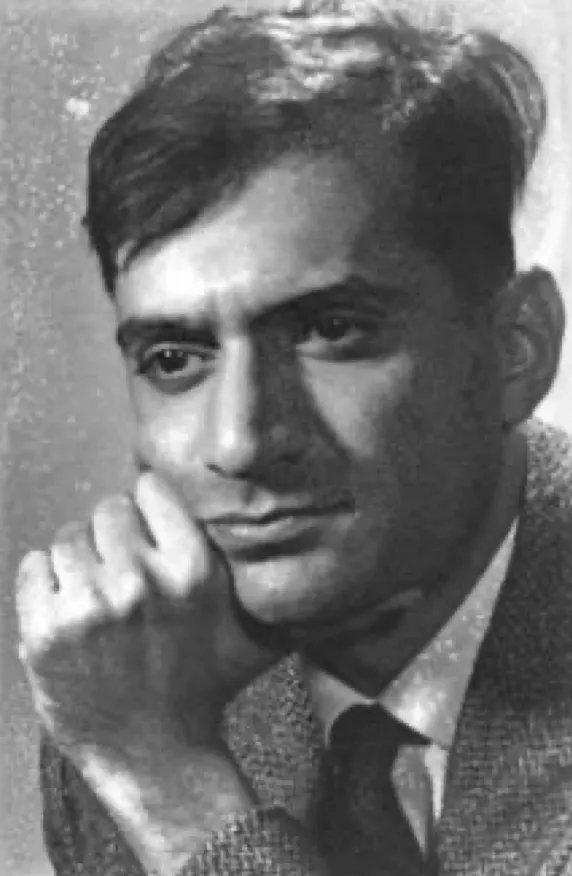
Those who saw’A Beautiful Mind’, would remember that John Nash’s doctoral thesis had just 26 pages and 2 references, yet it was instrumental in advancing “Game theory”. What if I told you there is a scientist whose achievement is so astounding that he is perhaps the only Indian to “create” an intersectional branch of science? What if I told you that every year, his name echoes across the hallowed halls of science in foreign lands, but most of our students haven't even heard of him?
Aneesur Rahman was born in Hyderabad in British India in 1927. His father was a professor and a philanthropist. His family generously donated their property for the creation of Urdu Hall in Hyderabad. His maternal uncle was a professor too. Rahman had a natural flair for subjects that would terrify ‘normal’ students — maths and physics. After getting BSc in Mathematics, he went on to get Tripos in Mathematics and Physics at the prestigious Cambridge University in the UK. From there, he went to Louvaine University in Belgium and got DSc in Physics under Professor Mannenbeck. It’s here that Rahman met a Chinese student Yueh-Erh Li who was doing MD( called Dr Jady by friends). They fell in love and got married.
He came back to teach in Osmania university along with his wife. Soon after, he developed interest in the structure of water molecule - especially the polarisation of the hydrogen atom. Unfortunately research in India was at infancy in those days and Dr Rahman realized he was a whale in a tiny pond. He had to move to the ocean. He joined the Argonne National Laboratory in Illinois.
His foundational paper in 1964 birthed “molecular dynamics” , one of the two pillars on which a vast body of computational physics rests.(the other is Monte Carlo method). His equation made it possible to calculate the trajectory of large number of interacting atoms with ease.
His work, like Ramanujan’s , was so ahead of his time - that even today, potential applications are being discovered. The Nobel prize in physics for 2013 went to Karplus, Levitt and Warshel whose work depended heavily on Dr Aneesur Rahman’s.
Some say there is an inverse association between genius and compassion -Dr Rahman was a prominent exception. He was known not just for his intellect, but also kind nature and mentored many students all over the world. His quiet, unassuming nature made him a much loved professor — and he remained so, until he got Non Hodgkin’s lymphoma — a cancer that took him away from us prematurely, at the age of 59. Perhaps he might have got a Nobel, if only he had lived longer.
American Physical Society honors him as the father of computational physics and has instituted an annual award in his name.
As a doctor with little idea of theoretical physics, writing Dr Aneesur Rahman’s portrait has been difficult , because of the complex nature of his work that straddles so many areas of science : mathematics, physics, computer science and chemistry. His equations are mind boggling, even intimidating, but
what I do understand is this : Dr Rahman didn't just have a beautiful mind, but also a beautiful heart.
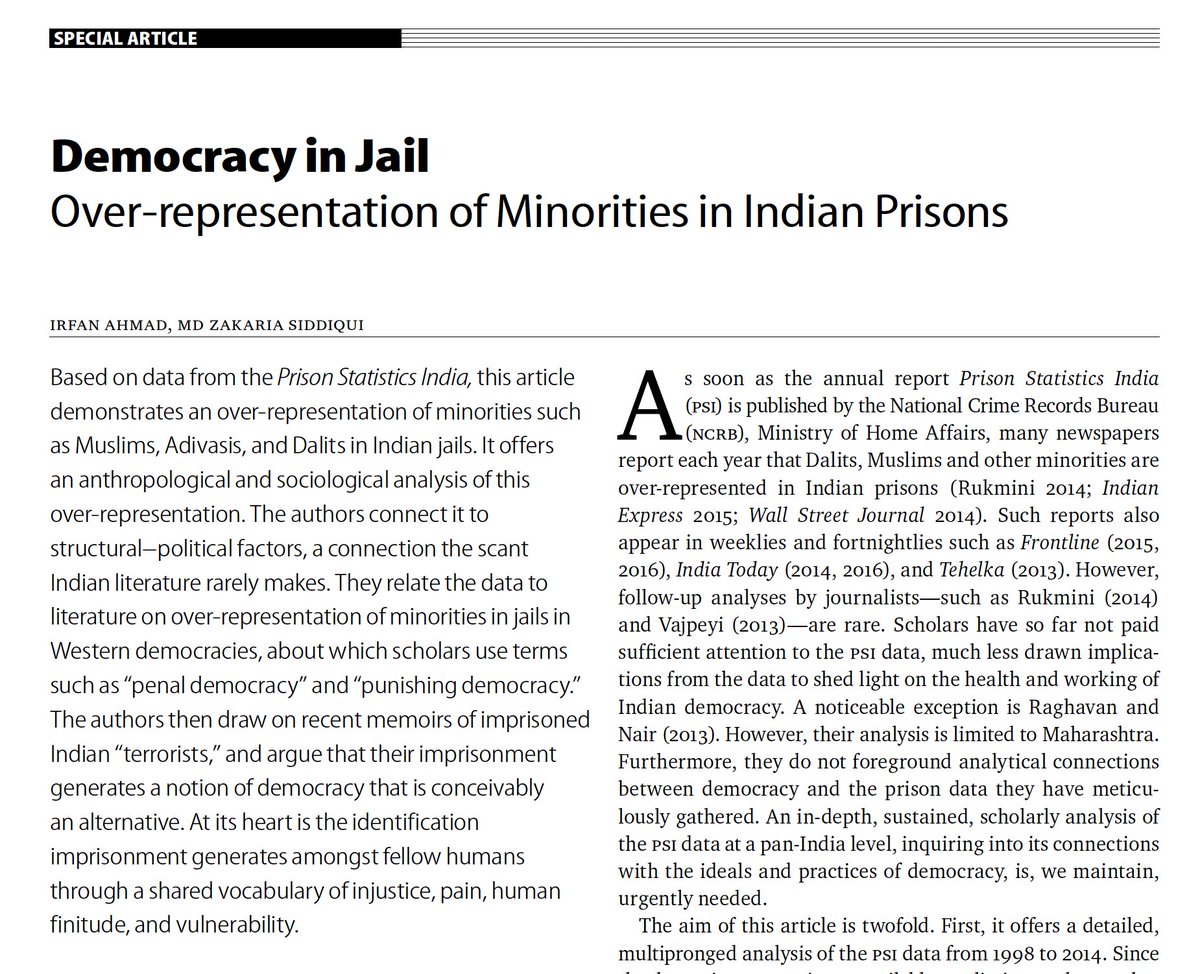
Good that @ThePrintIndia published this story about the dark condition of minorities -- rather minoritized groups -- such as #Adivasis, #Dalit s and #Muslim s in #prisons of #India , as reported by the French fimmaker and based on his visit to #jails. Not surprising, he was arrested.
In a paper co-authored with economist Dr Zakaria Siddiqui @zakku78 and based on hard data, we had highlighted this reality several years ago. We had also offered an anti-orthodox explanation of this phenomenon, analytically outlining an alternative notion of an incipient democracy -- a notion and practice deliberatly crushed.
"Based on data from the Prison Statistics India, this article demonstrates an over-representation of minorities such as Muslims, Adivasis, and Dalits in Indian jails. It offers an anthropological-sociological analysis of this over-representation. The authors connect it to structural–political factors, a connection the scant Indian literature rarely makes. They relate the data to literature on over-representation of minorities in jails in Western democracies, about which scholars use terms such as “penal democracy” and “punishing democracy.” The authors then draw on recent memoirs of imprisoned Indian “terrorists,” and argue that their imprisonment generates a notion of democracy that is conceivably an alternative. At its heart is the identification imprisonment generates amongst fellow humans through a shared vocabulary of injustice, pain, human finitude, and vulnerability."
If interested, read the article in its PDF form published in @epw_in below.
https://t.co/4snniObpZI
Link to EPW is here https://t.co/kld7ecNHqK
https://t.co/XoPmGmSvht
২০২৫ সালের ১৭ নভেম্বর, ফ্রি ভয়েস ও ভিন্নকথা যৌথভাবে মাওলানা আবদুল হামিদ খান ভাসানী (১৮৮০–১৯৭৬)-এর মৃত্যুবার্ষিকী পালন করে। তিনি ছিলেন দক্ষিণ এশিয়ার ইতিহাসে এক প্রভাবশালী রাজনৈতিক নেতা, ধর্মীয় আলেম এবং অত্যন্ত গুরুত্বপূর্ণ ব্যক্তিত্ব।
#মওলানাভাসানী
https://t.co/9lGnhE377V
সময়ে সময়ে শ্রেণী বিভাজিত ব্যবস্থার শাসকগণ অর্থনৈতিক, সাংস্কৃতিক আগ্রাসন চাপালেও বিস্তীর্ণ ছোটনাগপুর জুড়ে কুড়মি জনজাতি তাদের চিরাচরিত সংস্কৃতি ও পরম্পরা আজও দৃঢ়তার সঙ্গে বহন করে চলেছে। এই দাবির পক্ষে কুড়মিদের দীর্ঘ ইতিহাস রয়েছে।
@freevoiceforum
Today was born the founding father of AMU. His birth anniversary is celebrated as Sir Sayyid Day. I write a biographical note on him.
I hope we get more institutions for other religious minorities be they Christians, Sikhs or Buddhists.
@freevoiceforum
https://t.co/uNvDEw8lVU
Some academic classics on communalism:
1. Communal Deadlock and a Way to Solve it (1945) by Dr. Ambedkar
2. Bengal Divided (1994) by Joya Chatterji
3. Communalism, Caste and Hindu nationalism (2007) by Ornit Shani
4. Sexuality, Obscenity, Community (2002) by Charu Gupta
Today, marks the anniversary of the Poona Pact's signing on 24 Sep 1932. It granted reserved seats but denied Dalits minority status and a separate electorate. Ambedkar saw this as a deadly blow, trapping them within a Hindu majority and compromising their political independence.
https://t.co/CZrYKNHuya
Messages from my contacts
joining social media, posting photos of foreign trips,
joining mountaineering clubs, buying gold
and homestays on hills, taking dietary course
and visiting gyms and parlours and
readying for upcoming fashion shows
#poetrylovers