A recent study of manufactured homes’ vulnerability to hurricane-force winds, focusing on ground anchorage, offers insights into boosting resilience.
Explore how the findings can enhance risk assessment and improve quality control: https://t.co/5hoCkpX8kI. @ASCEpublishing
Locking carbon dioxide into stable underground minerals is emerging as a reliable, long-term climate solution, especially in certain rock types. Can less reactive rocks work too?
A new study explores carbon storage in atypical sedimentary formations: https://t.co/GZ1Y3eLLS4.
Congratulations to Markus Loidolt & Stefan Marschnig on receiving the 2025 Sinha Award for Best Paper, JTE-A, for their paper, "Rail Surface Irregularities as a Main Driver of Rapid Track Deterioration and Their Appropriate Handling."
Read it here: https://t.co/3MCMqdum9b
LLMs as Research Instruments for Problems in Engineering Management: A Context Modeling Framework | Journal of Management in Engineering | Vol 42, No 5 https://t.co/Og40BSRjjR
With many semiarid regions lacking reliable weather data to estimate reference evapotranspiration, a recent study explores how machine learning models can improve decision-making without requiring extensive new monitoring systems: https://t.co/c93dV2m1hN. @ASCEPublishing
Recent research closes a key gap in applying fiber-reinforced polymer anchors to reinforced concrete.
A new predictive model helps engineers anticipate system behavior before construction. Learn more: https://t.co/nEw0i6wAb4. @ASCEPublishing
Wildfire risk is rising as climate shifts and development expand into wildland–urban interface areas. Probability-based methods help capture uncertainty, improving decisions on preparedness, mitigation, and resource allocation: https://t.co/27tvljFUpZ. @ASCEpublishing
Curious how massive construction projects stay on track in the world’s toughest environments?
A new study explores how advanced surveying tools help teams make smarter decisions across a megaproject’s lifecycle: https://t.co/tKJhB0eYRL. @ASCEPublishing
Smooth zipper merging doesn’t happen by accident—there will be signs. But how many and which ones?
A recent paper studied real-world freeway work zones to evaluate how different combinations of static and electronic message signs influence driver lane use and merging behavior under zipper merge control.
Learn how strategically placed electronic signage can be used to improve driver compliance and make zipper merges function more smoothly in work zones: https://t.co/qxNMkBDMy4.
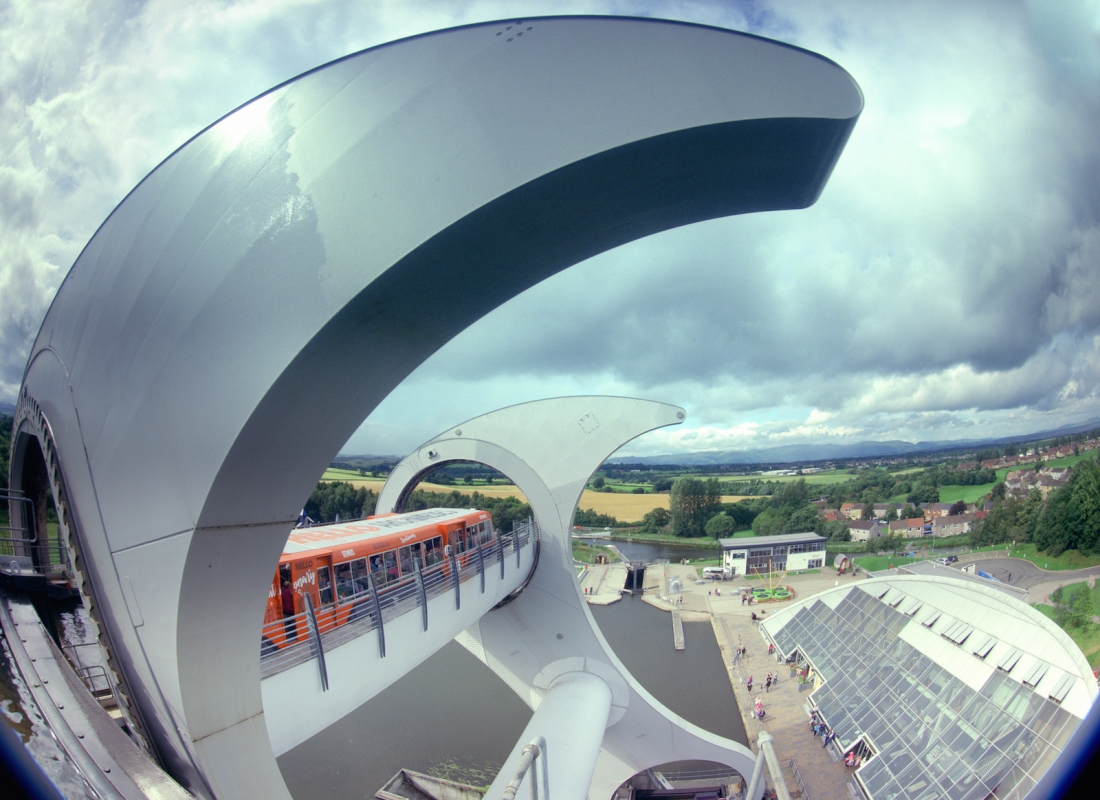
The world’s 1st and only rotating boat lift officially opened #OTD in 2002.
Taking the shape of a Celtic-inspired, double-headed axe, the Falkirk Wheel now connects two historic canals in central Scotland—but its story begins centuries earlier. When it was completed in 1790, the 35-mile Forth & Clyde Ship Canal was the world’s deepest sea-to-sea canal, linking the North Sea and Irish Seas. Later joined by the 31-mile Union Canal by an impressive flight of 11 locks, both canals fell into decline and, by the mid-20th century, were closed, severed or blocked at more than 30 locations. What followed was not simply restoration, but reinvention.
The result: A 115‑foot rotating lift with 2 arms to carry gondolas with water‑filled caissons—each holding up to 66,000 gallons and up to 4 boats—moving vessels between the aqueduct and the basin in about 15 minutes. Recognized as a joint ASCE / @ICE_engineers Landmark, the Falkirk Wheel showcases how past ingenuity and modern engineering can deliver enduring social, economic and environmental benefits.
Explore the history and engineering behind the remarkable innovation—free on @ASCEpublishing's #ASCELibrary now through May 31: https://t.co/tRTL1waxTT. #VisitASCELandmarks
Technical Paper
"Design and Evaluation of a Novel Solid Spray Dust–Suppressant for Coal Mine Dust Reduction Based on a Molecular Dynamics Simulation"
By
Wanqing Qiao et al.
https://t.co/G67B6VWDjw
The Florida Key’s original Seven Mile Bridge, built for rail in 1912, converted to a highway later, and abandoned in 1982, has sections now used by pedestrians, cyclists—and a hardy, friendly evergreen tree.
In the latest installment of his #ASCESource series, More Water Under the Bridge, Brian Brenner shares the tale of Fred the Tree: https://t.co/2v2eKRFsmD.
How close are we to achieving dust-free working conditions for below-ground coal miners?
Researchers examine the state of dust removal and personal protection gear: https://t.co/Kdeymru8He.
Smooth zipper merging doesn’t happen by accident—there will be signs. But how many and which ones?
A recent paper examined real-world freeway work zones to evaluate how different combinations of signage influence driver behavior: https://t.co/EhmrzeSpF6. @ASCEpublishing
Advancing Digital Transformation through Virtual Project Management: An Evidence-Based Implementation Framework in the Built Environment Industry | Journal of Management in Engineering | Vol 42, No 4 https://t.co/lB7AUrENOJ
Stud shear connectors are a proven solution in composite bridges, but construction is evolving. New research shows how grouped studs in steel–UHPC bridges can be evaluated to better predict strength and stiffness in design: https://t.co/xXpVk0Y2iB. @ASCEPublishing
Contract Management of BIM-Based Projects in the Brazilian Public Sector: Contractors’ and Owners’ Perspectives | Journal of Management in Engineering | Vol 42, No 4 https://t.co/P9ePgnJJfq