ASI under Ministry of Culture, Govt of India is the premier organization for the archaeological research and protection of the cultural heritage of the nation.
More than 4,500 years ago, the artisans of Dholavira transformed stone into a remarkable work of art. Today, their legacy lives on in India’s enduring tradition of stone craftsmanship, revealing a remarkable thread of artistic continuity across millennia.
Dholavira, one of the finest urban centres of the Sindhu-Saraswati Civilization, has yielded what is regarded as the largest known stone sculpture from the entire civilization spread across the northwestern part of the Indian Subcontinent.
Found during the excavations near the Eastern Gate of the Castle, this large sculpture is more than just an artefact. It stands as living evidence of a sophisticated artistic tradition of stone sculpting that began over 4,500 years ago and has continued unbroken in India.
From such monumental works of the Indus-Saraswati era to the modern craft of stone sculpting, India has preserved and carried forward this civilizational thread.
Dholavira does not merely preserve the past, it affirms that the creative genius of the Sindhu-Saraswati Civilization continues to beat throughout India.
#LivingContinuity #SindhuSaraswati #IndusValley #Indus #IndusValleyCivilization
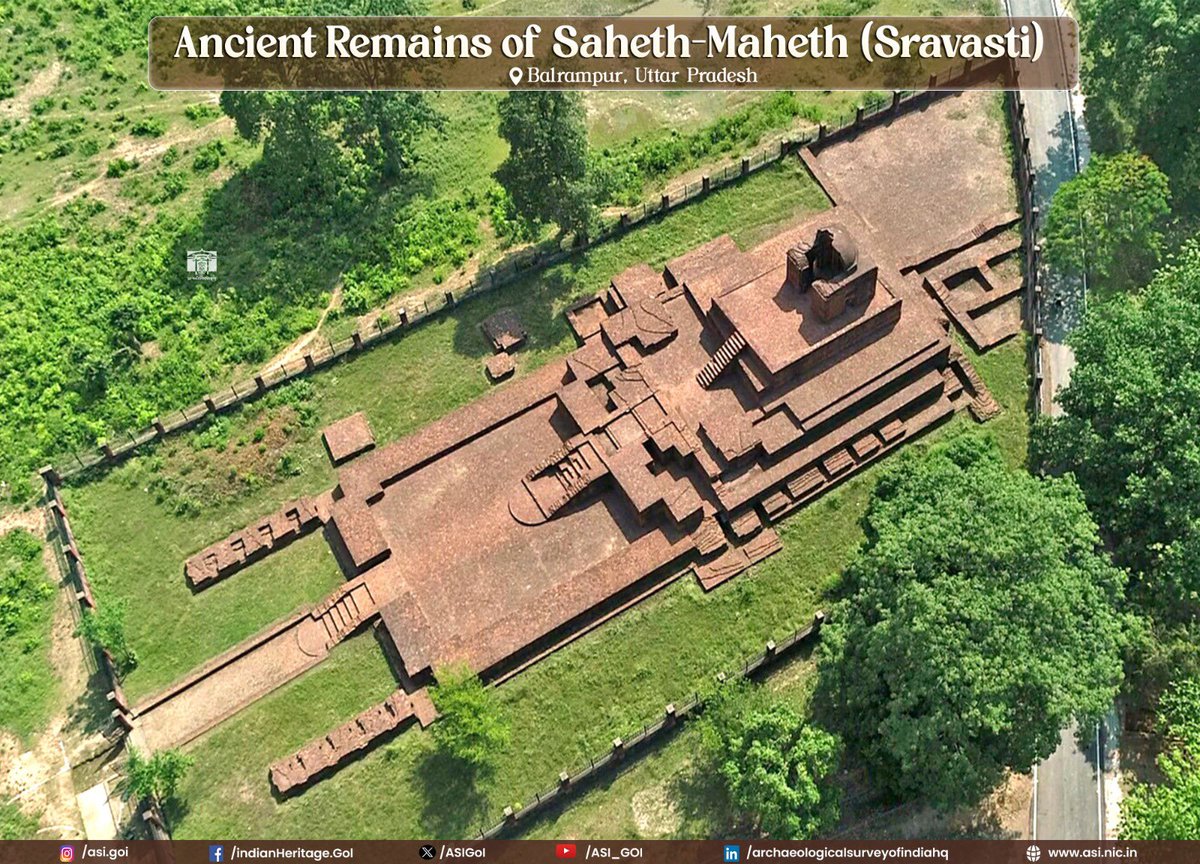
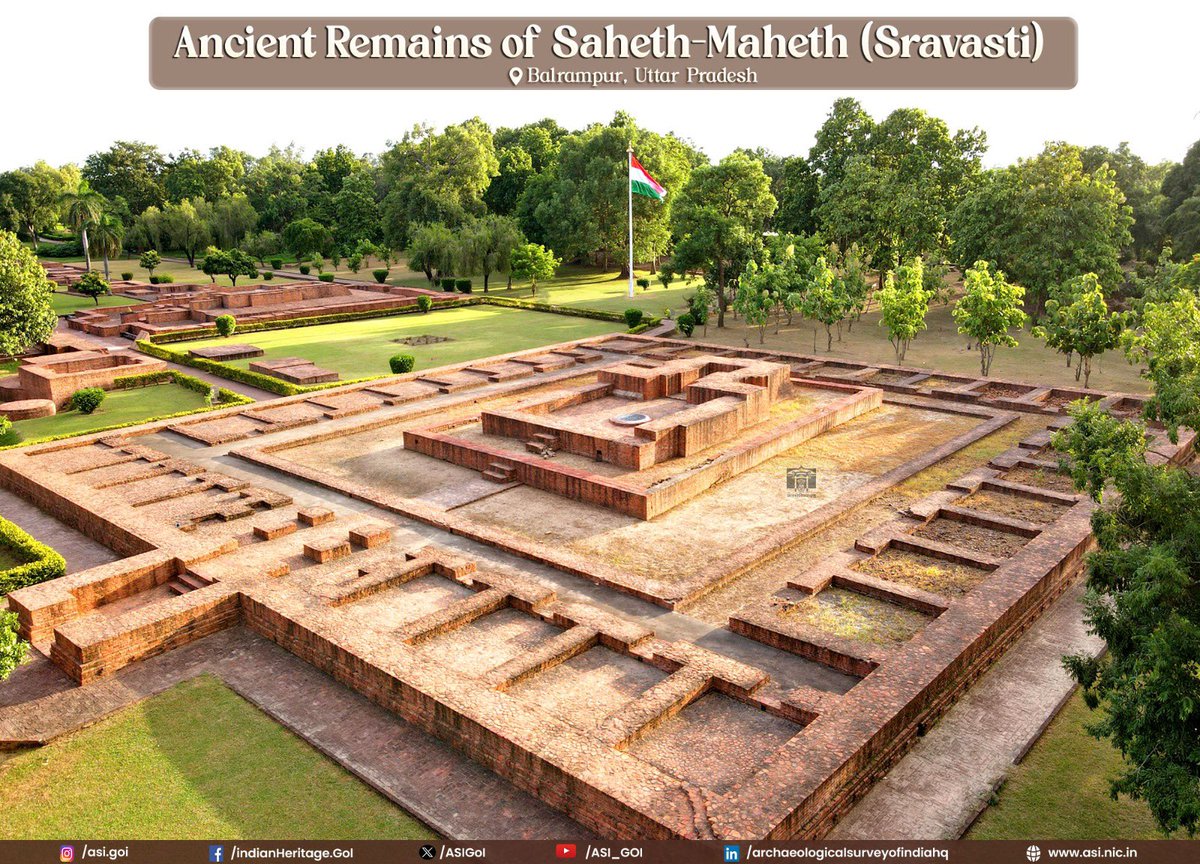
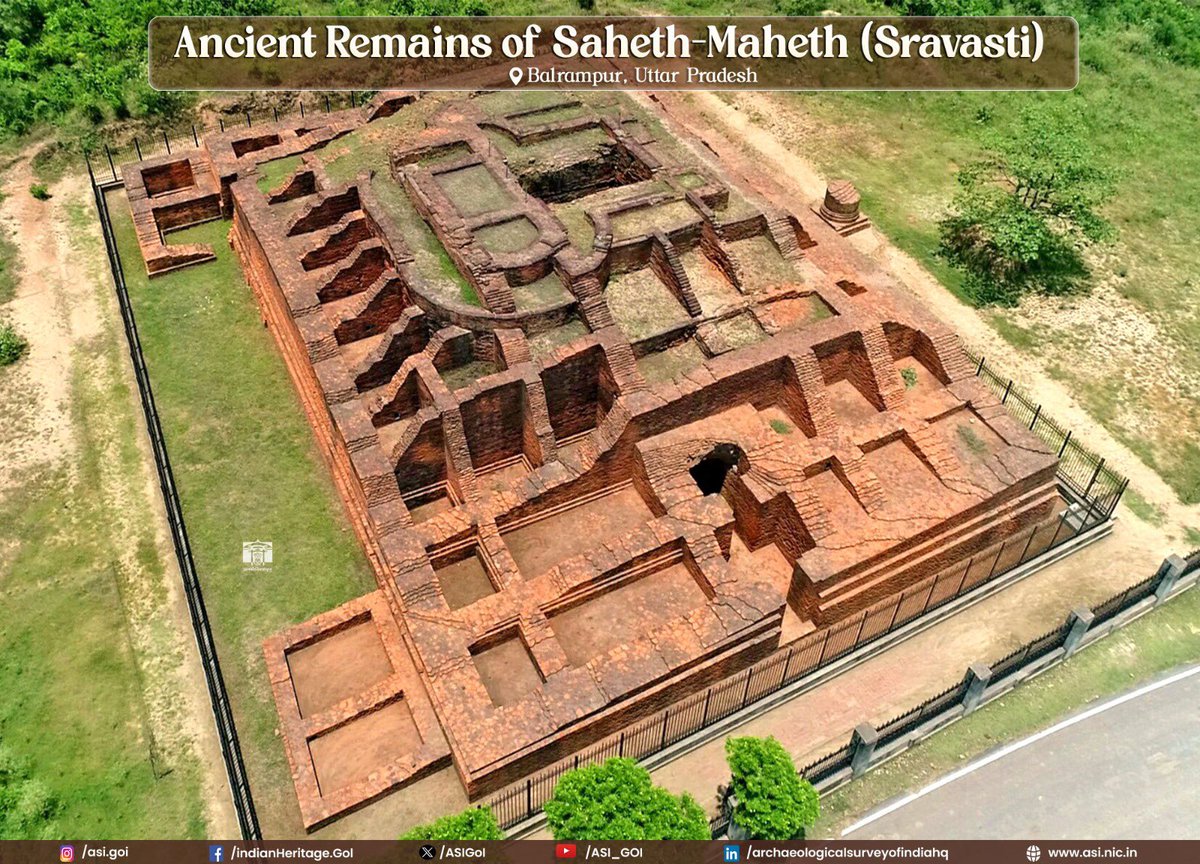
Dating from the 6th century BCE to the Early Medieval Period, Sravasti reached the peak of its prosperity during the time of Buddha under the powerful ruler Prasenaji. It is mentioned in the Mahaparinibbana Sutta as one of the six important cities where Buddha had a large following.
The remains of the famous Jetavana lie within an irregular enclosure at Sahet. Excavations have brought to light the remains of temples, stupas and monasteries. The earliest available relics include a few Kushan structures and images.
At Mahet, the fortified city of ancient Sravasti is represented by the ruins of two massive brick structures known as Pakki-Kuti and Kachchi-Kuti. These are regarded respectively as the stupa erected at the spot where Angulimala was converted and the stupa of Anathpindaka. (2/2)
Sahet-Mahet is an ancient site identified with Sravasti, the ancient capital of the kingdom of Kosala, situated on the bank of the Rapti. The site is divided into two parts: Sahet, located in Sravasti district, and Mahet, located in Balrampur district. (1/2)
India’s maritime history spans thousands of years, and an important part of this remarkable legacy lies beneath our waters.
On the occasion of the International Day for Underwater Cultural Heritage, the Archaeological Survey of India (ASI) reaffirms its commitment to documenting, protecting and preserving India’s invaluable underwater cultural heritage, ensuring that the stories and legacies it holds continue to be recognised and cherished for generations to come.
Thapnath Hill is located near Chogath village in Umarala Taluka, Bhavnagar district, Gujarat.
The first season of excavation, carried out from February to May 2026, revealed significant structural remains, including stone and brick structures, steps, cells, lime-plastered walls, and two brick-built water channels. A human skeleton was also encountered along the outer boundary of the structural complex.
The excavation yielded Red Ware, Red Slipped Ware, Fine Red Slipped Ware, and Red Polished Ware. The pottery assemblage recovered from Thapnath Hill is comparable to that from the excavations at Vallabhipur, suggesting similarities in the material culture of the two sites.
Other antiquities recovered include shell bangles, terracotta and carnelian beads, and medieval copper coins, indicating prolonged occupation and highlighting the archaeological significance of the site.
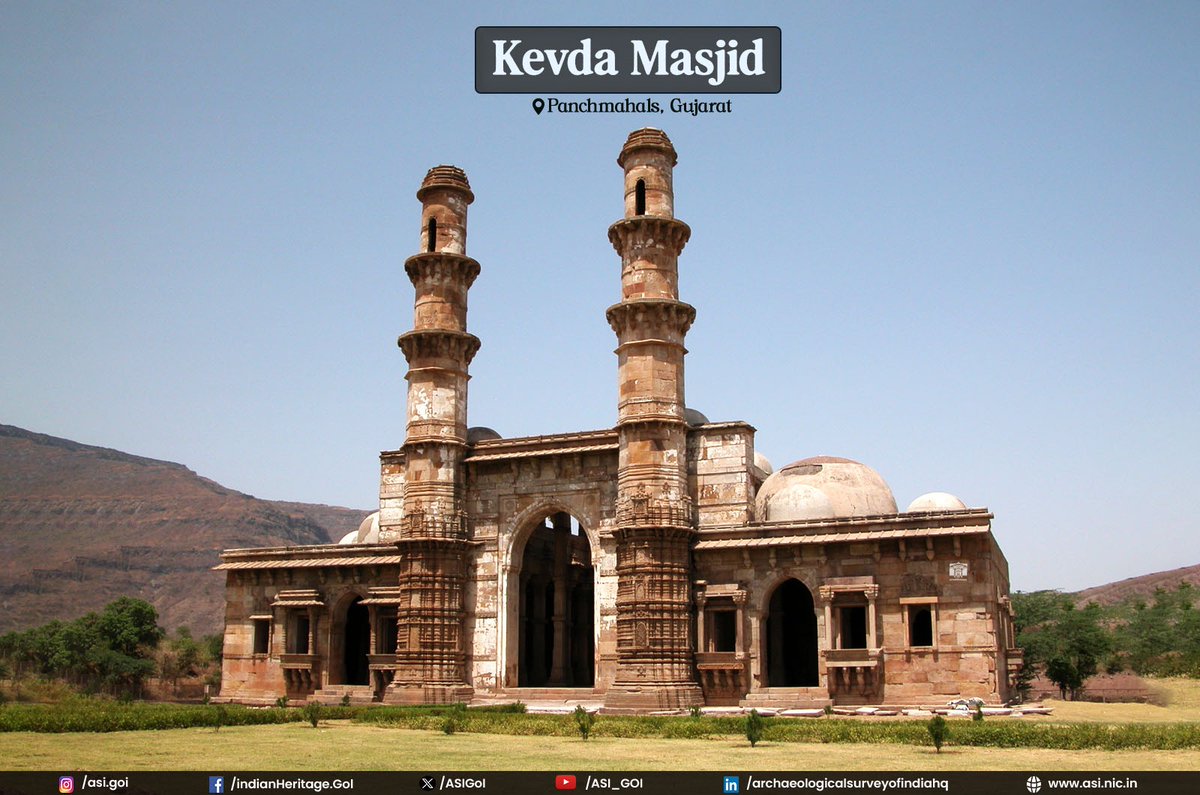
Located at Champaner, in the Panchmahals district of Gujarat, Kevda Masjid is rectangular in plan with a double-storeyed prayer hall.
Stylistically, it can be dated to the period of Mehmud Begda in the 16th century CE.
Architecturally, the two minarets on either side of the central arched entrance are beautifully carved, and the niches are filled with floral and geometrical designs. The windows, provided with pillared balconies, are beautiful and exquisitely decorated.
The complex also comprises a well, a tank for ablution, and a few ruined brick structures.
The temple consists of a rectangular deul preceded by a rectangular, flat-roofed jagamohana. It is distinguished by its semi-cylindrical (khakara) roof, crowned by three kalasas, popularly known as Tinmundiya.
The temple is dedicated to the goddess Chamunda and also features sculptures of Matrikas, along with Ganesha and Virabhadra, and a pair of terrific Bhairavas.
The exterior of the temple is lavishly carved with figures of Ardhanarisvara, Parvati, Mahisamardini, Lakulisa, Hari-Hara, Surya, Nataraja, Nayikas, and others. (2/2)
A striking example of Khakara order of temples, the Boital Temple, located in Bhubaneswar, Khurda district of Odisha, is associated with tantric worship.
Stylistically, the temple is assignable to circa 8th century C.E. (1/2)
Among the significant discoveries were an inscribed terracotta seal with a boss at the back and a seal impression on terracotta lump depicting a unicorn with usual Harappan script. Other findings included terracotta beads, pendants, wheels, toys, animal figurines, amulets, spools, a baby feeder, tablets, a female figurine, bangles, cakes and mushtikas. The excavation also yielded stone bangles, tablets and balls; beads and pendants of carnelian, faience, steatite, amethyst, pearl and lapis lazuli; chert blades and a touchstone; serpentine amulets; and copper objects such as a spearhead, needle, chisel, amulet, fish-hook, bangle, rod and ring, along with bone points.
The ceramic assemblage mainly consisted of Harappan red ware, dull red ware and grey ware, with a few pieces of black-and-red ware. Pottery types recovered from the site included perforated jars, goblets, beakers, small-necked jars, dish-on-stand, dishes, vases, miniature pots, tiny bowls, cups and lids with central knobs. (2/2)
Tarkhanewala-Dera is situated in the Anupgarh tehsil of in Sri Ganganagar district, Rajasthan, on the right bank of the dried ancient Ghaggar (Sarasvati) River. Excavations were carried out during 2003–04 in the north-western part of the site.
The excavation revealed mud-brick residential structures with square and rectangular rooms, built according to the Harappan tradition. The remains included rooms, a kitchen containing earthen utensils, mud floors, mud platforms, hearths, and two pyriform structures, identified as potter's kilns, along with two broken terracotta stelae. (1/2)
Glimpses from the #SuryapathTiranga, the first-ever global relay of our Tricolour 🇮🇳 following the rising sun under the #HarGharTiranga!
As the sun rose from east to west, our Tiranga traversed the horizon, uniting Indians everywhere in a shared emotion of pride and patriotism
#HGT2026 #VandeMataram150 #CultureUnitesAll
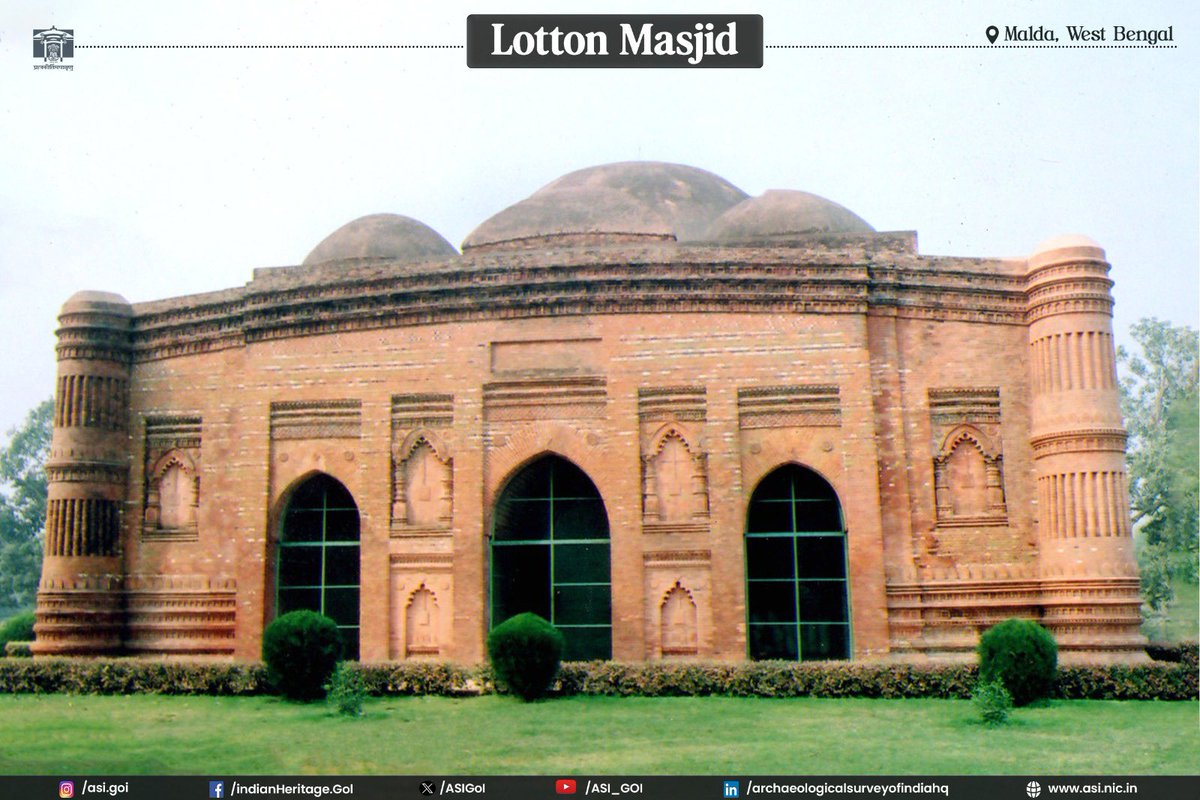
Lotton Mosque is situated at Gaur, Malda district of West bengal . The mosque was built by Sultan Yusuf Shah of the Ilyas Shahi dynasty in 1475 C.E.
It was once covered with enameled brickwork, but now the greater portion of the façade is gone.
The mosque consists of a square room covered by a single dome, with a verandah in front. The main room of the mosque is 34 feet square, and the corridor is 34 feet long by 11 feet wide.
There is a local tradition that the mosque was built by a dancing girl.
The temple is square in shape and faces south. On each of its four sides is a porch with a triple-arched opening. The arches are cusped and rise from heavy piers, creating a symmetrical arrangement.
The temple is known for its highly ornamental terracotta decorations, found both inside and outside the temple, including on the four walls, the areas beside them, and the towers above the roof. The terracotta panels depict a wide range of subjects, including Krishna-lila scenes, episodes from the Ramayana and Mahabharata, social life, and stories from Shaiva or Shakta legends.
Among these decorations, the Krishna-lila panels are noted for their high artistic skill. They depict episodes from the life of Lord Krishna, including the Rasa-mandala and other scenes. (2/2)
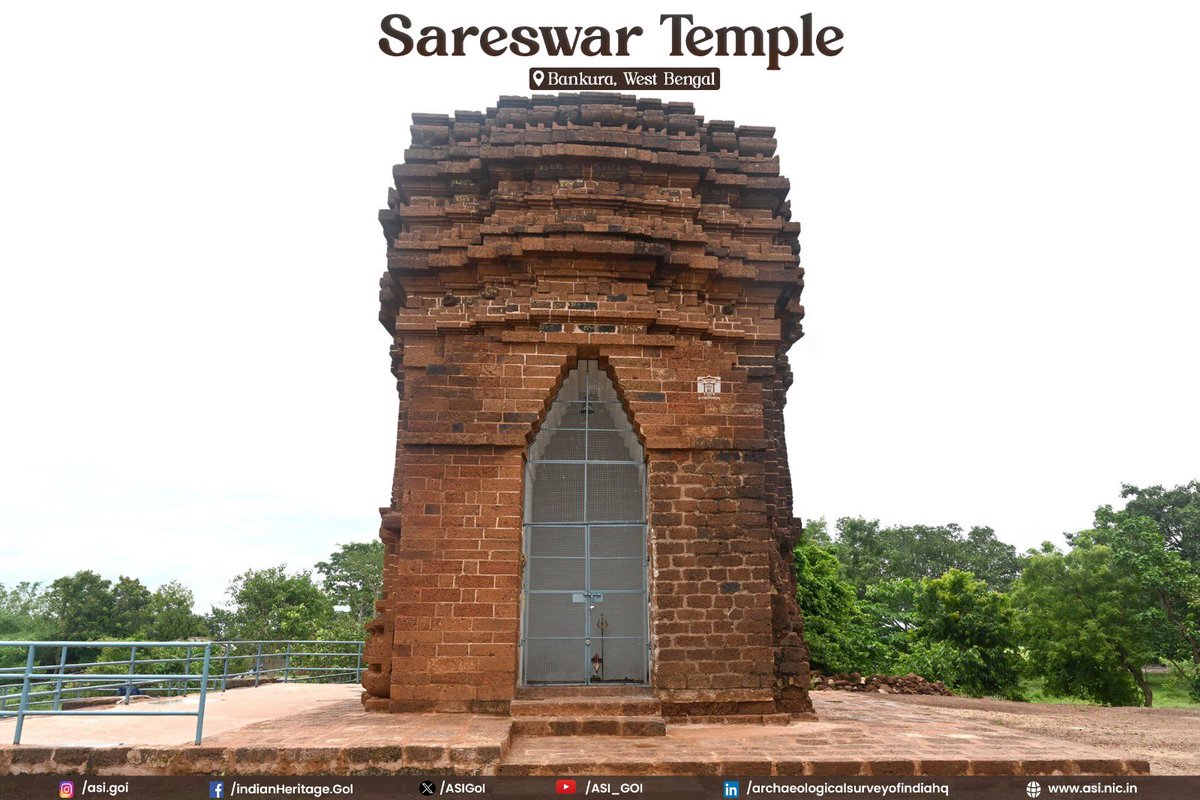
The Sareswar Temple is located at Dihar in the Bankura district. It is a Pancha-Ratna temple, with five towers or pinnacles called chura on its low-pitched, humped roof. These towers are commonly known as ratna-chura and form a distinctive feature of the temple’s architecture.
The temple is dated to c. 11th–12th century CE. An inscription on the temple credits its construction to Malla King Raghunath Simha, the son and successor of Vir Hambir. (1/2)
Located in Chhatarpur, Madhya Pradesh, the Vishwanath Temple displays one of the finest temple architecture of Khajuraho. The temple has an entrance porch, mandapa, maha-mandapa with transepts, vestibule, and sanctum surrounded by an ambulatory.
The temple was built by the Chandella king Dhanga in 999 CE. A long foundation inscription records that two Shiva-lingas, one of which was of emerald, were enshrined here.
Stylistically, the Viswanath Temple is intermediary between the Lakshmana Temple and the Kandariya Mahadeva Temple. It was built in the panchayatana style and anticipates the architectural form of the Kandariya Mahadeva Temple. Its facades feature three sculptural bands of equal size, while the basement niches depict the Satamatrikas, with Ganesha at one end and Virabhadra at the other. Its shikhara is also similar in design to that of the Kandariya Mahadeva, though simpler and with fewer anga shikharas.
The temple has well-proportioned sculptures with admirable poise and balance. These include figures of sura-sundaris and couples, reflecting the refined sculptural tradition of Khajuraho.
The colours of the Tiranga bloom into beautiful rangolis, celebrating the spirit of patriotism and unity.
As part of Har Ghar Tiranga, these vibrant creations reflect our love for the nation and commemorate 150 years of Vande Mataram.
#HarGharTiranga#VandeMataram150 #HarGharTiranga2026 #ASI
Tiranga rallies were organised at various historical monuments as part of the #HarGharTiranga campaign, bringing together communities in a collective celebration of the spirit of patriotism and national pride.
#HarGharTiranga2026#HGT2026#culturalheritage