Trading Book
Breakout- and Swingtrading
AST-Trade V1.0 2025
It's everyone's own journey to get sustainable profitable in Stock-Trading and this will be my way!
https://t.co/hJw82CBx5v
There's a lot of strong opinions floating between bullish and bearish narratives.
The best traders are always the ones who never anchor on a side and are fast to react when probabilities shift. Anchoring always leads to big psychological swings, mistakes, and lag in execution.
In the past, I've found myself a couple of times being "locked out" of moves due to V-shape recoveries, because of fear. Through the years I've realized that selectivity is the solution to protecting capital and minimizing fear. I can continue to execute and still be protected.
->Being selective in bad markets reduces your frequency.
->Less frequency reduces open risk exposure due to fewer trades.
->Less open risk reduces the avg drawdown of your capital compared to the avg of normal periods, where usually you have some open profits.
In the past 3 years we've seen a lot of V shape recoveries. We should always adjust our systems to fit what markets are doing and be at peace.
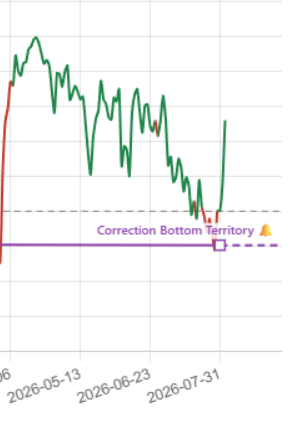
On the 28th-29th of July we got a signal in our system for a potential bounce, and on the same dates, 17 tickers were proposed by our Prioritization-Selectivity engine to focus on.
Focusing on 15-30 tickers is different from focusing on 50 or 100 in moments of uncertainty.
Everyone wants to spot the next leader. Few understand how they show up when the market is down.
Ariel Hernandez looks for relative strength when the broader market is declining. These stocks are holding up well, signaling potential future leadership and preserving capital.
Strength in a down market.
Software continues to be 1 of the strongest groups in the market.
$OKTA, $CRWD, $PANW + $DDOG are pulling in on lower volume.
With $IGV closing above the 50EMA, these are the tight setups I love trading on the right side... watch 'em!
Chart: $OKTA, $CRWD, $PANW & $DDOG.
As a beginner in swing trading, this video was among the ones I learned most, but most of all, where I could get confirmation that my learning is on the good path. Thanks for sharing so generously @stamatoudism and thanks @RichardMoglen for this interview! https://t.co/HGW0JyMxuY
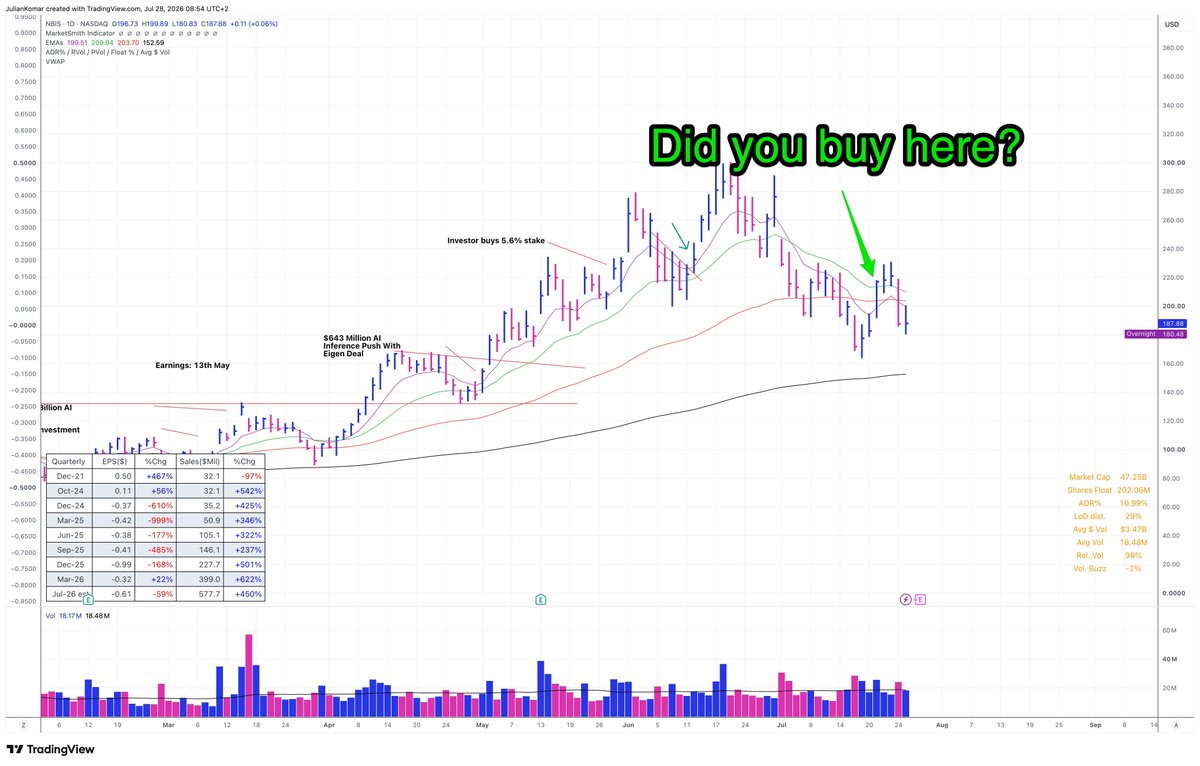
The market keeps setting the same trap over and over again. Did you fall into it?
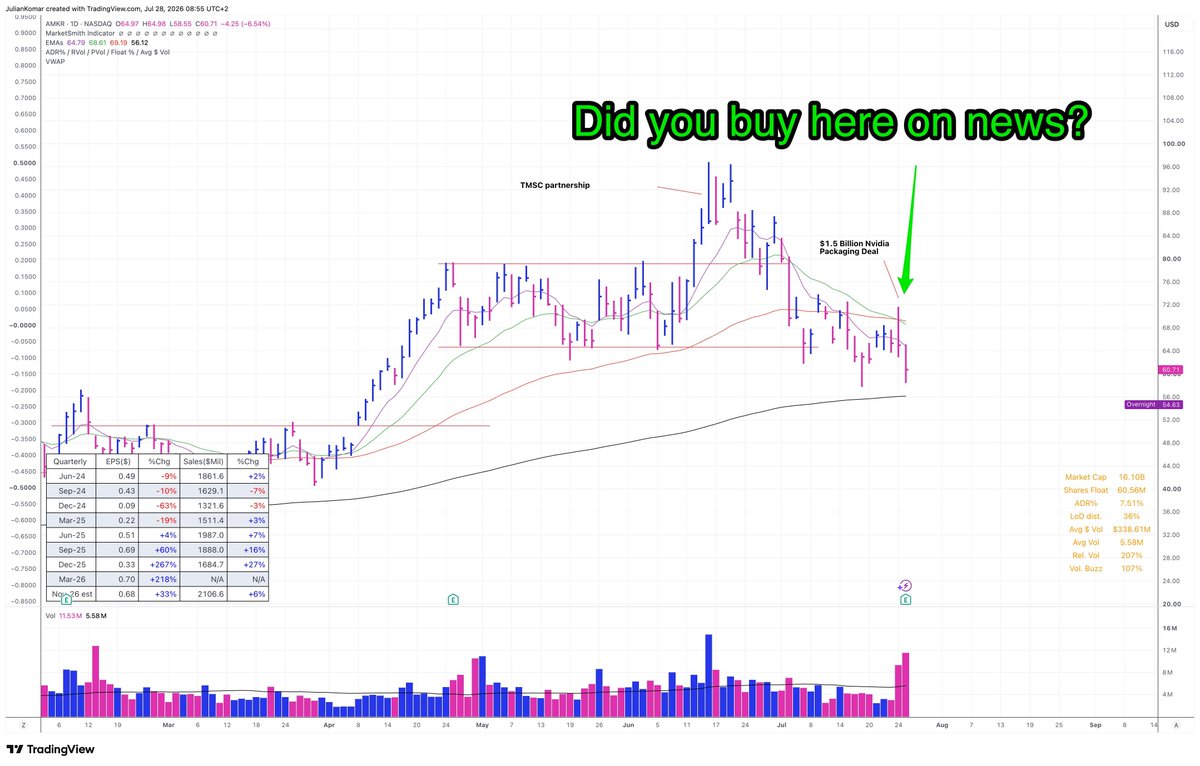
$AMD, $SNDK, $NBIS and $AMKR all looked tempting after correcting 20–30%. Familiar names. Former leaders. Stocks that appeared “cheap” and ready to recover.
But hope is not a setup.
$AMD moved sideways for weeks before rolling over. $SNDK reclaimed the EMA65, only to break down again. $NBIS bounced for two days and then headed toward new lows. $AMKR gapped into resistance on strong news and failed completely.
I see traders repeat the same behavior 👇
• They buy familiar symbols instead of learn how to find the new leaders
• They try to call the bottom of an established downtrend
• They enter inside choppy sideways ranges
• They mistake a short bounce for a real trend change
• They ignore the overall market environment
The problem is not a lack of knowledge. Most traders already know that buying downtrends is dangerous.
The problem is changing their behavior when money and emotions are involved.
This is one of the most important things I help traders with inside my community.
I give them a clear market trend model that tells them when the probabilities are against them. We discuss failed breakouts, weak price reactions and deteriorating market breadth every day. We study the difference between a former leader and a stock preparing to become the next leader.
Most importantly, I repeatedly reinforce the behavior that feels hardest during a correction:
Stay in cash.
Stop predicting.
Wait for proof.
Over time, members learn to recognize these traps before entering—not after another loss appears in their account.
The goal is not to catch the exact bottom.
The goal is to protect your capital, remain mentally clear and be ready when the market improves and the next real leaders appear.
Ready to take the next step in your trading? Start your 14-day free trial now 👉 https://t.co/1FnRkF2h5w
Here's a recent interview with Richard Moglen featuring my three top protégés, all of whom work with me every day helping run Minervini Private Access.
Bob Weissman has been with me for more than 20 years and, as many of you know, won the U.S. Investing Championship last year.
Before Mark Richie and Brandon, Hedgepath came to work for me, they were paying MPA customers for 10 years. And in 2010, they came to the very first Master Trader Program.
If you're interested in hearing how they approach the markets, their process, and the lessons they've learned over the years, I think you'll enjoy this conversation.
https://t.co/wyrRg1la14
Just because a market is showing relative strength does not mean it is showing absolute strength.
You cannot simply buy stocks in a sector or market because they are declining less than others.
Relative strength in a downtrend can help identify where the next leaders may emerge, but it is not a buy signal on its own.
Each stock and trade must still be evaluated on its own merits, with risk management as the cornerstone.
Leaders after six months in the stock division. Late entrants for the 2026 competition are welcome and are tracked from the close on the day they enter. https://t.co/iSk7ihf9tN
The nature of this game is just brutal. Survival rates are low. Only 16% of the USIC field is reporting profitable in June....I imagine it will be lower after July.
Anyone who has been doing this for 10+ years is an outlier. I always listen when they are generous enough to share their hard-won knowledge/wisdom.
I don't think technically I've improved that much as a trader over the years, I knew everything I needed to know within a year or two. The wisdom to know when to apply it. The patience to WAIT. The patience was, by far, the hardest part for me. It still is. I'm getting much better though!
Parabolic moves look exciting. But chasing them is one of the fastest ways to lose money.
In this video, I break down what a parabolic move really is, why it happens, and how to trade it without getting trapped.
The concept a lot of people struggle with is the ability to do nothing for weeks or months at a time. To sit there and know a better wave or market cycle maybe around the corner.
Most of that comes from learning it through pain and drawdowns. Honestly that’s the best type of learning there is. You trade a topping market, you get burned and there’s a lesson on the other end of it.
Folks screaming into a keyboard telling you don’t do this, don’t do that. That’s fine and peer knowledge is good wisdom. But the real learning comes from actually messing up. Feeling the pain, feeling the disappointment, going through the low yourself. Others can mask it or reduce it for you, sure.
The best traders out there, the ones whose word you actually respect, were all at some point trading this same chop. Trading a mess. Sitting in a drawdown. Giving back gains in a year that was going well. Taking a big gap down. Those emotional experiences harden how you approach the markets. You end up battle-tested because you’ve been through situation A, B, and C yourself instead of someone telling you to avoid them.
You can avoid some of it. But the best traders have always been through it. They know how it feels to be down and out and they know how it feels to be sky high, and those extremes build your emotional, psychological, and systematic ability to handle future cycles.
If you’re going through it right now, it’s not the end of the world. It’s making you a better trader. Better to learn in choppy water than in a market that only goes up, because that’s what breeds nonsensical risk management long term.
After more than 20 years in the stock market, one realization completely changed the way I think about trading.
For years, I believed that working harder would automatically produce better results.
- So I scanned more stocks.
- Read more news.
- Analyzed more charts.
- Spent more hours in front of my screens.
I thought the traders putting in the most work would eventually make the most money.
I was wrong.
The market doesn't reward hard work. It rewards good decisions.
Some of my best weeks required only one trade.
Some of my best months came from patiently waiting until everything aligned before committing capital.
On the other hand, some of my worst periods came when I was working the hardest.
I convinced myself that if I just looked a little longer, scanned a few hundred more charts or lowered my standards slightly, I'd find another opportunity.
Most of the time, I didn't.
I simply forced trades that never should have been taken.
That was a difficult lesson to accept.
Today, I no longer measure my productivity by the number of hours I spend working or the number of trades I place.
I measure it by the quality of my decisions:
- Did I wait for exceptional stocks?
- Did I stay patient when nothing met my standards?
- Did I protect my capital instead of forcing action?
Sometimes the most productive trading day ends without placing a single trade.
Being active and being productive are two very different things.
The longer I trade, the more convinced I become that patience isn't the opposite of productivity.
It's often the highest form of it.
The standings through June 30 have been posted at https://t.co/fBLPc8qGrH and https://t.co/oFCUswH2gM. It's been an extremely difficult year. On July 27, the final six-month standings will be tweeted here. Late entrants are still welcome and are tracked from the close on the day they enter.
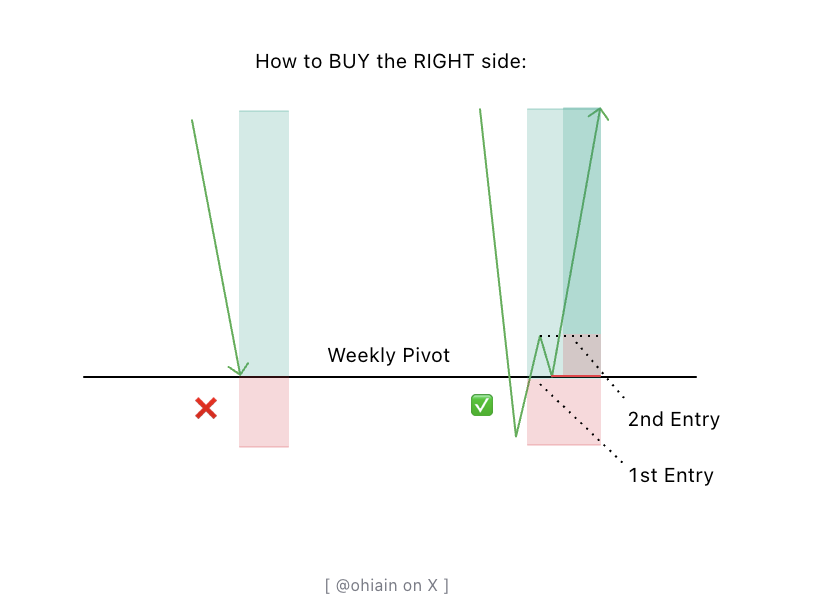
I ALWAYS buy the STRENGTH after the panic.
Simple process:
• find an RS leader
• let it flush into support
• watch for buyers to defend
• enter on the 30min reclaim
• risk the lows
That's how I consistently buy the right side of the V with tight risk + asymmetric upside.
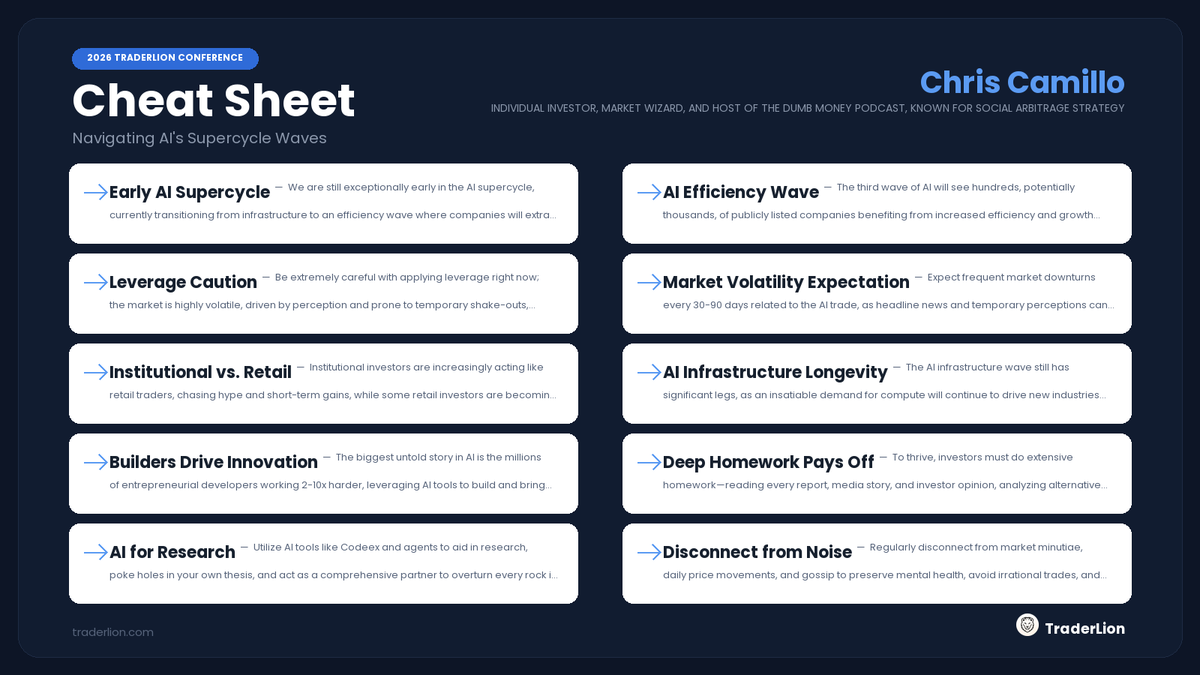
Market Wizard and Host of the Dumb Money Podcast Chris Camillo (@ChrisCamillo) opened the 2026 TraderLion Conference — AI Supercycles, market volatility, and what most traders get wrong.
10 lessons in one cheat sheet 👇
Everyone wants to find their next big winner. Few understand the power of eliminating losing strategies.
Phil Goedeker broke his first million dollars by rigorously analyzing his trades to identify and cut out what wasn't working. This disciplined self-correction refined his edge and drove consistent profitability.
Subtract to multiply.