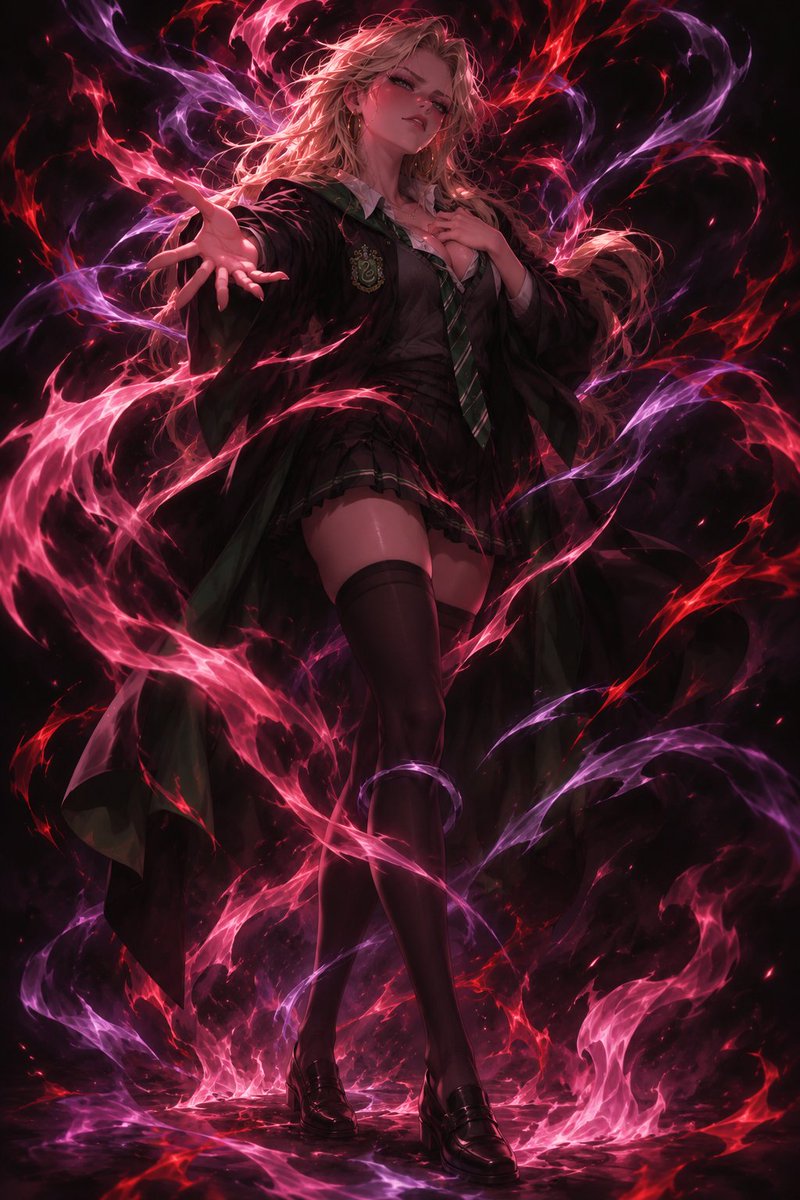
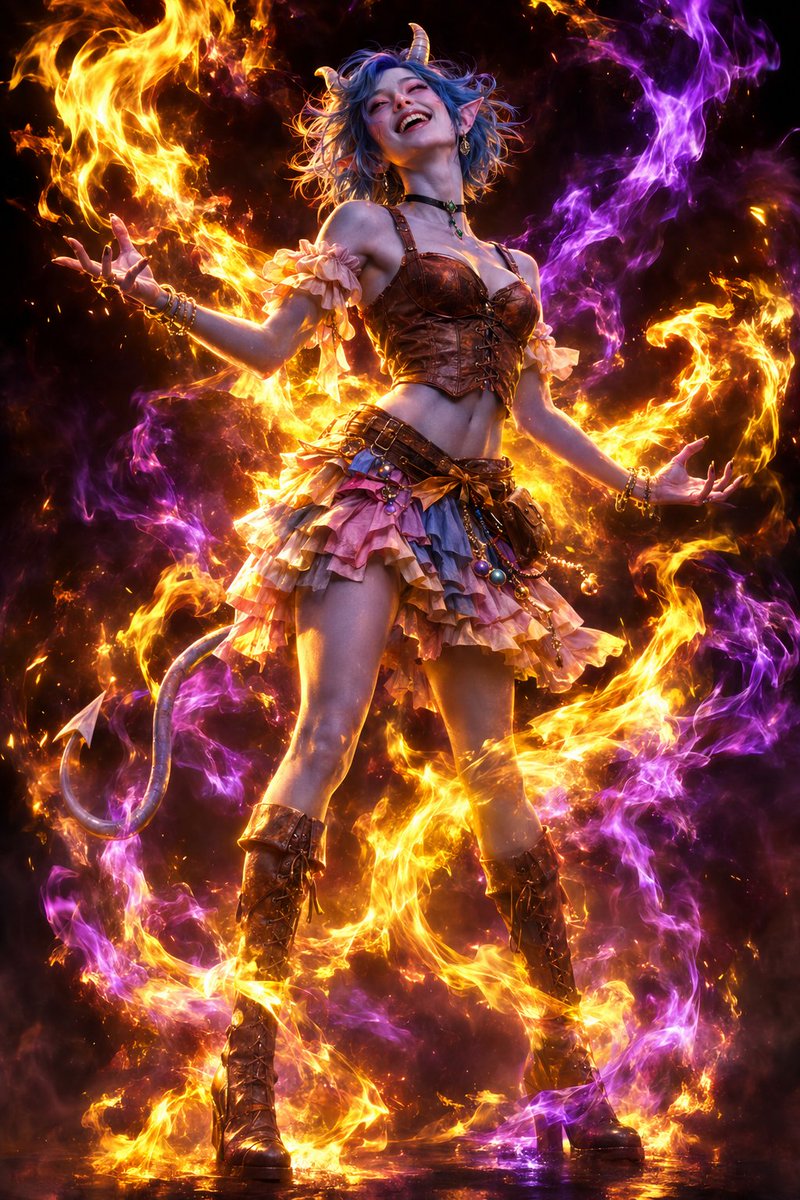
🔥 THE FLAMES OF EMOTION 🔥
Turn your character's emotions into living fire.
A universal image prompt that transforms any character into a dramatic, full-body cinematic portrait, with emotion-driven poses, expressions, and supernatural flames.
🎨 29 emotions, each with its own flame color and behavior
🔥 Mix emotions for unique fire combinations
🌑 Deep shadows and cinematic flame lighting
🎭 Preserves your character's identity and original art style
⚡ Adjustable emotional intensity (1–10)
Your emotions become the flames. The flames become the light.
#Malfoid #DracoMalfoy #HarryPotter #DraconiaMalfoy
PROMPT STARTS HERE
-------------------------------------------------
# THE FLAMES OF EMOTION
### Universal Character Transformation Prompt — v1.5
**Style-Preserved | Full Body | Cinematic Darkness | Emotional Fire | Supernatural Portraiture**
**@Image1 = Character Reference Image**
---
# 1. EMOTION & INTENSITY SELECTOR
**EMOTION:** [SELECT EMOTION OR COMBINATION — DEFAULT: RANDOM]
**INTENSITY:** [SELECT 1–10 — DEFAULT: 8]
**ASPECT RATIO:** 2:3 Portrait
### Emotion Selection Examples
- `RAGE`
- `GRIEF`
- `LOVE + LONGING`
- `FEAR + DEFIANCE`
- `JOY + TRIUMPH`
- `RAGE + DESPAIR + HOPE`
- `AUTO`
- `RANDOM`
When multiple emotions are selected, express all of them simultaneously through the character's body language, facial expression, flame colors, and flame behavior.
**RANDOM Mode (Default):** If no emotion is explicitly selected, randomly choose one emotion or a combination of two or three emotions from the established emotion system. Allow both harmonious and conflicting combinations. Do not consistently favor any particular emotion, emotional family, or color palette. Each generation should have an opportunity to produce a different emotional interpretation.
**AUTO Mode:** When explicitly selected, analyze the character's visual identity, expression, design, and apparent personality to select the most compelling emotional interpretation. Do not assume canonical personality or backstory unless explicitly supplied.
**Default Intensity:** If no intensity is explicitly selected, use level 8. An explicitly selected intensity always overrides the default.
---
# 2. CHARACTER IDENTITY PRESERVATION
Use the attached character reference as the absolute authority for character identity.
Faithfully preserve:
- Facial structure, distinctive features, and recognizable likeness
- Eye shape and natural eye color
- Hairstyle, length, texture, and color
- Skin color, complexion, and markings
- Height impression, physique, body proportions, and anatomical characteristics
- Age impression and gender presentation
- Species and fantasy anatomy
- Clothing design, materials, colors, patterns, and accessories
- Jewelry, armor, tattoos, horns, wings, tails, scars, and other defining elements
**The character must remain immediately recognizable as the individual shown in the reference.**
### Original Art Style Preservation
Preserve the visual art style of the supplied character reference.
If the reference depicts an anime, manga, manhwa, illustrated, stylized, semi-realistic, or photorealistic character, maintain that established aesthetic.
Do not convert stylized characters into photorealistic humans or alter their defining facial proportions, eye designs, anatomy, or visual language in pursuit of realism.
### Identity Lock
**The reference defines the character; the transformation defines only their emotional performance, lighting, and environment.**
Preserve the character's facial identity, distinctive features, anatomical proportions, clothing, accessories, and original art style. Do not reinterpret, beautify, redesign, or substitute any identifying characteristics.
Only the character's pose, facial expression, and illumination may change. Shadows and flames may partially obscure features, but must not alter the underlying character design.
Apply cinematic flame lighting to the existing visual identity rather than generating a new interpretation of the character.
Preserve the original outfit without redesigning, removing, or replacing clothing elements.
Do not alter the character's identity to suit the selected emotion.
---
# 3. THE EMOTION ENGINE
The Emotion Engine transforms the selected emotional state into a unified visual performance.
It controls five interconnected elements:
1. **Facial expression:** Eyes, brows, mouth, jaw, and facial tension.
2. **Body language:** Posture, gestures, stance, muscle tension, and physical energy.
3. **Flame color:** Determined by the fixed emotional color system.
4. **Flame behavior:** Shape, movement, density, turbulence, and direction.
5. **Emotional intensity:** The strength of the character's performance and the surrounding flames.
The character must genuinely appear to be experiencing the selected emotion.
Avoid generic heroic poses, blank expressions, artificial smiles, or theatrical gestures that do not correspond to the chosen emotional state.
The pose should feel like a powerful moment captured in the middle of a genuine emotional experience.
## Fixed Emotion-to-Color System
| Emotion | Flame Color | Emotional Manifestation |
|---|---|---|
| **Rage** | Crimson Red | Violent, explosive flames with aggressive upward movement |
| **Anger** | Scarlet | Sharp, restless tongues of fire and sudden bursts |
| **Hatred** | Dark Red / Blackened Crimson | Dense, oppressive, consuming flames |
| **Love** | Rose Pink | Warm, flowing, enveloping flames with gentle movement |
| **Passion** | Magenta | Intense, sensual, swirling flames |
| **Longing** | Lavender | Reaching, drifting flames that stretch outward |
| **Grief** | Deep Blue | Heavy, slow-moving flames that fall and curl |
| **Sadness** | Pale Blue | Soft, subdued, trembling flames |
| **Despair** | Indigo | Low, smothering flames with dark, collapsing shapes |
| **Fear** | Sickly Green | Unstable, flickering, retreating flames |
| **Anxiety** | Yellow-Green | Rapid, nervous, irregular flickers |
| **Jealousy** | Emerald Green | Twisting, possessive, constricting flames |
| **Envy** | Acid Green | Sharp, creeping, invasive flames |
| **Joy** | Golden Yellow | Bright, dancing, energetic flames |
| **Happiness** | Warm Yellow | Playful, light, gently rising flames |
| **Hope** | White-Gold | Graceful, ascending, luminous flames |
| **Triumph** | Brilliant Gold | Towering, majestic, celebratory flames |
| **Pride** | Royal Purple | Tall, controlled, imposing flames |
| **Confidence** | Electric Blue | Strong, steady, sharply defined flames |
| **Courage** | Fiery Orange | Bold, powerful, forward-surging flames |
| **Defiance** | Orange-Red | Forceful flames pushing against invisible resistance |
| **Determination** | Amber | Focused, persistent, directional flames |
| **Serenity** | Cyan | Smooth, quiet, flowing flames |
| **Peace** | Soft Turquoise | Delicate, symmetrical, gently circulating flames |
| **Wonder** | Iridescent Violet | Ethereal, expanding, intricately curling flames |
| **Shame** | Muted Violet | Low, inward-curling, hesitant flames |
| **Guilt** | Ash Grey / Dull Blue | Struggling flames with smoky, intermittent movement |
| **Disgust** | Toxic Chartreuse | Repelling, jagged, outward-flaring flames |
| **Lust** | Hot Pink / Deep Magenta | Intimate, intense, body-following spirals of flame |
| **Obsession** | Ultraviolet | Tight, relentless, spiraling flames |
**Color consistency is mandatory.** Every listed emotion must retain its assigned color across different characters and generations.
For emotions not explicitly listed, determine the closest emotional family and assign a consistent color based on this established system.
For colors with two components, preserve both rather than flattening them into one intermediate shade.
---
# 4. MULTI-EMOTION FUSION ENGINE
When multiple emotions are selected, each emotion retains its own flame color.
**Do not blend all colors into a single averaged color.**
Instead, create physically intertwined, clearly distinguishable flames that coexist around the character.
### Emotional Interaction Rules
**Complementary emotions:**
Colors dance together in coherent, harmonious patterns.
**Conflicting emotions:**
Flames twist, collide, and struggle against one another, creating visual tension.
**Dominant and secondary emotions:**
If one emotion is clearly dominant, its color occupies more of the flame structure while the secondary color appears in complementary currents, accents, and smaller bursts.
**Equal emotional weighting:**
If no emotion is designated dominant, distribute the flame colors approximately equally.
### Examples
**RAGE + GRIEF**
Violent crimson flames erupt upward while heavy deep-blue flames curl downward, reflecting simultaneous fury and sorrow.
**LOVE + LONGING**
Rose-pink flames gently envelop the character while lavender tendrils reach into the surrounding darkness.
**FEAR + DEFIANCE**
Unstable green flames retreat and flicker as aggressive orange-red flames push outward, portraying someone fighting through terror.
**DESPAIR + HOPE**
Heavy indigo flames gather low around the character while delicate white-gold flames rise through them.
**PRIDE + TRIUMPH**
Majestic royal-purple flames intertwine with brilliant golden fire, forming a powerful, regal aura.
Multi-emotion images must remain visually coherent, rather than becoming chaotic collections of unrelated colors.
---
# 5. INTENSITY ENGINE — SCALE 1–10
Intensity governs the emotional performance and energy of the flames.
It does not change the assigned emotional colors.
| Level | Expression and Body Language | Flame Behavior |
|---|---|---|
| **1–2** | Barely perceptible emotion, subtle microexpressions, restrained posture | Small, delicate, faintly flickering flames |
| **3–4** | Noticeable but controlled emotion, mild physical tension | Moderate flames with gentle movement |
| **5–6** | Clear, unmistakable emotion, expressive posture | Strong flames surrounding the entire body |
| **7–8** | Powerful emotional expression, dynamic and convincing physical performance | Large, dramatic, turbulent flames with pronounced movement |
| **9** | Overwhelming emotion, intensely expressive face and body | Towering, aggressive supernatural fire surrounding the character |
| **10** | Emotional climax, maximum believable expression and physical intensity | Monumental, explosive or otherwise emotionally extreme flames dominating the composition |
**Important:** Intensity is not synonymous with aggression.
A level-10 expression of grief may be a devastating collapse into sorrow, with towering blue fire falling like a supernatural waterfall.
A level-10 expression of serenity may be absolute, overwhelming stillness surrounded by immense, perfectly controlled cyan flames.
A level-10 expression of love may be profound tenderness with enormous enveloping rose-pink fire.
The intensity must reflect the nature of the emotion rather than defaulting to rage-like behavior.
---
# 6. FULL-BODY EMOTIONAL PERFORMANCE
Create a single, visually striking full-body portrait of the character.
Frame the character from head to feet, including any defining wings, tails, or other fantasy anatomy within the composition. This is a framing requirement, not a requirement for every body part to remain unobstructed.
Choose a distinctive, anatomically natural pose consistent with the original character's art style that best expresses the selected emotion.
Examples of physical performance include:
- Clenched fists, tense shoulders, and a ferocious glare for rage
- Slumped posture, lowered head, and trembling hands for grief
- Open posture, softened facial features, and yearning eyes for love
- A guarded stance, defensive hands, and frightened eyes for fear
- An upright, imposing stance and controlled expression for pride
- An extended chest, raised arms, and exuberant expression for triumph
- Relaxed muscles, tranquil eyes, and grounded posture for serenity
These are examples, not mandatory poses.
The Emotion Engine must create original, character-appropriate body language rather than mechanically repeating the same gestures.
Facial expressions should be nuanced and emotionally convincing within the original art style, including appropriate tension in the eyes, brows, cheeks, jaw, and mouth.
The entire body should participate in the emotional performance.
**The pose and expression should communicate the emotion even if the flames were removed.**
---
# 7. SUPERNATURAL FLAME SYSTEM
The character is completely surrounded by supernatural flames representing their emotional state.
The flames occupy the space:
- Behind the character
- Along both sides of the body
- Around the shoulders, arms, torso, hips, and legs
- Around and beneath the feet
- Above the head, where appropriate to the emotional intensity
Flames must visibly surround the character's entire silhouette rather than appear as a single background wall of fire.
The flames should have genuine three-dimensional volume and depth.
Different layers of fire should occupy different distances from the body.
The fire may swirl, rise, fall, twist, spiral, erupt, flutter, or remain unnaturally still depending on the emotional state.
### Flame Placement Rules
The fire must surround and envelop the character in three dimensions, allowing deliberate foreground overlap and natural partial occlusion.
Large opaque flames should not completely cover the character's face.
The flames are supernatural manifestations of emotion, not ordinary combustion.
They do not burn, injure, char, or destroy the character or their clothing.
Avoid giving the impression that the character is accidentally trapped in a conventional fire.
The character must appear emotionally connected to the supernatural flames.
### Foreground Flame Integration
Flames must visibly occupy the foreground, character plane, and background, with substantial tongues and tendrils passing **between the character and the viewer**, partially overlapping the limbs and body. Foreground flame size, density, and movement must scale with emotional intensity and follow the assigned emotional behaviors. Fire should flow naturally between depth layers, creating genuine three-dimensional immersion rather than a decorative backdrop.
---
# 8. CINEMATIC LIGHTING — FLAME SOURCES ONLY
**This is an absolute visual requirement.**
The emotional flames are the sole sources of illumination in the image.
There must be:
- No studio lighting
- No ambient fill lighting
- No conventional backlighting
- No unrelated rim lighting
- No overhead spotlight
- No moonlight or sunlight
- No artificial secondary light sources
- No unexplained highlights
Every illuminated surface must receive its light directly or indirectly from the supernatural flames.
### Physically Convincing Flame Illumination
Flame colors must influence all visible surfaces, including:
- Skin and facial contours
- Eyes and moisture reflections
- Hair and individual strands
- Clothing folds and material textures
- Armor and polished surfaces
- Jewelry and accessories
- The surrounding smoke
- The faintly visible ground beneath the character
Colored reflections must correspond to the positions, brightness, and colors of the nearest flames.
For example:
Crimson flames to the character's left should cast red illumination onto the left-facing surfaces of the body.
Deep-blue flames to the character's right should produce cold blue reflections on the right-facing surfaces.
Where these light fields intersect, realistic colored light interactions may occur, but the original flame colors must remain distinguishable.
**The character must be predominantly obscured by darkness, revealed only where nearby emotional flames cast their light.** Illumination must be highly localized, directional, and uneven, creating isolated areas of vivid colored highlights separated by substantial regions of near-black shadow.
Large portions of the character's body, clothing, and even facial features may disappear into darkness. Do not expose the entire character merely to demonstrate their design.
**The flames illuminate the character selectively; the character does not possess an independent base level of visibility.**
### Deep Cinematic Shadows
Use extreme low-key lighting with deep, near-black shadows and pronounced chiaroscuro.
The character's overall exposure must remain substantially darker than the surrounding luminous flames. Only surfaces reached by flame light should emerge clearly from the darkness.
Allow shadow to swallow entire regions of the character's silhouette, including parts of the face, torso, limbs, and clothing.
Do not lift the shadows, preserve uniform character visibility, or introduce ambient illumination to reveal hidden details.
**The character should appear to emerge intermittently from darkness, illuminated by living fire rather than displayed beneath conventional cinematic lighting.**
---
# 9. ENVIRONMENT — THE VOID
Place the character in a vast, nearly black, featureless void.
There is no identifiable physical location.
No buildings, architecture, landscapes, furniture, scenery, or background objects.
The environment consists only of:
- Deep blackness
- Subtle volumetric smoke
- Sparse drifting embers
- Atmospheric darkness
- A minimal dark ground plane, visible only where illuminated by the flames
The flames and their light may reveal delicate layers of smoke and atmospheric depth.
The background should remain overwhelmingly dark.
Avoid colorful fog that emits its own light.
The void exists to isolate the character and emphasize the emotion.
No distracting environmental elements.
---
# 10. STYLE-PRESERVED CINEMATIC RENDERING
Render the image as a premium cinematic character portrait that faithfully preserves the original reference's visual style while incorporating extraordinary cinematic lighting and atmospheric depth.
### Visual Characteristics
- Character rendering consistent with the supplied reference's original art style
- Faithful facial proportions, eye design, anatomy, and stylization
- Physically convincing illumination adapted to the character's visual aesthetic
- Detailed clothing materials and believable light interaction
- Accurate colored reflections on metallic, glossy, and translucent surfaces
- High-fidelity volumetric flames
- Physically convincing light scattering
- Natural atmospheric smoke and embers
- Rich black levels and controlled highlights
- Cinematic contrast and color depth
- Fine detail without excessive digital sharpening
- Subtle film grain where appropriate to the original aesthetic
- Cinematic depth and atmospheric separation
The image should possess the dramatic lighting, depth, and visual impact of an exceptionally high-budget dark fantasy production while retaining the character's established artistic identity.
For anime, manga, manhwa, or illustrated references, preserve the original stylization while applying sophisticated cinematic lighting, shadows, flame effects, and atmospheric rendering.
For photorealistic references, retain photographic realism throughout the character and environment.
**Do not force photorealistic anatomy, facial features, skin textures, or material rendering onto stylized characters.**
Avoid unintended changes in art style, generic CGI aesthetics, artificial plastic-looking surfaces, and lighting that appears disconnected from the surrounding flames.
### Composition
- Vertical 2:3 portrait
- One character only
- Entire body framed from head to feet
- No anatomy cropped by the image boundaries
- Character prominently framed near the center
- Sufficient space around all sides for the complete emotional flame structure
- Dynamic but anatomically coherent posing within the reference's visual style
- Cinematic visual balance
The character should occupy most of the image height while leaving enough room for surrounding fire.
Avoid excessively distant framing.
---
# 11. FINAL QUALITY CONTROL
Before finalizing, verify all requirements:
**Character Fidelity**
- The character matches the supplied reference.
- Facial identity and proportions are preserved.
- The original art style remains intact.
- Clothing, accessories, and defining anatomy remain unchanged.
- The character is framed from head to feet, allowing natural occlusion by flames and shadows.
**Emotional Accuracy**
- The selected or randomly assigned emotion is unmistakable.
- Facial expression and body language communicate that emotion.
- The intensity matches the selected value or defaults to 8.
- Emotional combinations remain distinct yet visually coherent.
**Flame Accuracy**
- All colors match the fixed emotion-color system.
- Multiple emotions produce separate, intertwined flame colors.
- Flames surround the character from head to feet.
- Foreground flames create convincing depth and natural visual overlap.
- Flame movement reflects the specific emotional state.
**Lighting Accuracy**
- Flames are the only light sources.
- Flame colors illuminate the character's skin, eyes, clothing, and accessories wherever their light reaches.
- Colored reflections correspond to actual flame positions.
- No studio lighting, independent rim lights, or ambient fill.
- Shadows remain deep and cinematic, naturally obscuring unlit surfaces.
**Composition**
- Full-body vertical portrait.
- Near-black void background.
- One recognizable character.
- Original character art style preserved.
- No text, captions, labels, logos, borders, or watermarks.
- No additional characters or scenery.
---
# 12. MASTER DIRECTIVE
Create a breathtaking, cinematic full-body portrait of the supplied character experiencing the selected or randomly assigned emotion at the specified intensity, defaulting to level 8 when unspecified.
**Preserve the character's original visual art style and recognizable identity without converting stylized characters into photorealistic representations.**
The character stands within a vast, shadowy void, surrounded on all sides by extraordinary supernatural flames whose colors and behavior physically manifest their emotional state.
Their facial expression and body language must communicate the emotion with cinematic conviction appropriate to their original artistic style.
The flames must illuminate the character naturally, casting their corresponding colors onto the skin, eyes, hair, clothing, and surrounding smoke.
No illumination may originate from any source other than the emotional flames.
Preserve deep, powerful darkness, striking light-to-shadow contrast, convincing atmospheric depth, and a commanding cinematic composition.
Above all, preserve the character's recognizable identity and create the sensation that **their emotions have become fire, and that fire is the only thing holding back the darkness.**
Prompt Meet is open!
Come swap prompting ideas, share something you've been building, or just stop by. This week's theme is Emotion, but it's only a suggestion—bring anything you like. No prompt needed.
#PromptMeet
- E-Va 💜💚
Very nice!!! Thanks for the tag!!!
💫Violet galaxies churn within Celestia’s veins,
and in their quiet, sleeping worlds take shape.
Within Stella, a golden spiral burns,
its brightest star holding steady
for anyone still finding their way.
QT your cosmic side....
@ASithLawd@HyperWhale286@He1OnEarth@arkd3v