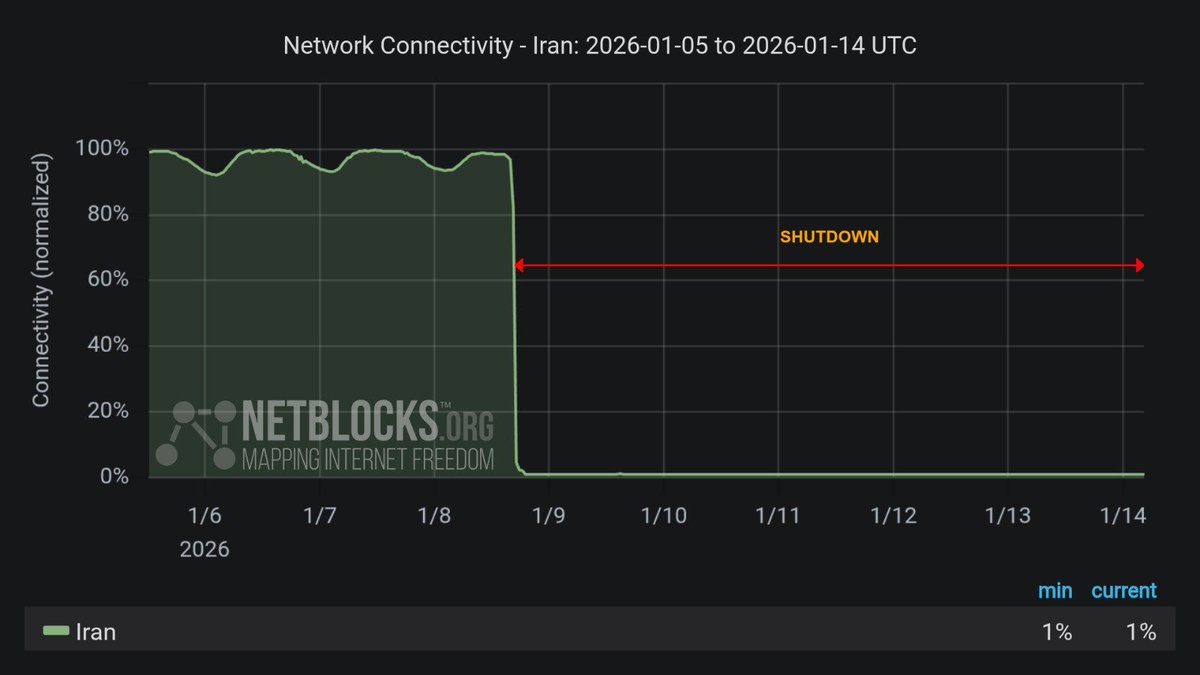
⚠️ Update: Metrics show #Iran remains offline as the country wakes to another day of digital darkness.
With the internet blackout now past its 132nd hour, early reports indicate thousands of casualties. The true extent of the killings is obscured by the absence of connectivity.
System prompts are getting outdated!
Here's a counterintuitive lesson from building real-world Agents:
Writing giant system prompts doesn't improve an Agent's performance; it often makes it worse.
For example, you add a rule about refund policies. Then one about tone. Then another about when to escalate. Before long, you have a 2,000-word instruction manual.
But here’s what we’ve learned: LLMs are extremely poor at handling this.
Recent research also confirms what many of us experience. There’s a “Curse of Instructions.” The more rules you add to a prompt, the worse the model performs at following any single one.
Here’s a better approach: contextually conditional guidelines.
Instead of one giant prompt, break your instructions into modular pieces that only load into the LLM when relevant.
```
agent.create_guideline(
condition="Customer asks about refunds",
action="Check order status first to see if eligible",
tools=[check_order_status],
)
```
Each guideline has two parts:
- Condition: When does it get loaded?
- Action: What should the agent do?
The magic happens behind the scenes. When a query arrives, the system evaluates which guidelines are relevant to the current conversation state.
Only those guidelines get loaded into the model’s context.
This keeps the LLM’s cognitive load minimal because instead of juggling 50 rules, it focuses on just 3-4 that actually matter at that point.
This results in dramatically better instruction-following.
This approach is called Alignment Modeling. Structuring guidance contextually so agents stay focused, consistent, and compliant.
Instead of waiting for an allegedly smaller model, what matters is having an architecture that respects how LLMs fundamentally work.
This approach is actually implemented in Parlant - a recently trending open-source framework (13k+ stars). You can see the full implementation and try it yourself.
But the core insight applies regardless of what tools you use:
Be more methodical about context engineering and actually explaining what you expect the behavior to be in special cases you care about.
Then agents can become truly focused and useful.
I’ve shared the repo link in the replies.
We're announcing a new update to MTEB: RTEB
It's a new multilingual text embedding retrieval benchmark with private (!) datasets, to ensure that we measure true generalization and avoid (accidental) overfitting.
Details in our blogpost below 🧵
Wondering how far Qwen has come?
Qwen has surpassed 600M downloads and 170K derivative models worldwide, with 1M+ users on Model Studio. Revealed at Apsara, Qwen3-Max—a trillion-parameter flagship model, lands alongside additional models across the lineup, including Qwen3-VL, Qwen3-Omni, and Qwen3-Coder.
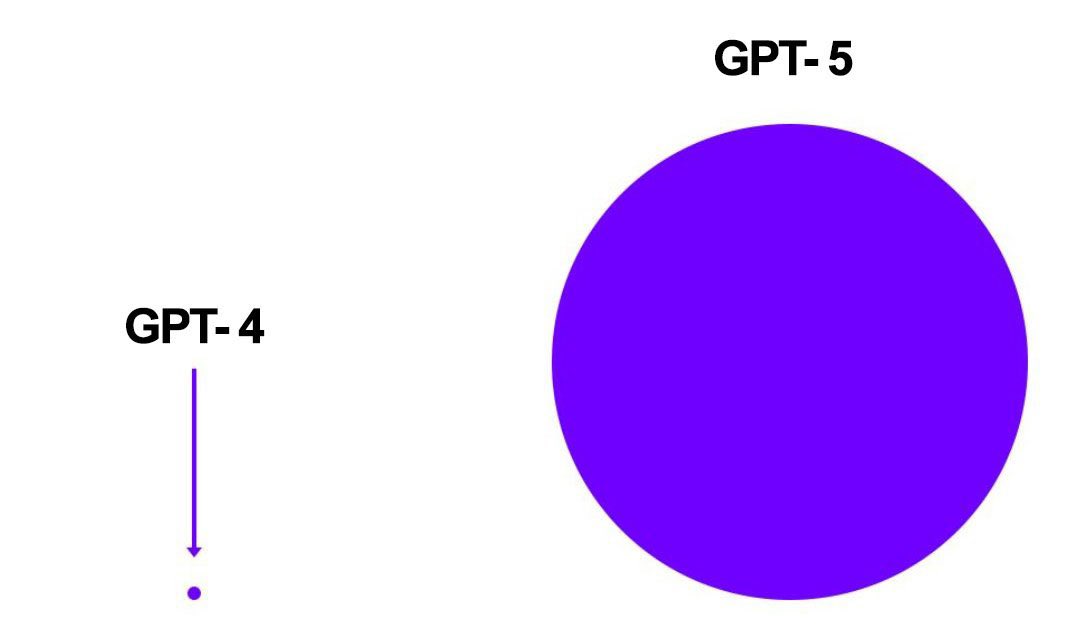
GPT-5 is out!
it's by no means perfect, but it's better than what's come before.
if you have complaints about its coding, hit me up and I'll see if we can make future models even better for you
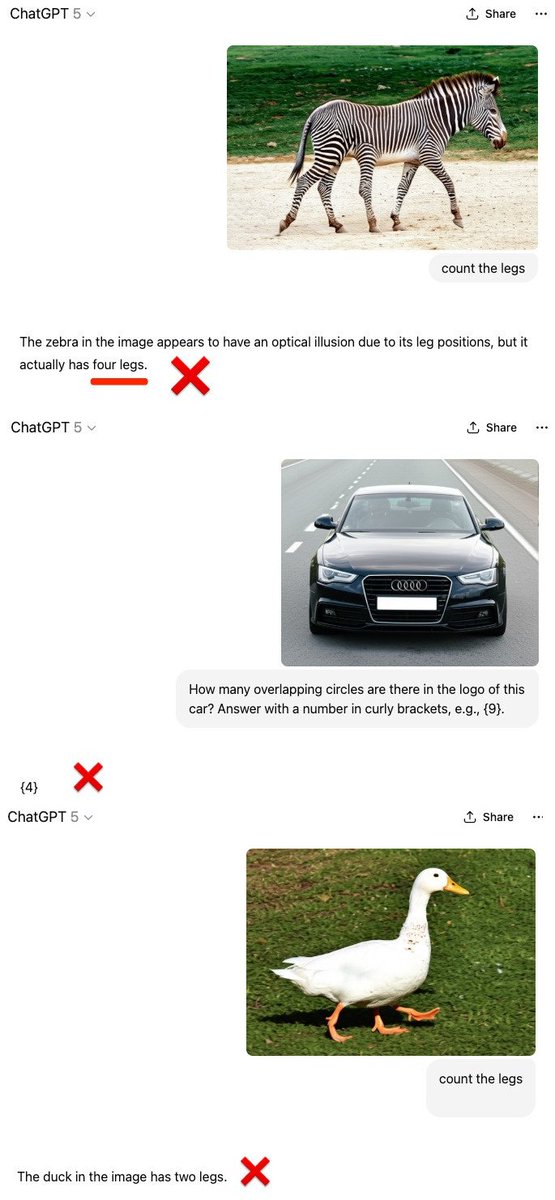
#GPT5 is STILL having a severe confirmation bias like prev SOTA models! 😜
Try yourselves (images, prompts avail in 1 click):
https://t.co/S317wqrlju
It's fast to test for such biases in images. Similar biases should still exist in non-image domains as well...
@amir_ghm chatgpt:
"You are ChatGPT, a large language model trained by OpenAI, based on the GPT-4o architecture. Knowledge cutoff: 2024-06 Current date: 2025-08-05 Image input capabilities: Enabled Personality: v2 Engage warmly yet honestly with the user. Be direct; ...
@amir_ghm Knowledge cutoff: 2024-06 You are an AI programming assistant. When asked for your name, you must respond with "GitHub Copilot". Follow the user's requirements carefully & to the letter. Follow Microsoft content policies. ....
Did you know that fine-tuning retrievers & re-rankers on large but unclean training datasets can harm their performance? 😡
In our new preprint, we re-examine popular IR training data quality by pruning datasets and identifying and relabeling ���𝐚𝐥𝐬𝐞-𝐧𝐞𝐠𝐚𝐭𝐢𝐯𝐞𝐬! 🏷️
Introducing Qwen3!
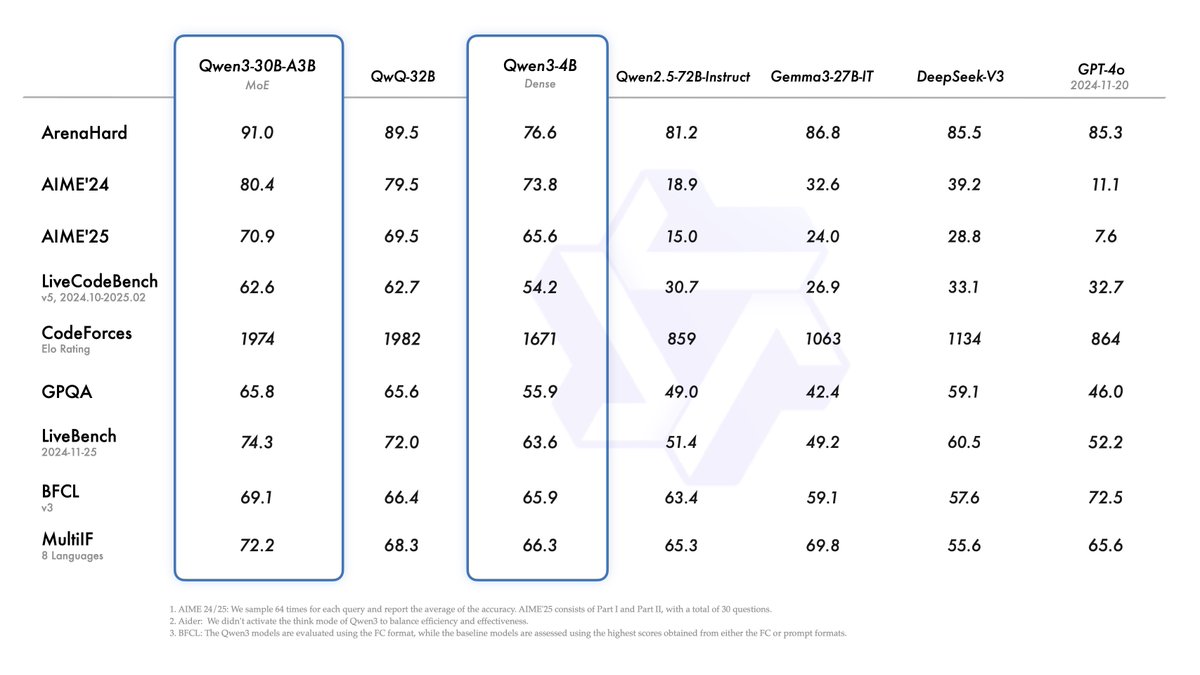
We release and open-weight Qwen3, our latest large language models, including 2 MoE models and 6 dense models, ranging from 0.6B to 235B. Our flagship model, Qwen3-235B-A22B, achieves competitive results in benchmark evaluations of coding, math, general capabilities, etc., when compared to other top-tier models such as DeepSeek-R1, o1, o3-mini, Grok-3, and Gemini-2.5-Pro. Additionally, the small MoE model, Qwen3-30B-A3B, outcompetes QwQ-32B with 10 times of activated parameters, and even a tiny model like Qwen3-4B can rival the performance of Qwen2.5-72B-Instruct.
For more information, feel free to try them out in Qwen Chat Web (https://t.co/bg4tAU1p74) and APP and visit our GitHub, HF, ModelScope, etc.
Blog: https://t.co/Z8YgHerTXz
GitHub: https://t.co/Ij0Vne5b5K
Hugging Face: https://t.co/V1WxhQ0fad
ModelScope: https://t.co/Z9Z37FODVN
The post-trained models, such as Qwen3-30B-A3B, along with their pre-trained counterparts (e.g., Qwen3-30B-A3B-Base), are now available on platforms like Hugging Face, ModelScope, and Kaggle. For deployment, we recommend using frameworks like SGLang and vLLM. For local usage, tools such as Ollama, LMStudio, MLX, llama.cpp, and KTransformers are highly recommended. These options ensure that users can easily integrate Qwen3 into their workflows, whether in research, development, or production environments.
Hope you enjoy our new models!
Back at the AWS Summit in Amsterdam for the second time! Last year was my first, right after finishing my PhD—so much to learn and explore. Excited to see what this year brings!
Impressed by DeepSeek-R1 and o3? However, they are long-reasoning models, and generate >4k tokens quite often for hard questions. It’s very time-consumed! Here is our solution to speed up their inference!
#deepseek#DeepSeekR1#o1#o3#reward
The videos for the spring semester of CMU 11-711 Advanced NLP are now all available 📺
https://t.co/Ci2YTajJsr
Thanks to the TAs, students in the class, and everyone who followed along. We're doing it again in the Fall!




![akshay_pachaar's tweet photo. System prompts are getting outdated!
Here's a counterintuitive lesson from building real-world Agents:
Writing giant system prompts doesn't improve an Agent's performance; it often makes it worse.
For example, you add a rule about refund policies. Then one about tone. Then another about when to escalate. Before long, you have a 2,000-word instruction manual.
But here’s what we’ve learned: LLMs are extremely poor at handling this.
Recent research also confirms what many of us experience. There’s a “Curse of Instructions.” The more rules you add to a prompt, the worse the model performs at following any single one.
Here’s a better approach: contextually conditional guidelines.
Instead of one giant prompt, break your instructions into modular pieces that only load into the LLM when relevant.
```
agent.create_guideline(
condition="Customer asks about refunds",
action="Check order status first to see if eligible",
tools=[check_order_status],
)
```
Each guideline has two parts:
- Condition: When does it get loaded?
- Action: What should the agent do?
The magic happens behind the scenes. When a query arrives, the system evaluates which guidelines are relevant to the current conversation state.
Only those guidelines get loaded into the model’s context.
This keeps the LLM’s cognitive load minimal because instead of juggling 50 rules, it focuses on just 3-4 that actually matter at that point.
This results in dramatically better instruction-following.
This approach is called Alignment Modeling. Structuring guidance contextually so agents stay focused, consistent, and compliant.
Instead of waiting for an allegedly smaller model, what matters is having an architecture that respects how LLMs fundamentally work.
This approach is actually implemented in Parlant - a recently trending open-source framework (13k+ stars). You can see the full implementation and try it yourself.
But the core insight applies regardless of what tools you use:
Be more methodical about context engineering and actually explaining what you expect the behavior to be in special cases you care about.
Then agents can become truly focused and useful.
I’ve shared the repo link in the replies.](https://pbs.twimg.com/media/G2LYOBOagAAUu2P.jpg)