Honored to earn my PhD in Sport Sciences from @UMU with Cum Laude distinction and eligibility for the Extraordinary Award. Thanks to my advisor, co-authors & tribunal.@UCAM@unizar
Take a little time to check out this #ShortReport#ArticleinPress from @uw_medicine, The other half of the sprinting coin: The neuromuscular profile of a 91-year-old female #world-record sprinter (Marta Colosio et al.):
https://t.co/wdZbWSKa6U
The aerobic vs anaerobic model is not wrong because it’s simple. It’s wrong because it implies a switch where there is only a continuum.
Glycolysis is always active. Lactate is always produced and cleared. Mitochondria are always involved. There is no moment where the body “switches” from one system to another. What changes is the balance between glycolytic flux and mitochondrial capacity and lactate is the best real-time proxy of that balance.
I proposed in 2013 a model based on substrate utilization. Now I propose an update of that model built around four metabolic states. From metabolic equilibrium at Zone 2 all the way to metabolic overload, where the central question is not what fuel you’re burning, but whether the system can sustain balance.
Ultimately, the ceiling of equilibrium matters more than the ceiling of oxygen consumption.
👇
https://t.co/CWkZyRohzT
Tengo cáncer de mama metastásico con un subtipo raro.
La OMS lo reconoce desde 2019.
Las guías españolas todavía no.
Y esto marca la diferencia en cómo me tratan 👇
Me llamo Miriam, tengo 35 años y mi tumor tiene una particularidad importante: el 80% de las células expresan marcadores neuroendocrinos (Cg 80% / Syn 80%).
Esto lo convierte en un BC-NED, una categoría reconocida por la OMS desde 2019 que las guías nacionales todavía tratan como “cáncer de mama hormonal estándar”.
No lo es. Y es un problema de guías, no de clínicos.
Tras 25 meses de terapia endocrina + CDK4/6i en dos líneas, mi último perfil molecular muestra:
🧬 3 mutaciones distintas en RB1 emergentes en ctDNA (Guardant360, abril 2026)
🧬 ESR1 D538G subclonal en biopsia líquida (VHIO36, 7 días antes)
🧬 CCND1 ×20 + FGFR1 ×13 amplificados (eje 11q13)
🧬 Progresión exclusivamente ósea multifocal con actividad metabólica creciente en PET
Es un perfil híbrido luminal + neuroendocrino con múltiples drivers de resistencia activos a la vez.
El gap estructural: las guías nacionales (SEOM en España y equivalentes en otros países) clasifican mi tumor bajo el algoritmo HR+/HER2-, sin algoritmo específico para BC-NED.
Las guías internacionales (NCCN Neuroendocrine Tumors 2025 y ENETS Consensus 2023) sí reconocen el BC-NED como entidad distinta con eje terapéutico propio, incluyendo valoración de SSTR2 y PRRT (177Lu-DOTATATE).
Misma paciente. Misma biología. Dos hojas de ruta distintas según el marco aplicado.
Los oncólogos que me atienden hacen su trabajo correctamente dentro del marco que tienen. El problema es el marco, no las personas.
Cuando las entidades raras se meten en algoritmos genéricos, la biología se aplana y los ejes terapéuticos accesibles se pierden.
Si trabajas en BC-NED, pérdida de RB1, SSTR2/PRRT, cáncer de mama ESR1-mutado en premenopáusicas, resistencia por FGFR1 amplificado, o integración de guías entre mama y neuroendocrinos escríbeme DM.
Si mi caso ayuda a impulsar actualizaciones de guías que beneficien a otras pacientes con subtipos raros, este post merece la pena.
📂 Caso completo en: https://t.co/mcFTTsZ3S5
Muy orgullosos de compartir nuestro nuevo trabajo científico junto a Hospital Clínico Universitario Virgen de la Arrixaca y Fundación Never Surrender.
Un proyecto que refuerza el valor de la colaboración.
DOI: 10.1186/s12885-026-15902-w
https://t.co/4xIOP34bWy
#Oncología
New position stand from the @ACSMNews on resistance training. GENERAL guidelines:
✔️Works in all people
✔️All forms (circuits, bands, home-based, etc.) work
☑️2x/wk min is likely best
☑️Large range of motion
☑️2-3 sets per exercise
☑️Effort
Most other variables matter less.
“As exercise intensity increases, ATP demand rises sharply and glycolytic flux accelerates. At some point, mitochondria cannot oxidize pyruvate fast enough to match the rate at which it is being produced.
The system requires a solution. That solution is the reduction of pyruvate to lactate, which regenerates NAD⁺ and allows glycolysis to continue.
Lactate production is not a failure of the system. It is its solution to a fundamental redox constraint, the mechanism that sustains ATP production when glycolytic flux exceeds mitochondrial processing capacity. In addition, lactate carries with it a proton from the cytosol, contributing to a temporary buffering of intracellular acidity”.
https://t.co/CWkZyRnJKl
What it takes to fuel a sub2h marathon record?
115 CHO g/h!!! Wow!!
This is insane. Congratulations to all Maurten team (specially Tobias & Olof)!
Great job, this is real history made!
Blood flow restriction induces similar peripheral stress but greater central drive impairments than systemic hypoxia during repeated cycling sprints
https://t.co/6o3JWB9YY9
Resistance-only and concurrent exercise induce similar myofibrillar protein synthesis rates and associated molecular responses in moderately active men before and after training
https://t.co/gIEtK41Fan
Cancer is not a genetic disease and it is not a metabolic disease either.
100 years after Warburg and 50 years after Watson and Crick, the field is still arguing about the wrong question and missing the molecule that ties both sides together: lactate
New piece on my substack today👇
https://t.co/Q3u8A6F6q1
🚨After years of work along with major funding and institutional challenges, I am proud to share this new study showing how tumor metabolism, through lactate, actively shapes immune escape.
CONTEXT
PD-1/PD-L1 blockade, such as pembrolizumab, dominates current immunotherapy. However, its efficacy in most solid tumors remains limited, and the mechanisms underlying resistance remain poorly understood.
OUR STUDY
Using breast and lung cancer cell lines, we show that chronic lactate-producing metabolic states, rather than acute glucose exposure, drive tumor-lineage–dependent immune checkpoint gene expression. Tumors do not rely on PD-L1 alone. Instead, multiple immune checkpoints including CD80, CD73, VISTA, LGALS9 (Galectin-9), CD47, and PVR are coordinately remodeled in lactate-rich environments.
By experimentally separating lactate availability from lactate production using an extracellular lactate clamp, we demonstrate that lactate-conditioned immune features persist even when endogenous glycolysis is suppressed.
WHY THIS MATTERS
These findings indicate that immune escape is multi-checkpoint and metabolically conditioned through lactate, helping explain the limited success of single-checkpoint therapies. Our study highlights tumor metabolism as an upstream regulator of immune resistance and underscores the need to target lactate production and exchange, both within and between cells, alongside immune checkpoints beyond PD-L1.
(This one´s for you Dad🙏 🕊️)
https://t.co/0uvCGoiDKm
#CancerImmunology #Immunometabolism #TumorMetabolism #ImmuneEscape #Lactate
Here, the addition of three weekly heat training sessions to a training camp at moderate natural altitude (<2000 meters above sea level) resulted in a greater increase in haemoglobin mass compared with traditional training at moderate altitude or sea-level in well-trained endurance athletes.
NEW PAPER now online
@HenryJMartyn led on this one showing that ketone monoester ingestion during prolonged cycling reduces oxidation of ingested carbohydrates
Please to be involved in this work with
@JamesyMorton and others
Link: https://t.co/5Fgs8bvTNZ
@japplphysiol
Are you overloaded, at equilibrium or are you a drifter?
Not asking about your mental health but about your metabolic training.
I like to be at metabolic equilibrium but here and there, I like to be a drifter and I also love to be overloaded 😉
Please check out this new metabolic model to understand exercise metabolism and training that I propose.
From 2013 to 2026, I just updated my “metabolic map”
👇
https://t.co/CWkZyRnJKl
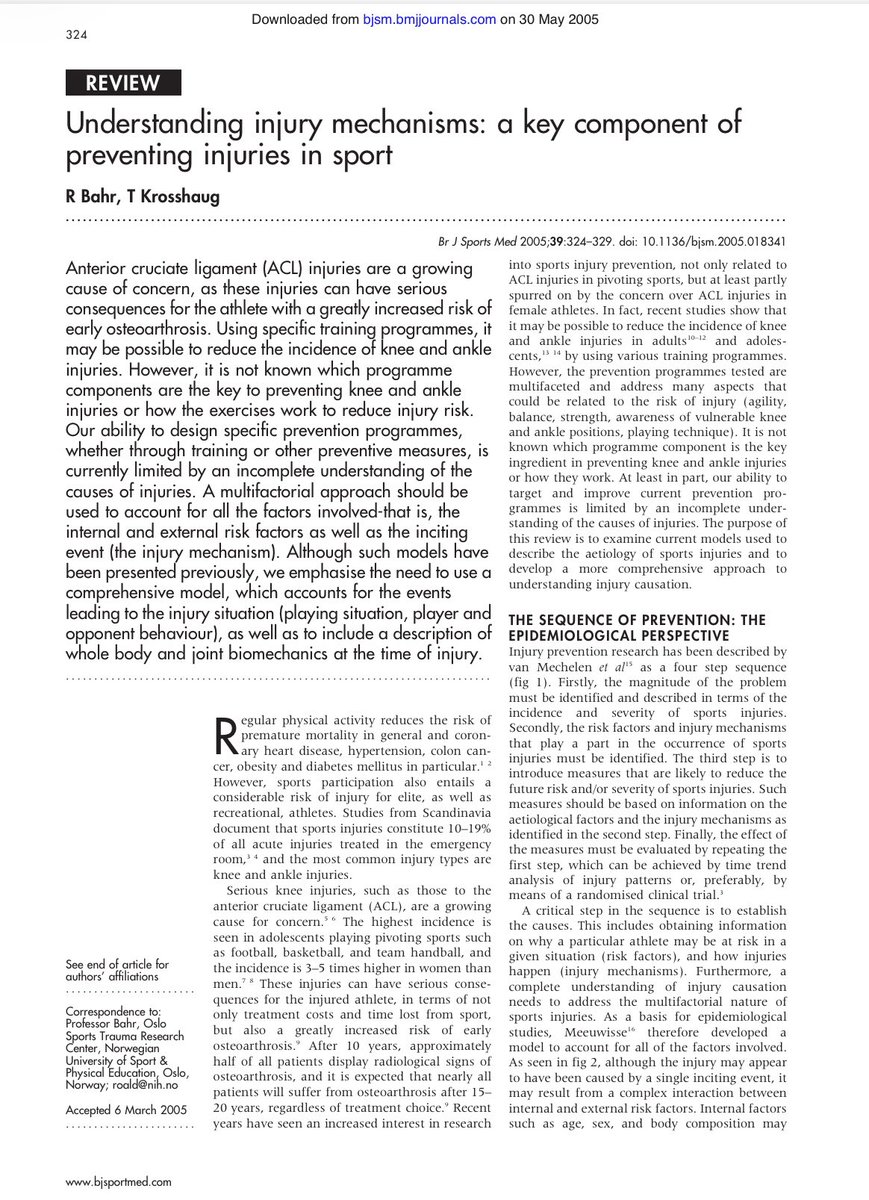
“Injury prevention” became a buzzword in sport for a long time. Too often it got reduced to corrective exercise menus, movement screens, and product driven claims that a test or tool could “prevent” injury. But Bahr and Krosshaug remind us that this is not what injury prevention actually is. They argue that our ability to design effective prevention strategies is limited when we do not first understand the cause of injury and the mechanism by which it occurs.
Their framework is simple, but important. The chart shows that injury prevention is not step 1. It comes after you define the injury problem and identify the aetiology and mechanisms. Only then do you introduce a preventive measure, and only then do you judge whether it worked by reassessing injury incidence and severity. In other words, prevention is not guesswork, and it is not branding. It is a process grounded in mechanism.
What the figure makes clear:
• First define the injury problem by incidence and severity
• Then establish the aetiology and mechanisms of injury
• Then introduce a targeted preventive measure
• Then test whether it actually changed outcomes by repeating step 1
Bahr and Krosshaug push this further by arguing that injury mechanism is not just a tissue level explanation. A complete model has to account for internal risk factors, external risk factors, the playing situation, athlete and opponent behavior, and the relevant biomechanical features at the whole body and joint level. That is the real challenge. Injury prevention cannot be taken seriously without a clear understanding of the mechanistic pathway of sport injury.
Conclusion:
Carbohydrate feeding during exercise is not merely nutritional support—it is a well-substantiated ergogenic strategy grounded in high-level evidence.
Carbohydrate ingestion during exercise: does it truly enhance performance? 🧪📊
A recent umbrella review (15 systematic reviews, 262 RCTs) provides one of the most comprehensive evaluations to date.
Key findings below ⬇️