My third paper from PhD is online at @EurJSportSci!
I would like to thank my coauthors, Dr Hugo Pereira and Dr Lia Bittencourt, from @UofOklahoma and @unifesp, respectively.
Special thanks to my supervisor @BrunoMSilva8!
https://t.co/tkiqrARqjX
Consistent with the broader body of research, this study found that training with a moderate proximity to failure (20% velocity loss) produced the greatest strength gains, whereas training closer to failure (40% velocity loss) elicited the largest increases in muscle size.
Take-home message: Proximity to failure appears to be goal-dependent. Training closer to failure becomes increasingly important when the primary objective is maximizing hypertrophy, whereas strength development may be optimized by stopping sets somewhat further from failure.
https://t.co/v7OmQSlFO3
Much Ado About Zone 2 https://t.co/FEguHuVt7b
Influencers can’t get enough of Zone 2 training. So why did @gibalam publish a research paper challenging Zone 2 for the general public? In this episode, we go through a critical examination of Zone 2.
https://t.co/K9DWIYUh4S
Physiological and subjective measures of exercise intensity cycling at 55% and 85% of functional threshold power: Findings from a randomised crossover trial
https://t.co/9dRCFpxaoN
A new study reports that focusing attention on the deltoids during the shoulder press increases deltoid muscle activity, whereas focusing on the triceps increases triceps activity. These findings are consistent with the broader body of research and lend support to the bodybuilding concept of using a "mind-muscle connection" during training for muscular development.
To date, my lab has conducted the only longitudinal study to directly examine whether this strategy influences muscle growth (PMID: 29533715). Participants performed arm curls and leg extensions with moderate loads (8–12 RM). One group used an internal focus by consciously contracting the target muscle on each repetition (i.e., "squeeze the muscle"), while the other group used an external focus (i.e., "move the weight").
The results were mixed: participants using a mind-muscle connection experienced greater hypertrophy of the biceps, whereas quadriceps growth was similar between groups.
Because several participants reported that they could visualize and focus on their biceps more effectively than their quadriceps, we speculated that the effectiveness of the strategy may depend, at least in part, on one's ability to direct attention to the target muscle. More research is needed before drawing definitive conclusions.
From a practical standpoint, it would appear that those seeking maximal hypertrophy should consider adopting a mind-muscle connection when using moderate loads: it may enhance adaptations and there doesn't seem to be a downside to the approach.
https://t.co/NqP3eqKNUd
Can you “think” a muscle into working harder?
In untrained adults, focusing on the deltoids during machine shoulder press increased deltoid EMG, while focusing on triceps increased triceps EMG. Useful cue—not magic
Long-term hypertrophy data still needed
https://t.co/tM6FSPXorn
What truly limits endurance performance: the brain, the muscles, or both?
Dr. Marius and Dr. Paul discuss how muscular function, fatigue, and central regulation shape performance.
Full episode: https://t.co/2eG11aX5Cl
@ProfTimNoakes@LoreofRunning1@PaulBLaursen@Athletica_AI
At Zone 2, mitochondria are at metabolic equilibrium and at the highest operating capacity. This is why it is a challenging intensity for well-trained athletes (it must be).
Lactate is being produced at a meaningful rate as glycolytic rate is moderate, but the mitochondrial lactate oxidation complex (mLOC) is clearing it at the same rate, converting it back to pyruvate and feeding it directly into oxidative phosphorylation. The lactate shuttle, both within and between cells and tissues, is running at full capacity.
Fat oxidation is at its peak. The NAD⁺/NADH ratio is stable, reflecting a healthy redox environment in which glycolysis and mitochondrial processing remain tightly coupled. The system is maximally stimulated while still in balance.
This is precisely why Zone 2 is probably one of the most powerful sustained training stimulus for mitochondrial adaptation. Mitochondrial biogenesis requires that the organelle be pushed close to its capacity. Zone 2 does that, while keeping the internal environment stable enough that the stimulus can be sustained for a prolonged period and recovered from it efficiently.
-And with all this said, high intensity training is absolutely key for performance.
https://t.co/CWkZyRnJKl
Muscles don’t need “confusion.” They need progression.
In trained men, 8 weeks of fixed exercises produced similar/slightly better strength & muscle-thickness gains than random exercise variation.
Keep core lifts stable. Progress load, reps 📈
https://t.co/xjkFRCOiCU
Opportunities for a fully funded PhD in Sport and Exercise Sciences at the University of Bologna. Deadline Jun 15 2026. More info here: https://t.co/W7X1hpHk6S
Cluster sets is an effective strategy for power and hypertrophy💪
Short intra-set rest periods help maintain power output, movement quality, and technique while reducing fatigue accumulation.
https://t.co/b3Le9hw5xg
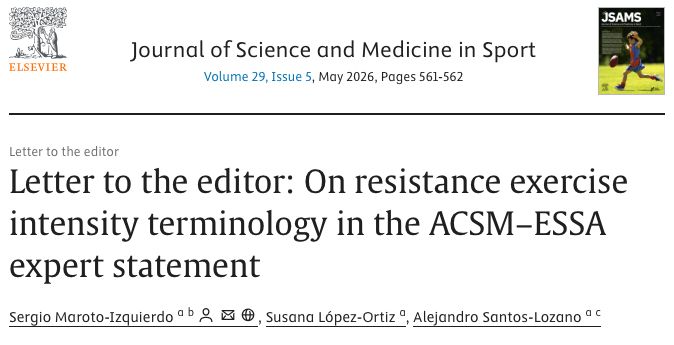
Pleased to see that our joint ESSA & ACSM expert statement on “Physical Activity and Exercise Intensity Terminology” https://t.co/65KQB1wwww & https://t.co/GdGPD7SR8F received some thoughtful feedback from the research community https://t.co/xNaHlhtUAJ https://t.co/EdryOU1DRk
Caffeine enhances soleus motoneuron output and preserves torque during repetitive wide-pulse high-frequency stimulation | Journal of Neurophysiology | American Physiological Society https://t.co/YqNHp4jxdI
The neuromechanical delay of the vastii muscles lengthens during a voluntary isometric contraction to exhaustion | Journal of Applied Physiology | American Physiological Society https://t.co/4FowsFU3bF
Cross-education of unilateral resistance training as a strategy to mitigate immobilisation-induced neuromuscular decline: A systematic review and meta-analysis | Journal of Applied Physiology | American Physiological Society https://t.co/jaxwwfxM1w
Our meta-analysis, led by @ExerciseBiology, compared power training (performing the concentric phase explosively with a controlled eccentric action) vs traditional strength training tempos in adults aged 60 years and older. Results indicated that power training produced a modest but potentially meaningful improvement in physical function compared with traditional strength training (SMD = 0.30).
Improvements were observed in tasks related to mobility and daily living, such as chair rises, stair climbing, and walking performance. Power training also appeared to improve self-reported physical function, although the certainty of evidence for this outcome was low. The implications are particularly important for older adults because muscle power declines more rapidly with aging and is more strongly associated with functional independence than maximal strength alone.
From a practical standpoint, the results suggest a benefit to dedicating at least a portion of a resistance training program to power-type training.
https://t.co/PFh9lmhqv8
The increase in time to task failure following endurance training is associated with adjustments in motor unit firing properties | Journal of Applied Physiology | American Physiological Society https://t.co/5ISjuPtjIJ