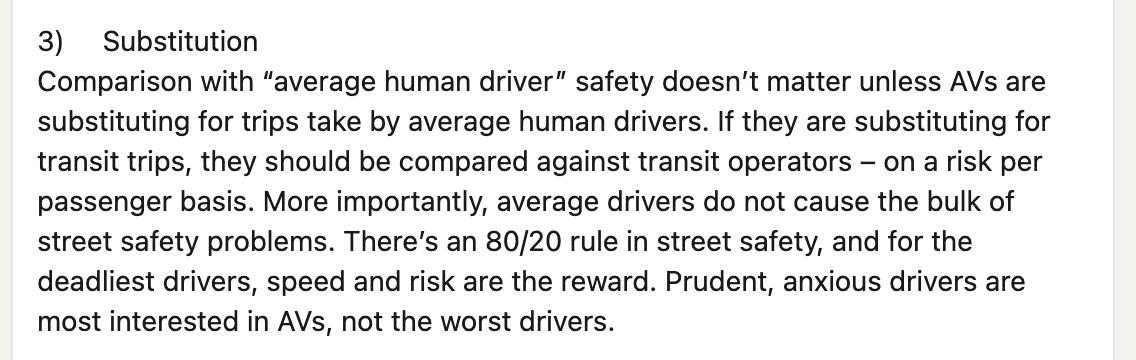
The anti-AV crowd has adopted a new argument that AVs won't take the worst drivers off the roads – and therefore won't meaningfully reduce injuries or deaths.
Zero-sum zipperites focus so much on banning AVs that they forget to think about the people inside of them.
A 60mph+ reckless wrong-way driver on a 40mph road can easily lead to severe collisions. Two different Waymos (and an attentive human ahead!) avoided tragedy in Phoenix the other week by taking evasive action.
@binarybits@mattyglesias@Scott_Wiener imagine all the punny names the hot dog vendors invent for these
relish the victory
dachshund delights
low rider links
place your brat
photo finish franks
wiener takes all
DC's buildout of bike lanes and the growth of Capital Bikeshare has been a phenomenal quality of life improvement over the past decade.
PBLs + Capital @Bikeshare ebikes = fast, safe, convenient, and happier trips around the city.
A few facts about bikes and DC:
🚲+60 new miles of bike lanes since 2015
🚲123 total miles of bike lanes, 35% are protected
🚲2nd graders learn how to ride a bike in DCPS
🚲Nearly doubled the # of Capital Bikeshare stations over the past decade
Happy World Bicycle Day, DC!
@Boenau My thoughts exactly. Moderating overall speeds, and modeling more respectful driving behavior, will pay even more dividends as people feel safer biking and walking
I think one of the early wins for the traveling public will be having just enough AVs in the mix to function as pace cars. That type of speed management alone will reduce crashes and save lives.
COUCH SURFING: A group of five friends in San Francisco were captured traveling around city streets sitting on a couch set atop two scooters late on Saturday, May 23.
The group sitting on the lounge, made it through an intersection, with onlookers cheering their safe passage as two of the occupants steered them through the stoplight.
For the latest in Bay Area news, weather and sports: https://t.co/tQ7EBe3cCN
Not to mention that the data from Waymo's 170m driverless miles show their AVs already significantly reduce crashes and resulting injuries when compared to human drivers.
At @IFP, we’ve spent the past 3 years thinking about all the different ways the US government & philanthropy fund R&D.
Until now, R&D funders haven’t had a systematic way to match the innovation problem to the right funding tool.
We built THE ATLAS OF INNOVATION to fill that gap.
https://t.co/XZshJ7pr1f
Alongside @UChi_MSA, we’ve boiled down thousands of hours of research into a handful of questions covering how much the R&D funder knows about:
- the problem they want to solve
- the solution it should have
- the team that should build the solution
Why the Atlas matters:
The US government spends close to $200 billion every year on R&D. And after the Anthropic and OpenAI IPOs, there will be hundreds of billions of dollars in new philanthropic giving.
Choosing the correct funding approach to the social problems they’re trying to solve will mean the difference between success and failure.
For example, NSF research grants have helped seed breakthroughs from MRI machines to search engines, but grants aren’t built to deliver the kind of industrial speed and scale that a project like Operation Warp Speed required.
Picking the wrong funding approach can leave programs behind schedule, over budget, or without anything to show for all the money they spent.
How we built the Atlas:
1. We began by creating a matrix of dozens of considerations that a thoughtful policymaker or funder would ideally weigh before deciding how to fund a project.
2. We looked at every major funding approach, from grants to R&D tax credits to advance market commitments, analyzing when they work well and when they fail to meet the mission.
3. We spent months deep in the weeds of contract theory and incentive design, looking at historical examples and the state-of-the-art research in innovation economics.
4. We then worked to turn that research into a tool that time-strapped policymakers and philanthropic funders could rely on at the start of an innovation funding cycle.
5. Three years later, we are launching just that: a new (and visually stunning) website to help funders decide how to best incentivize innovation. And all they have to know… is what they currently know about their innovation goal! The Atlas takes care of the rest.
How to navigate the Atlas:
Answer questions about your goal to find the funding approach aligned with the information you have.
Each funding mechanism has its purpose for particular technologies and specific moments in development.
There shouldn’t be an ARPA for every field, just like we don’t need a prize or AMC for every innovation. The Atlas helps you navigate those tradeoffs.
How does this even happen⁉️😭
A woman somehow drove her car onto Seattle’s elevated light rail tracks at Mount Baker Station on Wednesday evening, bringing train service to a halt. 😳🚆
Witnesses say the driver told people she was “following GPS” after ending up on the tracks and driving a significant distance before getting stuck. The vehicle had to be removed from the guideway, causing major delays for riders across the 1 Line. #DUBSEA
The new NoMa Metro entrance on 3rd St facing toward Union Market would genuinely save people like 3 minutes of walking, which doesn’t sound like much but it’s a 33% expansion of the 10 minute walkshed and would include a lot of the biggest and newest developments in the area
To this end, Waymo's call-to-action notes says it "has mapped all of Washington, D.C.’s wards and autonomously driven hundreds of thousands of miles in the District" and "is already investing in local infrastructure and stable, good-paying jobs."
https://t.co/GdckEDOUaF
It's been a month since @CMCharlesAllen introduced his bill to bring AVs to DC – and DC Council hasn't moved forward at all.
At another hearing last week, CM Nadeau said an AV hearing is "months" away.
Local supporters of AVs are now writing to @councilofdc to move forward. 🧵
As Reverend Bowen said, "It's not only mobility: it's access to mobility – it's also access to dignity."
Ensuring AVs can reach and serve all 8 wards and provide a service for everyone – regardless of the color of their skin – will be a huge step forward for the District.