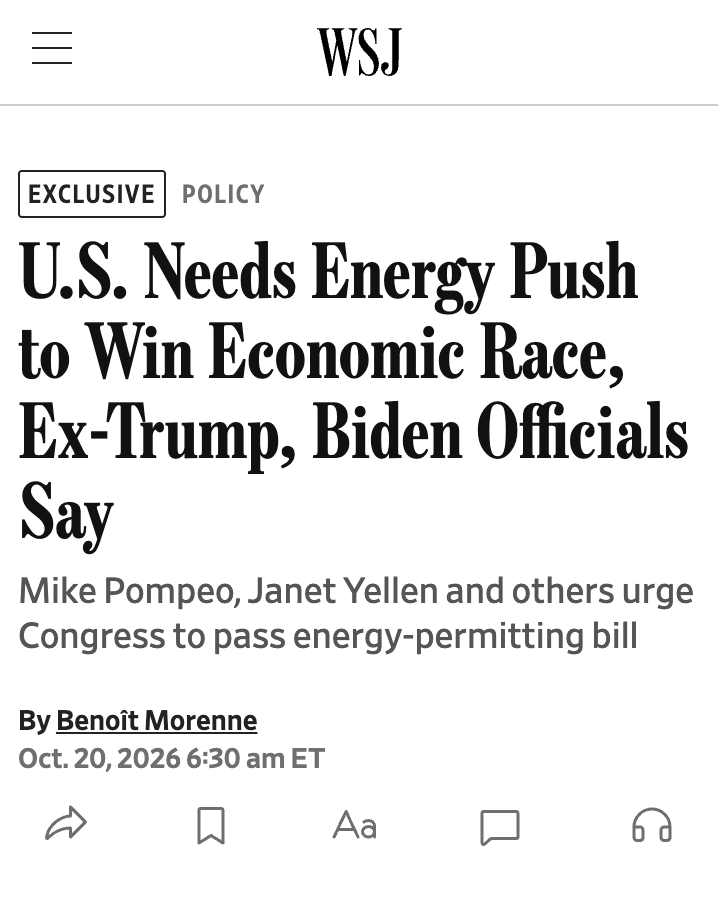
NEWS: 19 FORMER ECONOMIC AND NATIONAL SECURITY LEADERS ENDORSE THE BIPARTISAN PERMITTING REFORM BILL
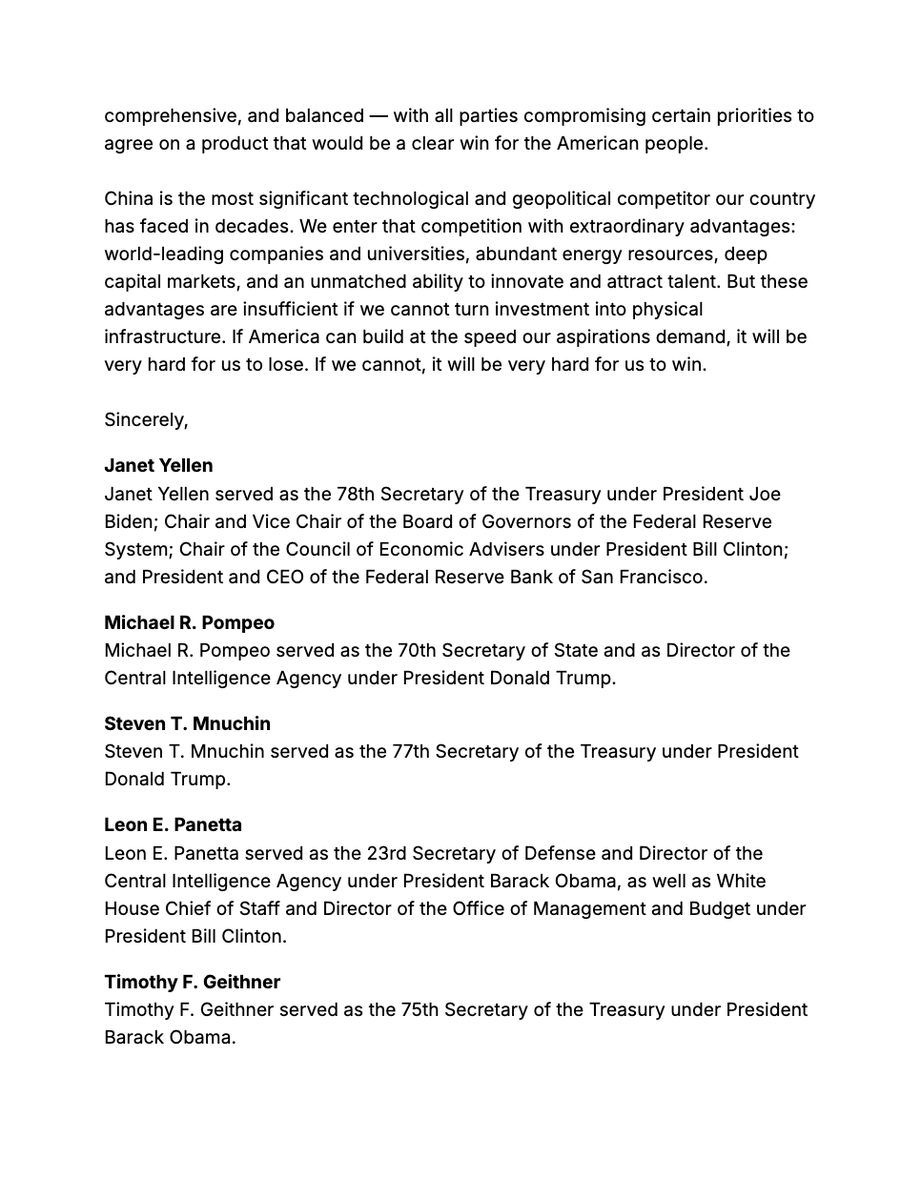
Today, a group of former Cabinet members and White House principals across seven Democratic and Republican administrations sent a letter calling on Congress to pass BAAJA. Here are the signatories:
Janet YELLEN, Michael R. POMPEO, Steven T. MNUCHIN, Leon E. PANETTA, Timothy F. GEITHNER, Henry M. PAULSON, Jr., Robert E. RUBIN, Stephen MIRAN, Jared BERNSTEIN, Tyler GOODSPEED, Jason FURMAN, Glenn HUBBARD, Laura D’Andrea TYSON, Michael J. BOSKIN, Jeffrey ZIENTS, Jake SULLIVAN, Brian DEESE, Larry KUDLOW, Allan B. HUBBARD
Key highlights from the letter:
1. “We are not building infrastructure fast enough to remain globally competitive… The median time for a new power plant to move from an interconnection request to commercial operation has more than doubled, from less than two years for projects built between 2000 and 2007 to more than four years for projects built between 2018 and 2024.
2. China has built more high-voltage transmission in the last fifteen years than the U.S. has built in all of its history... In 2024, China accounted for 31.5% of global knowledge- and technology-intensive manufacturing value added, compared with 20.7% for the United States.
3. Federally funded or permitted projects require NEPA review, but private projects often do not, creating a threat of failure precisely where the government is trying to be proactive, strategic, and engaged.
4. A project that spends years awaiting approval must continue carrying development and financing costs while remaining exposed to rising input costs. The IEA reports that prices for utility-scale transformers increased 26% in 2024, while lead times for some transformers have stretched as long as six years.
5. Mining projects also face tremendous uncertainty: a 2026 study by researchers at the Colorado School of Mines found that permitting for modern mining projects takes an average of 5.5 years, rising to 8.9 years for contested projects. The U.S. currently has the second-longest mine development timeline in the world.
6. The Bipartisan American Affordability and Jobs Act is the most significant bipartisan legislative effort that Congress has undertaken in decades to tackle these challenges.
7. BAAJA addresses key constraints stifling American industry by requiring interregional transmission planning, strengthening the federal backstop for nationally significant transmission lines, and creating a faster, more predictable process for connecting new generation to the grid.
8. BAAJA also makes permits more durable by imposing tighter timelines for litigation and limiting frivolous lawsuits that can halt projects indefinitely, while preserving community input and judicial review of substantive agency decisions.”
The letter was organized by @arnabdatta321 on behalf of @IFP and covered exclusively by the WSJ this morning.
I really think something like the IFP plan for equipping critical infrastructure to be ready for AI should be implemented urgently https://t.co/rNzMgBju0i
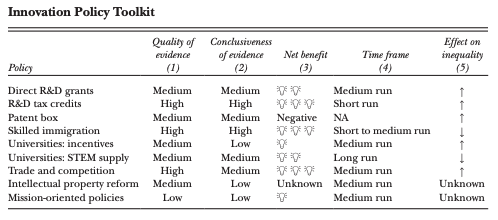
@johnvanreenen's Economics of Ideas, Science, and Innovation lecture helps us think about how policy designs influence things we care about in science: research conducted, people trained, intellectual property protected (or shared with the public).
The "lightbulb" table from John's paper with @heidilwilliams_ & @I_Am_NickBloom provides a quick way to think about the quality of evidence for different innovation policies and their net benefit.
Find John's lecture here (with intro text from @matthewesche): https://t.co/O6MjhAAW3n
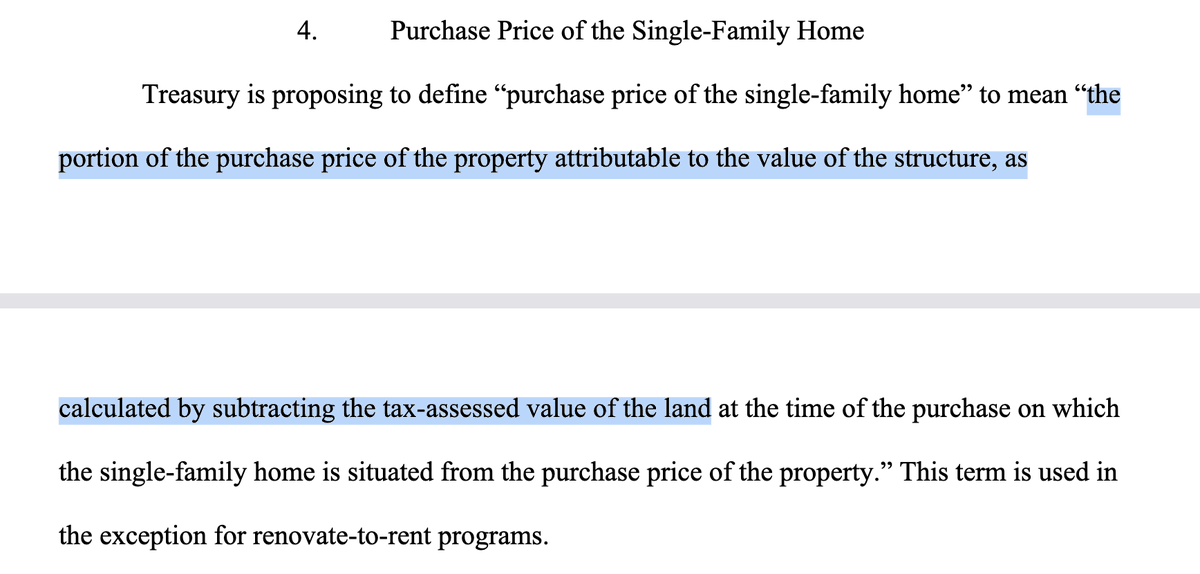
Treasury just put out an NPRM noting that it plans to use purchase price minus land values to assess structure improvements for ROAD implementation, solicits comments w/ fallbacks in case land values are not available:
Clean energy builders endorse BAAJA, saying it would:
-Significantly increase clean energy deployment to deliver affordable and reliable electricity to homes and businesses
-Double the transmission capacity to transfer electricity across the US--this is critical to get clean energy to where the sun isn't shining
But that's what the Certainty Title is for!
Goodwill is ideal and helpful for negotiation, but the certainty provisions themselves are why Democrats don’t need to trust Trump.
Here's how BAAJA enforceably stops future delay, revocations, and industry-wide abuse: 🧵👇
1. BAAJA sets timelines for agencies to take action on federal permits and authorizations.
- Why it's enforceable: (A) If the agency misses the deadline, mandatory interagency coordination starts and penalties kick in for permitting officials and agency leads. (B) project sponsors can sue and get courts to compel action on specific timelines (much faster than current law)
2. BAAJA disallows actions against issued permits — the only exceptions are narrow, specific circumstances (like demonstrated threats to national security or imminent harm)
- Why it's enforceable: If agencies issue illegal stop-work orders, sponsors can sue and courts must grant monetary damages (25-50% of money put into the project), overturn the illegal action, and *forbid* future gov action against the project unless the agency petitions the same judge
3. BAAJA bans Trump-style permitting blockades against classes of energy projects by making “disparate treatment” of projects in the federal permitting process illegal
- Why it's enforceable: Trump-level abuse (continued or new abuse) would allow a host of developers to sue and recover enormous monetary damages, which courts can toggle upward based on the level of abuse (50% of construction costs is the baseline, 100% is the ceiling). To keep the damages, developers are *required* to build the project they proposed
- The Trump admin (any future admins) would have a strong incentive to avoid disparate treatment because (1) they don't want to hand out $ billions to developers they dislike, and (2) getting the monetary damages *ensures* the proposed project they tried to block will get built (because the Dev will want to keep the damages)
It would be helpful to disambiguate these two claims, both true imo:
1. BAAJA treats new data much centers worse than other grid users, making them pay the full cost of the upgrades they trigger *and* a full share of the existing grid (and states can the elect to charge them even more on top). This redounds to the benefit of all other grid users.
2. BAAJA makes it easier to build about anything that needs a federal permit and/or new power, and data centers benefit from that the same way factories, housing, transit projects etc do.
So many critical vulnerabilities in ubiquitous packages are being exposed simultaneously. The temporal intensity/correlation of these risks is stunning. It presumably complicates some patching operations in the very near-term (like 2 weeks) and will make life feel like continuous hell for the next 8 months, as it undoubtedly has for security engineers since spring, but concentrated neuralgia has its benefits in the long run.
As @joshua_saxe says, initial access isn’t always the bottleneck for CNE actors (e.g., SIGDEV, target interactivity, access proximity to relevant information, encryption), but surely this period will result in much more opportunistic access operations than has historically been possible. We’ll need to routinize eradication or offensive CI conops to contain the damage of these operations.
It’s clear—The Bipartisan American Affordability and Jobs Act is backed by immense support!
We need permitting reform NOW to unleash American energy, lower costs for families, and protect our national security. Let’s get this bill passed!
Essential reading from anyone who cares about American technological leadership, industrial strength, and national security, from @fiiiiiist and the team at @IFP.
"As leaders who have served six presidents in economic policy and national security, we believe Congress has a generational opportunity to strengthen our nation’s industrial capacity in the face of unprecedented competition from China.
We call on Congress to pass the Bipartisan American Affordability and Jobs Act of 2026 and send it to President Trump’s desk."
-Janet YELLEN, Michael R. POMPEO, Steven T. MNUCHIN, Leon E. PANETTA, Timothy F. GEITHNER, Henry M. PAULSON, Jr., Robert E. RUBIN, Stephen MIRAN, Jared BERNSTEIN, Tyler GOODSPEED, Jason FURMAN, Glenn HUBBARD, Laura D’Andrea TYSON, Michael J. BOSKIN, Jeffrey ZIENTS, Jake SULLIVAN, Brian DEESE, Larry KUDLOW, Allan B. HUBBARD.
We think existing executive branch authorities could be used to double America's current AI lead over China by the end of 2027.
This decision could be made by a very small number of people:
- @howardlutnick could ~halve China's access to AI training compute, without reducing overall US AI chip sales
- Ferguson (FTC chair) + Woodward (oversees DOJ antitrust division) + McCotter (acting DOJ DAG) could provide legal protections for US companies to share threat intel and best practices to allow the US AI ecosystem to counter China's adversarial distillation
Permitting reform is about more than growing our economy and building new infrastructure.
Passing the Bipartisan American Affordability and Jobs Act will be key to protecting our national security and preserving American leadership around the globe.
https://t.co/CfWBVj9LCX
Many people are saying!
We have a once-in-a-generation opportunity to make it easier to build, grow, and power our country—and make life more affordable for American families in the process. Let’s get it done.
Permitting reform is critical to America's economic competitiveness and our national security. Proud to join this letter urging Congress to pass the Bipartisan American Affordability and Jobs Act, so that American industry can build the infrastructure needed to secure our prosperity and safety for years to come.
Impressive names from across the aisle & administrations, arguing that permitting reform is needed for national and economic security.
Included in here: a reminder that NEPA was waived for semiconductor fabs etc getting govt support, because Congress felt speed was important.
💯💯💯Yes, permitting reform IS a national security issue. If we can't build, we are beholden to adversaries for energy, materials, and tech.
The names are the headline here, but the rationale on everything from transmission to mining is worth policymaker attention.