Energy, deep tech, and geopolitics at Center on Global Energy Policy @ColumbiaUEnergy | Former Breakthrough Energy policy and strategy leader | Views my own
Seeing our @ColumbiaUEnergy analysis of the BAAJA bill quoted out of context in multiple places I am dismayed by what seems like a concerted effort to warp findings to whatever suits one's priors.
Example: it's not a pro data center bill but that's what's all over my feed.
When I asked about this, a @AFLCIO spokesperson tells me: "Any bill that receives a legislative alert from the AFL-CIO may be scored."
The group, the largest federation of labor unions in the U.S., has endorsed BAAJA
@JasonBordoff's piece sorts through the noise on the BAAJA bill in a way I think is very helpful for those who want an honest assessment of the state of play.
In my latest column @ForeignPolicy, I argue the House should pass the bipartisan permitting reform bill that cleared the Senate last week.
The current system makes it too difficult and costly to expand the grid, bring cleaner energy online, and lower energy costs. This bill offers an important opportunity to change that.
Too much of the debate has been dominated by overheated rhetoric from both sides, obscuring some of the bill’s benefits and also legitimate concerns about some of its provisions.
In the piece, I examine those concerns, how revisions have addressed some of them, and where risks remain.
Lawmakers should pursue opportunities to address credible objections as the legislative process moves forward. But regardless of how much of that remains possible at this late stage, the bill’s benefits outweigh the risks.
https://t.co/cbTLhybtTv
Enjoyed this article: "Taste, like language, is irreducibly social. It can never exist in some vacuum of pure interiority. What’s different now is that the internet has created a vast asymmetry between the internal and the external."
https://t.co/7pTeK8hhRK via @NYTimes
Whatever you think of BAAJA, it would be a real loss to see the updated Manager's Amendment not make it in to the version that will pass the Senate this evening because 1-2 senators are objecting to something the other 98-99 are fine with.
Changes in the new Manager's carry real benefits for Tribes, farmers, and telecom providers, and all sides are comfortable with them.
"It's a large shift away from how we've governed the grid to date, where the benefits of the grid are broadly shared and we socialize the costs," CGEP expert @RobinMillican tells @nytclimate reporter @bradplumer.
https://t.co/PwHlyfFLI4
"I do not expect, in every case, that that would lead to outcomes I like. But leaving the system unchanged is a guarantee of calamity. The status quo has left us completely unable to build the energy system we need."
Gift link: https://t.co/bAVs7jXZbK
@ezraklein in NYT today: "The bill represents Democrats and Republicans deciding that the fight over what gets built should play out in elections and markets rather than in... agencies and courts. It should be driven by what people want... rather than what they can block."
I was thrilled to re-join @drvolts on Volts this week to discuss the November 7 Managers' Amendment to the BAAJA permitting bill.
There was plenty to unpack, including the changes made, the evolving politics, and the potential path forward for the bill.
https://t.co/kKU7b3EWtV
Texas is at the center of the data center boom—but could a political shift change its trajectory?
🎧 In the latest episode of the AI, Energy & Climate Podcast, host David Sandalow talks with @UTAustin professor @MichaelEWebber about the state's data center buildout, what new leadership could mean for the industry, and the national implications.
Listen 👇
https://t.co/vzhTyffz6L
Voters sent a clear message last week that they are deeply concerned about affordability. The rising costs of healthcare, housing & energy are putting real pressure on families.
But affordability can't just be a campaign slogan; it must be a governing philosophy. There are two main ways to address high costs: subsidies and supply side reforms.
Subsidies have their place, but also serious problems, particularly in an environment of limited fiscal capacity with $2 tln annual deficits and the 10-year at 5%. More importantly, subsidies often treat the symptoms of high costs rather than their causes.
Supply side reforms address the underlying problem. They expand capacity and competition, reduce costs for all Americans and do so without adding to the national debt.
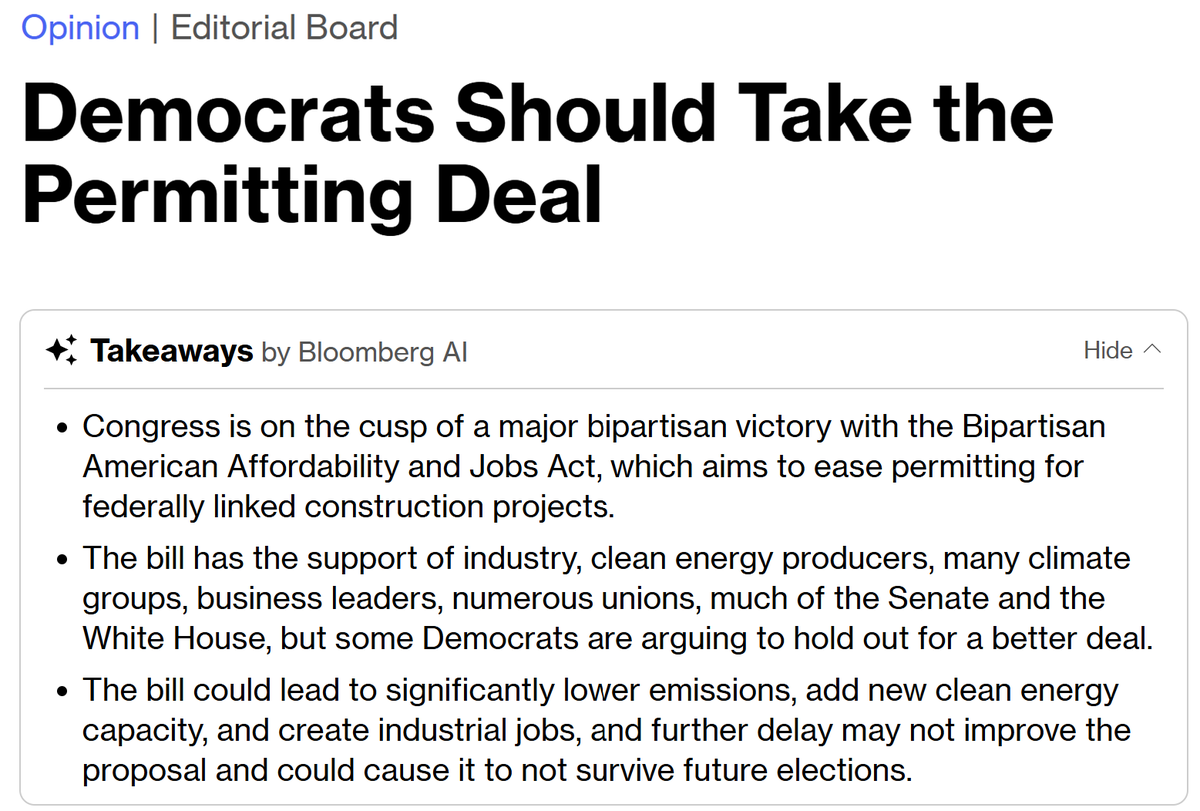
The Bipartisan American Affordability and Jobs Act is among the most important energy affordability bills this century. It helps the energy system deliver on multiple priorities by lowering costs, improving reliability, reducing emissions, creating jobs, strengthening energy independence, and supporting economic growth.
These goals transcend party lines. That's why two Democrats and two Republicans, representing very different states, ideologies and priorities, were able to negotiate a comprehensive bill that provides greater certainty for projects and streamlines environmental reviews while preserving the right to raise and adjudicate legitimate objections. It's also why the bill received 73 votes in the Senate yesterday, the first of several votes needed to make it law.
This bill is not perfect. No bill is. It includes some Republican priorities and some Democratic priorities. But mostly it includes American priorities that aren't partisan, like ensuring data centers pay 100% or more of their costs, establishing clear rules for responsible development, limiting executive authority to favor one energy source over another, and making better use of the infrastructure we've already built.
Politicians spent months telling voters they understood their concerns about affordability. Now they have a chance to prove it.
I’ll be speaking this Thursday at After the Ballots: What the 2026 Election Means for American Clean Energy, hosted by ACORE in NYC. I'll join a stacked lineup to unpack what the results mean for investors, developers, and innovators. Details below.
The revised BAAJA bill includes several very important changes that would avoid unintended outcomes in the permit certainty title that we at @ColumbiaUEnergy mentioned in our analysis. It's a good bill, now made stronger & hopefully we'll see it move forward.
NEW: the BAAJA managers' amendment is out. “I’ve worked hard to incorporate the feedback we’ve heard from Tribes and New Mexicans into this Substitute Amendment, and I’m proud to join my colleagues in releasing it," Heinrich says. 494 pages https://t.co/uvQXwrGzzj
Very smart people have been scrutinizing the language of BAAJA for weeks offering constructive edits and concerns with the bill. Kudos to the sponsoring senators for negotiating in good faith to adopt many improvements and clarifications to strengthen the bill.
BAAJA is a model for bipartisan lawmaking. It will lower costs, improve reliability, create jobs, and reduce emissions. After an election focused on affordability, it’s imperative that Congress show it can still be responsive to the needs of Americans.