The electricity affordability crisis is upon us. GOP will surely blame Democrats without self awareness that global trade wars and throttling supply (especially projects that are almost complete!) makes electricity more expensive not less.
The French hate air conditioning.
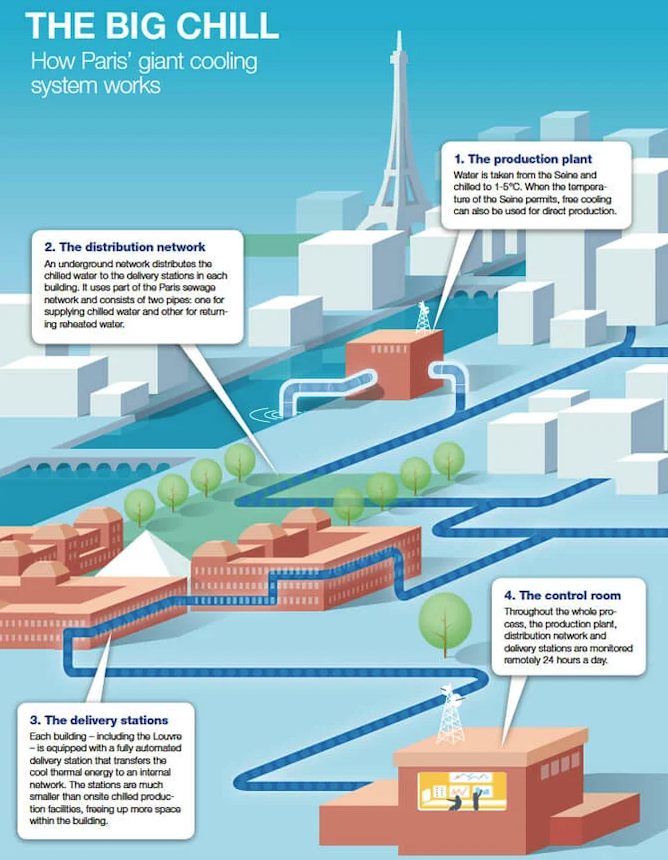
So Paris built a 120-kilometre machine under its streets for producing cold.
It’s called Fraîcheur de Paris, and it does for summer heat what district heating did for winter: centralise the problem.
Instead of every museum, office, hotel, hospital and shop bolting its own cooling plant onto the building, Paris moves cold through pipes.
The network sends water chilled to 2 to 4°C through buried supply lines. The water enters a connected building, absorbs heat through an exchange station, then returns at 12 to 14°C to be cooled again.
It essentially functions with two pipes. One carries the cold out, the other carries heat back.
The production plants cool the circuit from 12°C to 4°C. Some sites use the Seine as a heat sink. In colder periods, the system can use the river’s own temperature for free cooling, which means the machines work less and the electricity demand drops. The Seine water doesn’t become the building water. It stays separate, passing temperature across heat exchangers.
The scale is pretty strange when you see it written down though.
It's got 15 production sites, 4 storage sites, 120 km of underground network with 924 subscribers. This has resulted in 7 million square metres cooled, and 493 GWh of cooling sold.
A cold utility running beneath one of the densest cities in Europe.
The Forum des Halles has been cooled this way since 1979. The Louvre since 1986. Galeries Lafayette, Opéra Garnier, Hôtel de Ville, Station F, La Samaritaine and the National Assembly all sit on the same idea. Tourists stand in the Louvre looking at paintings while a municipal cold loop does part of the dull work below ground.
The boring part is the breakthrough.
Cold can be stored at night in chilled water or ice, then used during daytime peaks. The network is monitored from a control room with more than 125,000 control points. A delivery station inside a building takes 5 to 7 times less space than a standalone cooling installation and avoids the roof and façade clutter that turns cities into compressor farms.
That matters because conventional air conditioning solves heat by moving it somewhere nearby. In a dense city, thousands of private machines mean thousands of outdoor units rejecting heat into streets, courtyards and roofs, plus refrigerants, noise, vibration and maintenance spread across every building.
Paris’s public cooling network has a stated coefficient of performance of 4, against 3 for a wet standalone system and 2 for a dry standalone system. Against an equivalent set of autonomous installations, Fraîcheur de Paris says the network gives 100% higher energy efficiency, 35% less electricity use, 90% fewer refrigerant-fluid emissions and 50% lower CO2 emissions.
The climate backdrop is the real reason this exists.
Paris ran a full crisis exercise called “Paris at 50°C” in 2023. Météo-France’s 2050 reference trajectory for France points to heatwave days becoming five times more frequent, hot nights rising sharply in urban centres, and some local extremes around 48°C becoming possible.
The city signed a 20-year concession in 2022 with Fraîcheur de Paris, owned 85% by ENGIE and 15% by RATP. The contract is worth a projected €2.4 billion. The plan is to extend the network by 158 km by 2042, add 20 production plants and 10 storage sites, and reach more than 3,000 subscribers, including hospitals, nurseries, schools and care homes.
This is basically the infrastructure version of admitting that summer is becoming a public systems problem...
Check out this piece with @FToddDavidson on turbomachinery. Though first developed over a century ago, turbines continue to power our future.
https://t.co/LQg5fmOs8Z
The Sloan Foundation is hiring a Program Coordinator to support its Energy and Environment program. The role provides admin support for all grants related to the Energy and Environment program at the Foundation.
More details: https://t.co/1yV7CXuj8s
A forest has sprung up from what was once a frequently flooded wasteland in the middle of Austin.
On 13 acres along lower Waller Creek, workers with Waterloo Greenway have studiously planted some 1,600 trees and around 200,000 other native or adaptive species.
This new-old forest gathers in an area called the Confluence, a $91 million project named for the meeting of the creek and Lady Bird Lake.
https://t.co/KWAR0Vww7n
You might like my latest column in the @HoustonChron
"Gas prices are punishing summer drivers again. Here’s what not to do."
https://t.co/wQaHe9ggOj via @houstonchron
ERCOT low key sitting with the highest reserve margin of the major North American grids this summer according to NERC:
Given an Anticipated Reserve Margin of 67.9% and Reference Reserve Margin of 13.75%, ERCOT expects to have sufficient operating reserves...
https://t.co/xiYXOcreq8
Ten takes on the Iran war that are correct, and do not require sophisticated analysis:
1. It should be blindingly obvious that if the Strait stays closed longer, prices will go up and flows will be hindered (why keep publishing pieces that say this?).
2. When the Strait opens, under almost any conditions and for many years, there will be a security premium that adds cost to everything flowing through it. (Yes, consumers will ultimately pay that delta.)
3. There will be alternative infrastructure (pipelines) put in place at very high cost and at great haste.
4. This poorly-conceived war will permanently change the global landscape of trade for oil, but also LNG, sulfur, helium, fertilizer chemicals, etc.
5. US consumers will see continued inflation and high pump (and other) prices in the short to medium term.
6. Many other regions and countries will have to structurally change or realign their currencies and economies.
7. The regional relationships in the Middle East will be even more fraught and tenuous. Setting conditions for even more conflict and violence.
8. China has taken military lessons here, like they did from Ukraine.
9. US natural gas sector comes out a likely winner both domestically and for exports.
10. In other jurisdictions, either or both solar and coal demand strengthens.
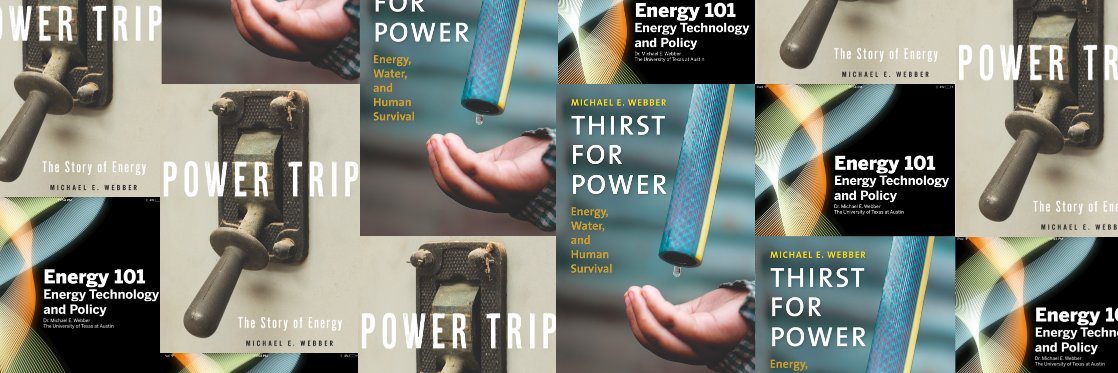
The relevance of the top 10 list of problems for humanity to solve as postulated by the late Nobel Laureate @RiceUniversity Rick Smalley is timeless and connections as highlighted by @MichaelEWebber should be the guiding principles for any world government. Energy is the #1.
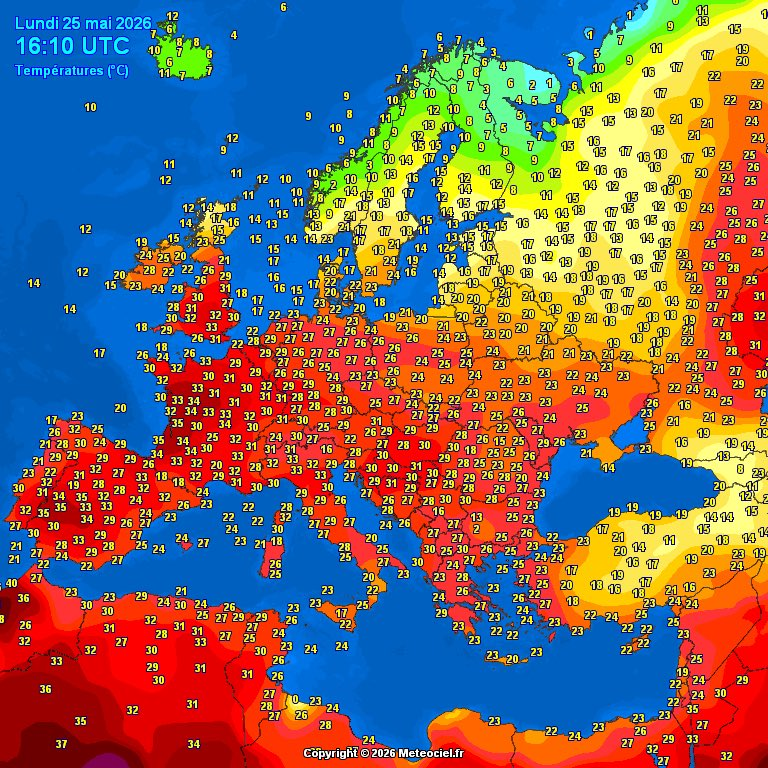
If you are a summer tourist, you dont have to go to Southern Europe. Denmark has just the right temperature. Sunlight for 17 hours a day, 7000 kilometers of great beaches, 400 small islands and short distances to a ton of historic and cultural attractions. Welcome 🇩🇰☀️
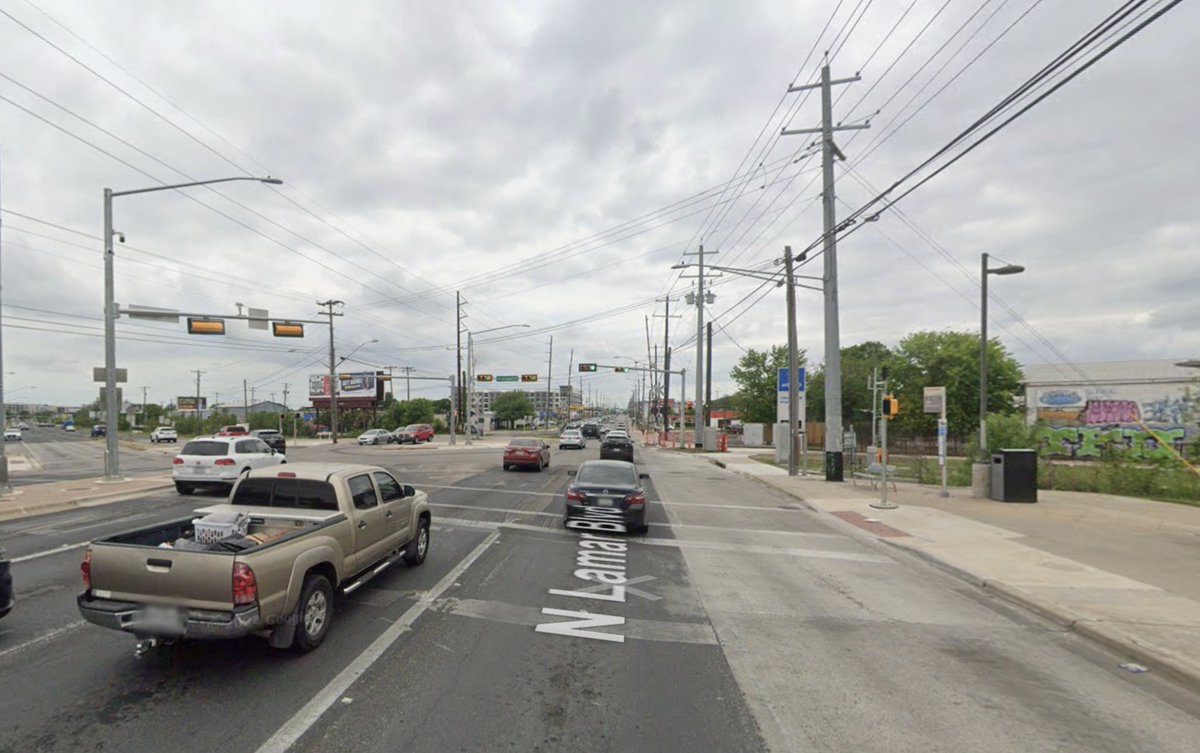
Imagine how good North Lamar would look if we buried the power lines
I can literally feel my blood pressure lowering 10 points by switching to the second image
As an American patriot and someone who earned tip income for 6 years…I say with confidence that I think American tipping culture is insane and hard to understand and that all of these same questions run through my head at every transaction.
The tipping culture in America never fails to baffle me I won’t lie.
A pint is around $9 (just under £7) which includes an 18.75% service charge (so around $7.50 for the actual pint itself, which isn’t too dissimilar to UK prices) and I’m fine with that.
But then they give you a pen with the receipt to write an extra tip on and it’s so bloody awkward.
So many questions going through my mind every time.
What do you want me to do here? What was the 18.75% for? Are you not getting paid by the hour? How much are you getting of that service charge? How much more are you expecting? Do I look a tight bastard if I just do $1 more?
I’d say I’m a very generous bloke too with my time and my money but it’s just mind-blowing stuff how this is a normality.
Can’t beat just buying 3 pints in the UK (well Europe, let’s be honest) in a pub for around 18quid… and just giving a 20sheet to the barman and letting them keep the change 🍻