A compute market cannot work in the way people think it will work because:
- the number of companies that can correctly transition tenants in a multi-tenant infiniband cluster in an automated and secure fashion is under 10
- of those companies, the number of companies that can offer a live market the works financially is 1, maybe 1.5.
The vast majority of GPU cloud operators literally do not have the basic capability of doing things like "transition tenants".
Transitioning a tenant is a manual process for them that can take weeks and cost millions in idle time. These operators designed themselves for clusters that only ever had one customer.
The idea that you will have a wide variety of neoclouds who will operate the GPUs and have a market operator will not operate the GPUs is a fantasy dreamed up by people who have no experience in supercomputing.
Without this capability, you cannot create a viable forwards curve. Simply brokering clusters from one operator to another, on long term fixed contracts, does not build a forwards curve. There isn't enough transaction data to make it viable.
So instead, index providers are forced to build their datasets off on-demand and spot, who's prices do not represent the vast majority of compute deployed, making it very hard to use them for any form of hedging. Index providers are making a valiant effort, but they need physical settlement of the actual asset they're trying to hedge.
I've been working on a nice open source CRM.
- Deploy anywhere like Unkey
- Postgres from anywhere
- Sync your own auth provider
- Enriched using https://t.co/wshFut1WJA
- API keys from Unkey or roll your own
- MCP and API support.
Here is a sneak peak
A compute market cannot work in the way people think it will work because:
- the number of companies that can correctly transition tenants in a multi-tenant infiniband cluster in an automated and secure fashion is under 10
- of those companies, the number of companies that can offer a live market the works financially is 1, maybe 1.5.
The vast majority of GPU cloud operators literally do not have the basic capability of doing things like "transition tenants".
Transitioning a tenant is a manual process for them that can take weeks and cost millions in idle time. These operators designed themselves for clusters that only ever had one customer.
The idea that you will have a wide variety of neoclouds who will operate the GPUs and have a market operator will not operate the GPUs is a fantasy dreamed up by people who have no experience in supercomputing.
Without this capability, you cannot create a viable forwards curve. Simply brokering clusters from one operator to another, on long term fixed contracts, does not build a forwards curve. There isn't enough transaction data to make it viable.
So instead, index providers are forced to build their datasets off on-demand and spot, who's prices do not represent the vast majority of compute deployed, making it very hard to use them for any form of hedging. Index providers are making a valiant effort, but they need physical settlement of the actual asset they're trying to hedge.
My take on the state of sandbox twitter right now:
- This is not a commodity product (yet!). There are still huge differences between providers, and there's only a handful you can really scale a business on (we're happy customers of both @modal and @e2b)
- Price is a terrible differentiator for start-ups in this market. If you are AWS/GCP/Azure, please try to clone the market leaders at half the price. You'll do great. For anyone else, it is a losing game.
- I do not know if picking fights on Twitter is a winning GTM strategy, but I really hope it's not. One of my favorite things about devtools is that (more than most markets) the best products win. I hope this stays true.
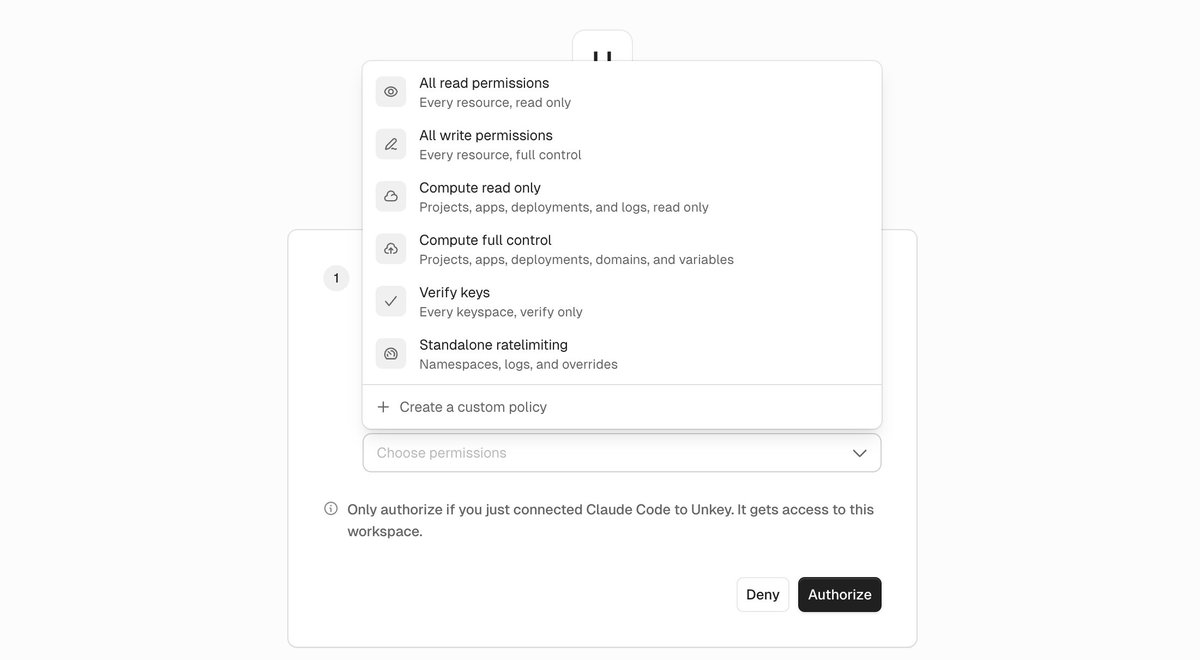
The @unkeydev MCP just got a nice upgrade.
- premade policies
- scope permissions to anything you want
- OAuth for easy setup
You can start using it by going to https://t.co/A9iwZfahRo or telling your agent to set it up.
Enjoy!
2026 was the year of Agents
2027 will be the year of Bots
How do I know?
1/ Every company is racing to build their own
(Grok Bot, Muse, Dots, Duet)
2/ Even more are building open versions
(OpenBot, Dusk, Cue, Rakazo, OpenMaus)
We've seen this before...
1999: every company needed a website
2012: every company needed an app
2027: every company needs Bots
But there's one BIG difference between '99 and '27: a website *shows* your business, whereas Bots will *run* it.
Which means that they need to know ALL your data, customers, decisions etc.
NO serious company will risk renting that from someone else.
They'll prefer to pay for a product they can own, and which works on their custom stack/infra/design.
Only one company is building for this:
@0penBot by @CopilotKit
It's:
- enterprise-ready
- self-hostable
- fully customizable
- works on any stack
And literally built on infra that's been adopted by Google, AWS, Microsoft and Oracle, with production-usage by majority of the Fortune 500.
You can't find this anywhere else.
Don't get locked into enterprise products.
Don't move everything to an open version that'll break in production.
Start with https://t.co/B7zkN3ug2q
Your CEO will thank you 👇
If you are considering buying gpus to capture the residual value or to distribute to your fund, please contact sfcompute
We offer turn key cluster deployments, where you own the gpus.
sfc’s top price on b300s yesterday was $18/hr, if you have a stagger ing number of long term b300 capacity you would like someone to operate, please let us know
Bringing AI to mineral exploration is one of the most obvious and compelling applications I have seen, and yet very few teams are focused on it. This week may be a celebration of LLMs. but meanwhile @earthaiexplore is using their models to find literal gold.
What counts as a Chinese model? What about models originally from Chinese labs served by American inference? What about the 100 important fine-tunes within products?
Super lame idea.