Calling the API from the app is faster to build, and it gets expensive once real users arrive. If you ship an AI mobile app, where do your model calls run today? #SwiftUI
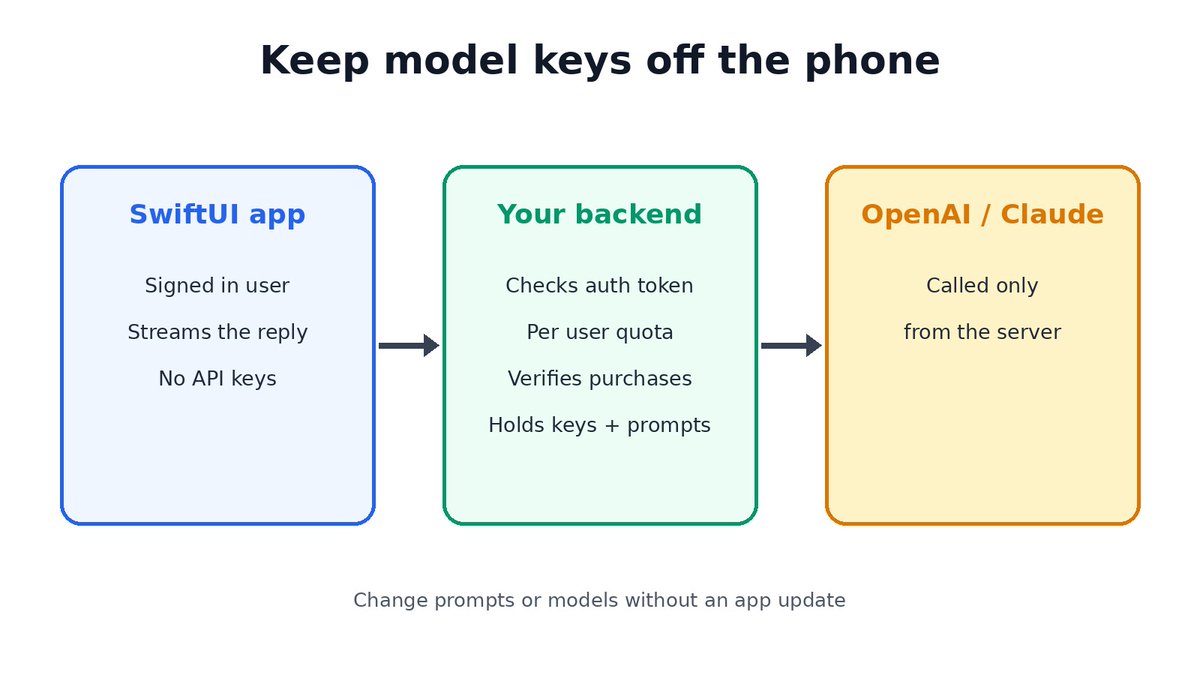
If your iOS app calls OpenAI or Claude directly, your API key ships inside every copy of the app. On the SwiftUI AI apps I've built, the phone never talks to the model provider. Here's the setup I use 🧵
Stream tokens back so the UI stays responsive when the model is slow. Keep prompts on the server so you can change them or switch models without an app update.
@TryMeetHint@prajhub p95 under 2s with live audio is mostly a pipeline problem: start retrieval on partial transcripts, keep each org's repo embeddings warm, and stay silent below a confidence threshold. I build retrieval and LLM pipelines on contract, remote: https://t.co/xjV4uzmm7G
5/ You do not need every model on day one. You need a seam so switching is a config change, not a rewrite. Which do you run today: one provider, or more than one? #AIEngineering
Hardcoding one LLM provider is fine until that provider has a bad afternoon. On one client AI product, every call went straight to OpenAI. When it slowed down, the feature looked broken even though Claude was healthy. How I wire both 🧵
4/ API keys stay server side. Only your backend talks to OpenAI or Anthropic. Log which provider answered each request so you can debug and compare quality later.
@whitesmithco "Know where it breaks" is the right filter. Most of my recent work is LLM agents with tool use inside real ops workflows, with evals, run logs and a human approval step before anything writes. I'm based outside Portugal, but glad to talk if contract FDE help is ever useful.
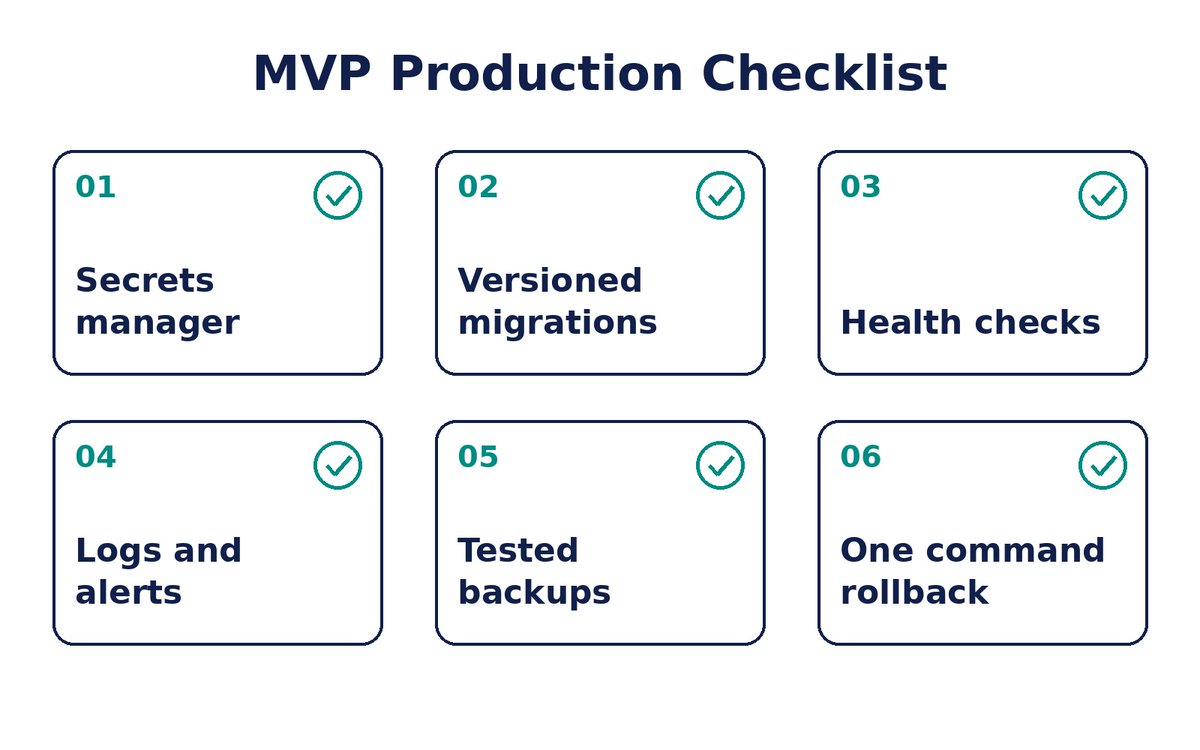
1/ An MVP that works in a demo can still fall over in its first week with real users, and the feature code is rarely why. Building tertAI, which turns AI generated apps into live products on AWS and Kubernetes, I keep seeing one gap. My pre launch checklist 🧵
4/ Automated database backups, plus one restore tested before you need it. And the previous build stays one command away, so a bad deploy is a rollback, not a lost weekend.
@asad_builds Same path here. Each job row has an idempotency key and attempt count, workers back off exponentially within each platform's per-account rate limits, and after a few failures the job goes to a dead letter queue I can replay. pg-boss or Inngest for you?
1/ When I built BrandoPilot solo to about 5,000 users, Supabase carried auth, Postgres with RLS, and storage for a long time. Pain showed up when background jobs and long running AI work no longer fit one request. Here's how I decide Supabase first vs a traditional backend 🧵
@petesoder@modal Interesting FDE-style work. Most of my recent work is production LLM agents with clear run logs and human review, plus Next.js/Node product surfaces. Happy to share how I wire tool use and eval loops if useful.
@Keanaalabre Fits the founding engineering seat if the stack is broader than geospatial models alone. I have shipped production LLM agents with tool use, APIs, queues and review UIs, plus full-stack product work around them. Happy to DM a short summary.