NYC has 144,000 hotel rooms for 8 million residents, India has 196,000 branded rooms for 1.4 billion people
That is one branded room per 7,100 Indians versus one per 56 New Yorkers. When supply is this starved, occupancy stays above 68% and operators raise rates without improving anything.
Nomura calls this a golden cycle - 15% EBITDA growth through FY28. One can celebrating the same chokepoint that makes a Bali wedding cheaper than a Goa one.
The cartel does not need to collude. The licensing does it for them.
India charges 18% GST on hotel rooms above ₹7,500 a night, Thailand charges 10%, Malaysia 6%. then we wonder why indians fly to bali for weddings.
Hotel project here takes 57 months on average and needs around 100 licenses before opening. the ₹200 crore threshold for infrastructure status kills mid-market supply before it starts.
Industry asked to cut it to ₹10 crore. the budget announced infrastructure benefits for 50 destinations over a year ago. still not done. the supply shortage is not a market failure, call it ease of doing business
India luxury hotel supply sits at 30,000 keys for 1.4 billion people. Leela RevPAR jumped 20% last quarter not because they improved, occupancy just stayed tight.
Every new hotel takes 7-10 years to build and gets financed under real estate lending norms, not infrastructure rates. The incumbents have no reason to push for reform.
Every license delay, every FSI restriction, every approval bottleneck keeps new entrants out.
Air India was privatized in 2022 instead of 2015. The cost of that seven-year delay - $2.4bn in losses last year, CEO gone, SIA questioning its stake, safety ratings at the bottom.
Now apply that delay math to hotels - ₹200 crore infrastructure status threshold announced in the 2025 budget has not been implemented, over a year later.
Every month of inaction means fewer mid-market hotels entering the pipeline, which means higher ADRs five years out. BJP-NDA has 20 chief ministers. The bottleneck is not opposition, It is inertia
the government wants you to skip foreign travel and spend in india, sure. but india charges 18% gst on hotel rooms above ₹7,500, Goa wedding costs more than bali.
Hotel sector is running the same script, everyone knows what needs fixing, nobody is fixing it. 20 BJP chief ministers, comfortable majority, this is not an excuse
India made itself competitive for startups - lowered angel tax friction, improved ease of incorporation, simplified compliance. Founders stopped defaulting to Silicon Valley and started building here.
The hotel sector never got that same push. Lending norms still treat hotels as real estate. FSI caps block new supply in metros. 100 licenses to open one property.
The PM is asking citizens to travel domestically while state and local governments run a permit system that keeps domestic travel unaffordable.
Everyone should learn about valuation Class, India is expensive
Jai Maharashtra,
Two days ago, Prime Minister Narendra Modi appealed to Indians to adopt austerity. Reduce gold purchases, avoid unnecessary foreign travel, consume less petrol and diesel, shift to electric vehicles, and embrace work-from-home practices. Why? Because gold and crude oil are imported, and they drain precious foreign exchange reserves. And with the Iran conflict escalating, global crude prices have surged sharply.
Fair enough. But the Prime Minister and senior leaders continue to travel across the country with massive convoys, roadshows, helicopters, flower showers, and extravagant political campaigns. Will the prime minister admit that ‘such political excesses were our mistake, and all of us including me, will not repeat it’? Why should the common man suffer for your mistakes? Is austerity meant only for the citizen and never for the political class?
Crude oil today is hovering around 90–100 dollars per barrel. But this is not the first time the world has seen such prices. During the 2008 financial crisis, during the Arab Spring of 2011–12, and the 2013–14 phase (when the BJP itself aggressively attacked the UPA over fuel prices) and again during the OPEC production cuts in 2022–23, crude prices had similarly touched these levels. During 3-4 such periods Dr. Manmohan Singh was the Prime Minister. Narendra Modi himself held the position once. Dr. Manmohan Singh did not ask citizens to stop travelling abroad. Narendra Modi himself did not make such appeals earlier either. So why now? When global crude prices had fallen to nearly 60–65 dollars per barrel, Indian citizens were still paying extremely high prices for petrol and diesel because of heavy taxation. The government earned lakhs of crores through fuel taxes. Where did that money go?
The Prime Minister once mocked the “freebie culture.” Yet elections - from Maharashtra to Bihar to West Bengal - are increasingly fought and won through precisely such populist giveaways. In Maharashtra, the ‘Ladki Bahin’ scheme has put tremendous strain on state finances. Instead of genuinely empowering women through jobs, education, and safety, governments distribute temporary cash benefits while inflation silently takes back much of that money. If the economic situation is indeed serious, will the Prime Minister openly ask all political parties to stop competitive populism?
The PM now asks citizens to reduce fuel consumption. Fine. But why did this wisdom not emerge during massive election campaigns involving thousands of vehicles, endless roadshows, and the transport of lakhs of supporters across states like West Bengal, Assam, Tamil Nadu, and Kerala? That itself would have burnt crores of liters of petrol and diesel. This didn’t occur to you when massive money power was wielded to gain votes there? Citizens are also being advised to avoid foreign travel. But how many Indians can afford international travel today? Even the middle class that can afford it is living under constant job insecurity. Students wish to study abroad because India has not invested deeply enough in higher education over the last decade, nor created enough confidence in domestic institutions. All you seem to be interested in is imposition of Hindi.
Meanwhile, foreign institutional investors have been steadily pulling money out of Indian markets. Estimates suggest that nearly ₹1.5 lakh crore has exited over the past few months. The Prime Minister and his Chief Ministers travel to colder climates to cement investment deals. But if they are making those deals with Indian companies, why even go to Switzerland for it? The Prime Minister himself is embarking on another multi-country foreign tour beginning May 15. First cancel these travels and then preach austerity.
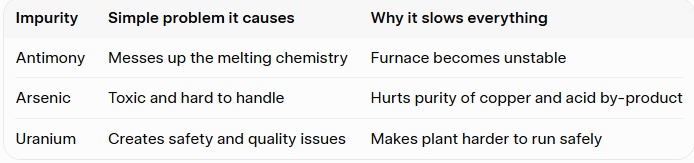
Adani Kutch copper plant faced significant technical setbacks - produced only 94,000 tons in 10 months and closed for repairs.
Uranium in the mix! This is rare and surprising for a new plant. It adds extra safety headaches that most people do not expect in copper smelting.
Kutch Copper is a huge new factory in Gujarat that can make 500,000 tonnes of pure copper every year. It started about 10 months ago. But right now, it is not running well at all.
Global copper market is tight right now (mines are not producing enough clean concentrate, China is buying a lot). Kutch entered at the worst possible time – like opening a new petrol pump when there is a national fuel shortage.
Kutch Copper is an integrated smelter-refinery. That means the chain is connected:
Copper concentrate → smelter → anode/semi-refined copper → refinery → copper cathode
If the smelter side is unstable, the refinery side also cannot run properly.
Bloomberg also noted that the company imported more than 26,400 metric tonnes of copper anodes over two years, which suggests the refinery may have used semi-processed input during ramp-up instead of relying fully on its own smelter output.
A 500 KTPA plant needs world-class feedstock sourcing and smelter control. Kutch is trying to scale both at the same time in a very tight global concentrate market.
Mahindra Logistics #HarResultKuchKehtaHai#GOOD
The headline profit of ₹22 Cr is just the surface of a much deeper balance sheet transformation. The real story is the disappearance of ₹825 Cr in debt, which was wiped out almost entirely this year. This deleveraging has removed a massive interest drag, allowing the operational improvements in the core supply chain business to finally reach the bottom line. For every ₹100 of profit reported, the company generated over ₹2,300 in real cash from operations, a testament to the strength of its asset-light model. Management has demonstrated rare discipline by strategically shrinking the Last Mile Delivery business, which saw revenue drop to ₹82 Cr.
This was a deliberate exit from low-margin, high-competition contracts. The result is a multi-year high operating margin of 6.27%, up from 4.95% a year ago. The Express Logistics segment, which includes the Rivigo acquisition, is now on the cusp of EBITDA break-even after being a persistent drag for nearly three years. While the 58% revenue dependency on the Mahindra Group remains a concentration risk, the core Automotive and Farm segments (62% of total business) provide a stable volume base that competitors struggle to match.
The warehousing footprint has reached 20 million square feet, and the focus has shifted from adding space to optimizing yields, evidenced by the 47% reduction in capital work-in-progress as projects move into the revenue-generating phase. The upcoming joint venture with Seno (Japan) represents the next leg of growth, specifically targeting Japanese OEMs in India. While this is likely a FY27 story, the groundwork is visible in the current quarter's operational stability. The market has already noticed this turnaround, with the stock outperforming the Nifty by 54% over the last three months, which suggests that further gains will depend on the company's ability to maintain these expanded margins as it scales its non-Mahindra business.
Full breakdown → https://t.co/cjGPjRk0Rr
Public NSE/BSE filings · Not Investment Advice
#MAHLOG #Q4FY26 #StockMarket #Earnings
A Gmail ID was used to impersonate a Central PSU. Nobody questioned it. And ₹20,000 crore in govt tenders got rigged.
Let me tell you the story of India's most absurd corruption case.
Jal Jeevan Mission, PM Modi's flagship scheme to give tap water to every rural home. Rajasthan alone got ₹10,180 crore from the Centre in FY22 and ₹13,328 crore in FY23. Almost 23% of the entire national JJM budget went to one state.
Two tubewell companies wanted these tenders. Problem? They had zero experience. Solution? They forged experience certificates of IRCON, a Railways PSU. Fake letterheads, fictitious officer names. And for verification, they created a Gmail ID pretending to be IRCON officials.
A Central govt PSU under Ministry of Railways. Replying from @ gmail. com. Not .gov.in. Not .nic.in. Gmail. And nobody in the entire PHED department found this suspicious. Not one officer. Combined, these two firms filed 230+ tenders using these forged documents.
But the real Bollywood moment? PHED sent an engineer to Kerala to "physically verify" IRCON's work. The contractors and a forger reached Kochi ONE DAY before him. Checked into Hotel Woodlark. The forger was introduced to the engineer as "Vijay Shankar, CEO, IRCON International." Random photos of pumphouses were submitted as proof. The contractor left his personal phone in Jaipur and used an employee's SIM card to avoid GPS tracking. The engineer came back and submitted a "positive verification report."
Now here's the part that makes your blood boil.
In June 2023, IRCON's own Vigilance Department wrote DIRECTLY to the Addl Chief Secretary Subodh Agarwal — "These certificates are fake and fabricated." What happened? The warning emails were deleted. Compliant engineers were handpicked to give false positive reports. Three separate legal notices were sent to the department. All ignored.
But the scam wasn't just about fake certificates. That was just ₹960 crore. The bigger game was ₹20,000 crore.
Agarwal introduced a rule — "Site Visit Certificates" mandatory for tenders above ₹50 crore. Sounds like transparency, right? It actually exposed which companies were bidding BEFORE tender opening. Once everyone knows who else is bidding, you form cartels. You fix prices. Tender premiums were inflated 30-40% across the board.
The numbers:
₹20,000 crore in tenders rigged 30-40% inflated premiums, 4% bribery formula ₹47 crore seized by ED so far — 0.2% of the scam
The fraud ran from 2021 to 2023 under the Congress govt in Rajasthan. IRCON warned in 2023. CBI filed an FIR in 2024. ED arrested the minister in 2025. Agarwal was finally caught this week — after being on the run for 2 months, evading 40+ ACB teams across 100 locations in 21 cities.
JJM 2.0 just got approved. Budget: ₹8.69 lakh crore. The real question — has the system that enabled this actually changed? Or are we just funding the next scam on a bigger scale
Saw many tweets about PM-KUSUM 2.
Here are my two cents I captured on March 15th "Timepass talk on Sunday"
In KUSUM 1.0, the “low-hanging fruit” was Component B, installing standalone solar pumps for individual farmers. This is where companies like Shakti Pumps and Oswal Pumps made a killing. However, KUSUM 2.0 is shifting the focus from the individual level (one solar plant for every pump) to the feeder level.
Essentially, the KUSUM 2.0 approach is to build one large solar plant (0.5 MW to 2 MW) that powers an entire agricultural feeder, a distribution line that supplies electricity to 50–100 farmers.
So, instead of installing 100 individual solar pumps, the government may increasingly build one mini-utility solar plant that powers the entire feeder. The concern for companies like Shakti Pumps and Oswal Pumps is that if the policy focus shifts toward “solarizing the feeder” rather than “replacing the pump,” the immediate demand for new solar pump sets could slow down.
That said, demand is unlikely to drop to zero, as standalone solar pumps will still be needed in off-grid or remote areas. However, the “unlimited growth” phase these companies enjoyed during KUSUM 1.0 could moderate as grid-connected regions transition to feeder-level solarization.
One potential driver for Shakti and Oswal could be the replacement cycle, especially if the government pushes for 4-star or 5-star rated energy-efficient pumps. Alternatively, these companies may need to pivot toward EPC-style participation in feeder-level solar projects to remain relevant in the evolving policy framework.
Additionally, KUSUM 2.0 introduces the Agri-PV (Agri-Photovoltaic) component, targeting 10 GW of agricultural solar power generation.
Long story short: read these policy shifts carefully and understand how prepared solar pump companies are for this transition before starting to accumulate the stocks.
Disc: Not a buy or sell recommendations.
India has an ethanol problem: Too much supply (20B litres) and not enough demand (11B litres). 📈
India is currently facing a significant industrial mismatch: we have the capacity to produce 20 billion litres of ethanol, but oil marketing companies (OMCs) are currently taking off only 11 billion litres.
This massive 9-billion-litre surplus is leaving distilleries underutilized and creating financial strain across the supply chain.
To solve this, policymakers and industry leaders are shifting the strategy from "Petrol Blending" to a "Total Ethanol Economy."
1. Moving Beyond the Gas Tank:
While the E20 (20% ethanol blend) target remains, the surplus is so large that new avenues are being explored:
Ethanol-Powered Stoves: Being tested as a cleaner, renewable household alternative to LPG.
The Diesel Frontier: Early trials are running for ethanol-blended diesel in Karnataka State Road Transport Corporation (KSRTC) buses and backup generators.
2. The Flex-Fuel Readiness
Major automakers like Maruti Suzuki, Toyota, and Bajaj Auto have already developed flex-fuel prototypes spanning two-wheelers to passenger cars. These vehicles can run on varying blends of petrol and ethanol, providing a scalable solution to absorb the excess supply.
3. The Policy Hurdles (GST & Pricing)
Mass adoption hinges on "Economics."
Currently, there is a massive tax disparity:
Electric Vehicles (EVs): 5% GST.
Flex-Fuel Vehicles (FFVs): Taxed between 18% and 40% depending on engine configuration.
The Price Dilemma: To make ethanol fuel attractive to the public, it needs to be priced lower than petrol. However, the government is reluctant to cut prices as it would hurt the profit margins of the distillers.
4. State-Level Incentives
Some regions are already moving. Sikkim has become the first state to waive road tax on flex-fuel vehicles, creating a potential blueprint for the rest of the country to follow.
#Ethanol #Biofuels #GreenEnergy #IndiaGrowth #Sustainability #FlexFuel
Most people don't know there's a right order to file health insurance claims when you have multiple policies.
Getting it wrong = leaving money on the table.
Here's how to do it:
1. Start with the policy that covers your hospital (best network, fewest exclusions). Employer group cover usually goes first.
2. Collect Form-64 (Claim Settlement Summary) from insurer #1. This is your proof for the next claim.
3. Use Form-64 + remaining docs to claim the unpaid balance from insurer #2.
For multiple individual policies, the order matters too: — Claim first from the policy where NCB is low — Keep the unlimited restoration policy for last — Keep the zero co-pay policy for last
One ₹70L claim, ₹0 out of pocket — entirely possible if you stack a group cover + individual plan + super top-up correctly.
Full breakdown in the infographic and story by @PuranikIra https://t.co/2IMTziBi4P
News is focused on which camera brand replaces Hikvision. The more interesting story is who makes the chip inside the camera.
Until 2019, that answer was overwhelmingly HiSilicon, Huawei's semiconductor arm that dominated surveillance SoCs globally. US sanctions killed that supply chain overnight and the entire industry moved to Ambarella, Novatek, and Sigmastar.
India's CCTV ban accelerates the same logic one layer deeper. Not just who assembles the camera, but who designs the silicon.
And that story is already further along than most people realize. L&T Semiconductor Technologies has signed a deal with CP Plus to supply indigenously designed Vision SoCs for 9 million IP cameras over three years. These aren't concept chips. They support 8MP imaging and this is the first time surveillance cameras will be made using chips from an Indian company.
CP Plus is the largest domestic brand by market share, so this isn't a token pilot.
Beyond L&T Semi, there are at least four more startups building surveillance SoCs under the government's Design Linked Incentive scheme. Mindgrove Technologies has the V2600, a surveillance-grade edge AI chip targeting late 2026 commercial launch. BigEndian Semiconductors raised $3M from Vertex Ventures and partnered with Cadence on Project VASU, a secure-boot SoC with encryption baked into the silicon. 3rdiTech and Netrasemi round out the group. Collectively these four have raised over ₹300 crore and taped out test chips in 2025.
Two years ago none of this existed. Now you have five separate Indian chip efforts targeting the same market, with the largest one already locked into a volume manufacturing agreement.
India did the same thing in telecom: kicked out Huawei, filled the gap with allied vendors, then started building its own stack with Tejas Networks. Surveillance silicon is following the same script, and hopefully moving faster.
Just see the level of toxicity in this Indian Muslim family where the wife Yasmeen Khan ran a beauty parlour where she invited Hindu girls for free beauty parlor courses. And when these girls came she used to spike their drinks. When they used to became unconscious, she used to call her husband Mohammed Sharif Khan who used to r@pe them. The wife meanwhile used to guard the reception while his husband r@ped the Hindu girls & video recorded his act to blackmail Hindu girls to have s€x with more Muslims.
When police asked the wife why she offered young Hindu girls to her husband for r@ping them, she said that they will get Jannat as she is helping r@ping kafir girls who deserved to be r@ped by Muslims. Hindus needs to be extra beware & should not allow their children's to be in contact with anyone of them. They are crooked evil people
It is now common knowledge that the US has had a hand in many security issues in India for decades now. Even communist issues like Naxalism were US run ops against the then Soviet-friendly INC led India.
Even recently, I think I got it wrong about Pahalgam. I initially thought it had a China hand when it happened. Later events gave me the realization that US intel using Pak intel must have been behind Pahalgam.
It was used to make India react, almost egging on India to attack Pak by US officials and senior politicians giving full support surprisingly to India then.
Not surprising anymore if we see they used India's retaliation to make China influenced Pak's army and govt to run to the US and pivot it away from China. Now Pak is being used by the US against Iran and Afghanistan to weaken China.
I may still be wrong in my conclusions above. But history doesn't lie. India's greatest destabilizer is not Pak, not China, but the country that has supported and used both against India since 1960s.
The Iran war has a supply chain tail risk nobody's pricing: Impact on Data centres & Semis
1. Qatar = 33% of global helium → Ras Laffan offline after drone strike.
2. Helium has NO substitute in lithography & wafer cooling
3. Strait of Hormuz blockade means that helium can't even exit if produced.
4. Bromine (Israel/Jordan) = 66% of global supply, also at risk.
5. Iran is explicitly targeting infra owned by US companies like Amazon, Google, Microsoft, Oracle, Nvidia etc in the Middle East.
The war Trump started to project strength may be quietly strangling the AI chip buildout he bet his legacy on. Will the TACO trade accelerate given more than half of US GDP growth is coming from Data centre capex push
Shocking 😮
I was traveling from Hyderabad to Mumbai on 1st March 2026. The moment I entered ORR, my @HDFC_Bank FASTag suddenly showed blacklisted.
I tried checking my balance (₹600+ already available) but it kept saying “failed to load balance.”
After calling HDFC customer care, I was shocked to learn that a new @IDFCFIRSTBank FASTag had been issued for my car on 28th Feb 2026 — something I NEVER applied for.
HDFC clearly said they can’t help anymore since IDFC FASTag is now active. IDFC customer care, on the other hand, would only talk to the registered mobile number, which wasn’t mine.
Turns out, IDFC issued a FASTag to someone else using my car number. His car number was 9230, mine is 8230 — one digit mistake, huge trouble.
At a toll plaza, some FASTag vendors helped me track that person, took OTP from him, and issued me a new FASTag (for ₹900 extra).
I somehow managed to recharge it and return to Mumbai, but my ₹3000 annual pass is wasted.
This is a massive loophole in the FASTag system. What’s meant to be a convenience has become a serious hassle — and honestly, scary. @NPCI_NPCI@NHAI_Official@MoRTHIndia@jagograhakjago@nitin_gadkari
" Iran can make over 100 ballistic missiles a month - we can only make 6 or 7 interceptor units, and the 1000's of one way attack drones"
Wait, what?! did Marco Rubio accidentally say the quiet part out loud?
The downside of running a highly concentrated portfolio while being surrounded by sharp minds is constant exposure to great ideas you simply can’t act on, high allocations leave no room, and the result is inevitable FOMO.
Concentration creates FOMO by exclusion, diversification creates FOMO by dilution!