In 1983 the BBC set a camera in Richard Feynman's living room. He talked for 66 minutes and wrote 0 equations.
The film is called "Fun to Imagine." Shot at his home in Altadena. 1 chair, 1 Nobel laureate, no script, no slides.
He describes fire as sunlight a tree trapped years before. Burning the log releases it back into the room.
He explains why a rubber band stretches. Why a mirror swaps left and right yet leaves up and down alone.
Then the interviewer asks how magnets work.
Feynman turns down the shortcut: "I can't explain that attraction in terms of anything else that's familiar to you."
That refusal carries the whole film. He teaches a way of seeing before he hands over a single fact.
Feynman died 5 years after the recording. The full version still circulates in HD.
66 minutes in an armchair. 43 years of people still watching.
A foam-and-cleaning ingredient used in shampoos, soaps, and detergents sells for $200.28 per gram, 2.1 times the price of gold.
Myristamine oxide is a surfactant. It helps water grab oily dirt, so a shampoo or cleaner can spread, foam, and rinse away residue. Manufacturers buy it when they need mild cleaning power for personal-care and household formulas.
Sigma-Aldrich in Germany sells it for $200.28 for 1 gram. MedChemExpress MCE in Sweden sells it for $250.47 for 100 milligrams.
This is one of 920 molecules selling today for more than gold per gram. Here's the list:
I'm a cardiologist. Everyone is sharing this study as a skin story. They're burying the part that matters.
Scientists took the aorta of a 75-year-old donor, applied a single engineered enzyme, and stripped away more than 70% of the molecular damage — bringing it down to the levels you'd see in a 30-year-old artery.
Published five days ago in Nature Communications. Revel Pharmaceuticals, with Calico and the University of Colorado.
Here's what they erased.
Sugar reacts with proteins in your body the same way heat browns bread — slowly, over a lifetime. It leaves behind a residue called CML, the most abundant advanced glycation end product in aging tissue. It welds itself onto collagen and elastin in your skin, your eye lens, and your arterial walls.
Two things follow. Your arteries stiffen. And CML latches onto a receptor called RAGE, which drives chronic inflammation — the exact fire I've been writing about for months as the engine of heart disease.
Since the 1980s this damage was considered permanent. Your body has no enzyme to remove it. Every existing approach only slows new damage from forming. Nothing touched what was already there.
So they built an enzyme that doesn't exist in nature. They screened 45,000 protein structures, then ran five rounds of directed evolution across more than 500 million variants until they had CMLase — a molecular lawnmower that oxidizes the CML off the protein and restores the original, healthy lysine underneath.
Not patched. Reversed.
Over 70% cleared from elderly arterial tissue. Over 55% from elderly skin — below the levels found in 31-year-old skin. 45-78% in lens proteins. The CEO said they expected 20% and were floored.
Arterial stiffness drives systolic hypertension, heart failure, and stroke, and I have no drug that reverses it. I can slow the process. I cannot undo it. This paper says undoing it may be possible.
The caveats are real and I won't skip them. This was done on donated tissue in a dish, not in a living person. No functional data yet — we don't know if that artery got measurably more elastic. Delivering a large enzyme deep into human tissue is a hard, unsolved problem. Clinical trials are years away.
But something considered permanent for forty years just came off human tissue.
We spent a century learning to slow aging. Someone finally figured out how to erase it.
Thank you @theallinpod@friedberg@chamath@pesottas
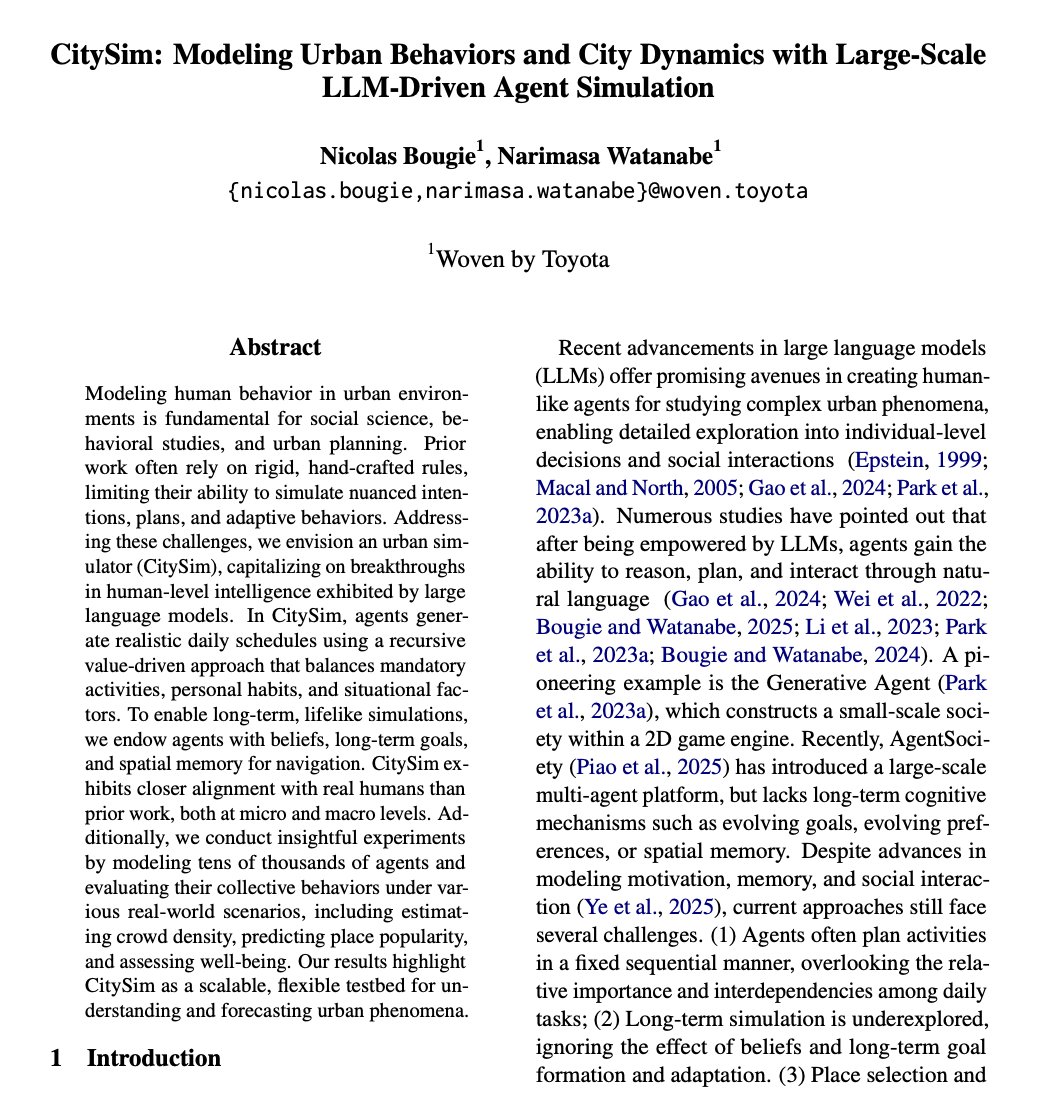
Japanese researchers created a system that simulates an entire city by generating up to 1 million virtual residents who behave like humans using LLMs.
And it predicted real-world with terrifying accuracy.
They created an urban simulator called "CitySim" that populates a digital twin of Tokyo with up to 1 million autonomous AI agents.
Each resident is powered by an LLM, complete with:
• Personal memories
• Long-term goals
• Human-like desires (hunger, fatigue, social connection)
• Spatial awareness and navigation
Most urban simulations rely on rigid, hand-crafted rules, if A happens, B follows.
CitySim is different. It’s "value-driven." The agents have agency. They generate their own schedules based on their personal habits, situational needs, and changing environments.
When researchers ran the simulation in Tokyo, the output was chillingly accurate.
Weekday commuting patterns, weekend leisure activities, and shopping habits matched Japanese government statistical data with near-perfect precision.
It even successfully predicted crowd distributions in Shibuya and identified which stores would actually become popular, months before the real-world data caught up.
The implications for urban planning are massive.
We can now safely and cost-effectively test disaster preparedness, commercial site planning, and public infrastructure upgrades without moving a single physical person.
But it’s not just about planning.
The researchers are already looking at implementing high-level human drives, like "self-actualization," into these agents to see how they evolve.
The paper went up on arXiv in June 2025 and almost nobody outside computational social science has read it.
Whether a movie is good or bad, and I realize this even more as I've grown older, is simply a function of whether it gets you emotional or leaves you cold. The story, the cinematography, everything we like to talk about in reviews, is quite beside the point; it's the post-facto rationalization of wherever our heart took us.
Two things one needs to know before going to see Christopher Nolan's latest, #TheOdyssey. First of all, anything other than IMAX, prepare to be disappointed. This is cinema in its purest form, visual storytelling by a master of the craft, and it needs to be experienced without gimmicks (no 4DX, please).
Second, and more important. You should know the Odyssey and Greek mythology fairly well walking in. Nolan drops you in the middle of the action with no introduction, nothing, and it is very difficult to follow along if you don't know the lore. Most of us know who Achilles and Hector are, and Helen, though the first two do not appear in the movie at all. Fewer of us know Agamemnon, or Menelaus, or how the Greeks assembled their army against the city-state of Troy. If that's you, you will most likely be "out" of the movie within the first thirty minutes.
Nolan takes a lot of surprising creative choices, which include no lesbians, one Gujarati, and at least two classic Nolan flourishes of presenting things out of order. And that's not all. He puts his own spin on the old story, making it about the corrupting effect of war and violence on the human soul. It is a trope Tolkien made his own, where Gandalf says he doesn't know if Bilbo Baggins will come back, or how much of him will be left if he does.
It is the same thing here.
Odysseus, the noblest and smartest of the Greeks, doesn't want to come home because he is ashamed of who he has become in the Trojan War, of the moral code he knows he has irretrievably broken by disguising a peace offering as a weapon of war, making profane that which was once holy.
All of this, of course, worked for me. The cinema, the drama, and that which is deeper. I was on the crest of emotion throughout, fully connected to its world, but well aware that this movie is not for everyone, and that everything I have written above is just my heart looking for reasons.
Robert Merton won a Nobel Prize in October 1997 for an equation. Eleven months later, the same equation lost him $4 billion. He teaches it at MIT for free now. Almost nobody who watches the lectures notices what he changed.
The equation is the Black-Scholes-Merton options pricing formula, published in 1973. It made pricing derivatives possible. It launched an entire industry. It won the 1997 Nobel Prize in Economics for Merton and Myron Scholes. Fischer Black, the third contributor, had died two years earlier and was ineligible.
While the Nobel was being announced, Merton and Scholes were also principals at Long-Term Capital Management. LTCM was the smartest hedge fund on Wall Street. It had two Nobel laureates, dozens of PhDs, and the actual authors of the formula the industry was built on. It was leveraged 25 to 1. Its models were airtight. Everything about it worked.
Then in August 1998, Russia defaulted on its debt. The market moved in ways the models rated as nearly impossible. It happened in six weeks. LTCM lost $4.6 billion. The Federal Reserve had to organize a private bailout to prevent the entire global banking system from unwinding. Merton and Scholes lost most of their personal fortunes.
The formula was not wrong. It assumed volatility was a constant. The market kept teaching everyone that volatility is itself a random process. Merton knew this. He had written papers about it before LTCM even existed. He also knew his colleagues at LTCM were pricing off the simple version of the formula because it fit the data during normal markets.
Merton teaches this now at MIT. His course is on OpenCourseWare. He spends the first half explaining the formula that won him a Nobel. He spends the second half explaining why he then lost $4 billion using it. He does not soften either part.
The lesson: a model is a lens. Every lens has a blind spot. The blind spot is not the model's fault. It is the fault of the person who forgot the model had one.
Merton is 82 years old. He is still at MIT. He has been teaching this specific course, in various forms, for four decades. The Nobel is on his wall. The $4 billion is in the syllabus.
Martin Hairer, Fields Medal winner who rewrote the rules for what randomness math can actually prove:
"I can build a model using nothing but a dot jumping in four random directions on a grid, the crudest toy version of reality imaginable, and it prices real large scale risk as accurately as models funds pay quants $600K to build. The tiny details of the mechanism turn out not to matter at all."
this is the exact principle that lets a wildly oversimplified model still price real risk correctly, and almost nobody states why it's allowed to work.
cut through the abstraction and the claim is precise, not hand wavy. when you zoom out far enough from any process built out of many small independent random events, the specific mechanism generating those events stops mattering, and only a few large scale features determine the outcome.
that's not an approximation you're hoping holds, it's a proven mathematical result called universality. a crude four direction random walk on a grid and the actual chaotic motion of a real particle converge to the exact same large scale behavior, despite having nothing in common at the small scale.
zoom out to how this plays out justifying a simplified pricing model on a desk today. a model built on wildly unrealistic micro assumptions, like every trader acting independently and randomly, can still correctly capture the large scale statistical behavior of price movements, precisely because universality says the small scale mechanism doesn't determine the large scale outcome.
most people evaluating a model ask whether its underlying assumptions are individually realistic, when the more relevant question is whether the model preserves the handful of structural features that actually survive the zoom out to large scale behavior.
this is exactly what "the assumptions are unrealistic" critiques skip. an unrealistic microscopic assumption doesn't automatically invalidate a model's large scale predictions.
the model was never trying to be realistic at the small scale. it only ever needed to preserve the handful of features that survive the zoom out.
Bookmark this principle.
Source: London Mathematical Society Popular Lectures 2015, Martin Hairer, "The Mathematics of Randomness."
@prathgodbole In Corporate ,the person who receives complaints is more interested in ensuring that he/his team does not get the blame rather than solving the actual problem.
We are looking for engineers, welders, and workers ready to follow us to the ends of the Earth and build classical megastructures that defy this age of apathy.
Harry Markowitz, the Nobel laureate who invented modern portfolio theory:
"Every fund from Bridgewater to Citadel runs on one equation I wrote as a 25-year-old grad student. Wall Street pays quants $500K to use it. It's free."
the thread above teaches you to build a portfolio the real way, with the mathematics of capital allocation. every line of it traces back to one paper markowitz wrote in 1952.
before him, "don't put all your eggs in one basket" was folklore. he turned it into algebra. he proved a portfolio's risk isn't the average of its parts, it's driven by how the parts move together, the covariance. combine assets that don't move in lockstep and you cut risk without giving up return. that is the closest thing to a free lunch in all of finance, and he wrote the exact equation for how much of it you get.
that single insight, mean-variance optimization, is the engine under every serious fund on earth. renaissance, bridgewater, citadel, your pension, all of them size risk with markowitz's math. he published it in 1952, won the nobel in 1990, and it sits in every textbook and this free lecture. same story i keep telling: the math that runs the trillion-dollar machine has been public and free for seventy years.
here is the part markowitz himself warned about. the equation is only as good as the numbers you feed it, your estimates of return and covariance. feed it garbage and the "optimal" portfolio it hands back is confidently, precisely wrong, and it detonates in the exact crisis it was built to survive. the optimizer is free. estimating the future honestly, and knowing when to distrust your own inputs, is the entire job.
This prologue scene in Treasure Planet where Jim while solar surfing, cuts the engine and plummets always floors me because of how accurately it treats the physics of a free fall.
The sheer sense of weight, speed, and genuine air resistance they managed to capture. The violent camera shake perfectly mimicking how you'd experience it in a real dive.