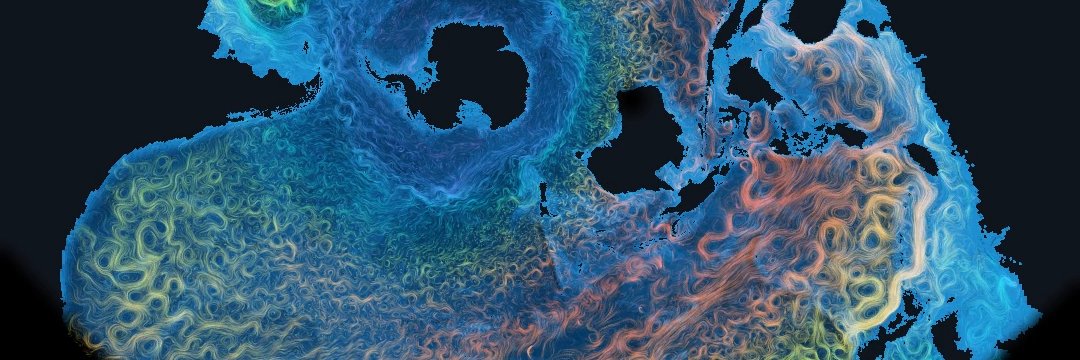
Most maps cut the ocean apart to keep the land whole. The Spilhaus projection splits the continents instead, so all of Earth's seawater reads as one body.
A year of surface currents, colored by sea temperature. Now also a print.
#ocean#dataviz
@climate_ice@Tokyo_Tom the Bering Strait is the one place this projection cuts ocean-- small dashed lines in top right and bottom right, hard to see at phone scale. It's not possible to make a flat map without at least one ocean cut and this is the smallest possible one.
@SethBRKV there's a small dashed line in the top right and bottom right corners where the Bering Strait gets cut-- can't make the map flat without cutting the ocean in at least one place, this is the smallest possible ocean cut.
This is the first printed map I've ever made and sold to the general public, and it took months of obsessing over details for me to feel comfortable getting to this point. Please consider check it out!
https://t.co/PQLRaGpcwg
Every southern winter, humpbacks that feed near the Antarctic swim north to calve off Brazil and West Africa, and barely eat until they are back south.
Lines are simulated whales placed from Happywhale photo-ID sightings via GBIF.
#humpbackwhale#whales
Every July, America's Corn Belt glows brighter than the Amazon, in a far-red light plants give off as they photosynthesize, seen from orbit. Then the harvest comes and the farms go dark, while the rainforest glows all year. #photosynthesis
Lighthouses of Greece, from Othonoi to Strongyli off Kastellorizo. The big stations sweep; harbor lights and buoys blink on the rhythm printed on the chart. Spetses, lit in 1837, was among the first lighthouses of the new Greek state.
#Greece#Lighthouses#Maps
Each fall, Blackpoll Warblers weighing less than half an ounce fly nonstop over the open Atlantic, about 1,600 miles in up to three days. A year of their migration from eBird sightings and geolocators. #birdmigration#birds
Many Western Tanagers stop in the Southwest each fall to replace their feathers before flying on to Mexico. A year of their migration from eBird sightings. #birdmigration#birds
Every fall about 4.5 million hawks and vultures squeeze through Veracruz, Mexico, the largest raptor migration counted anywhere. A year of four species from eBird sightings and GPS tracks. #birdmigration#raptors
Ruby-throated Hummingbirds weigh about 3 grams, and many cross the Gulf of Mexico nonstop each spring and fall. A year of their migration from eBird sightings. #birdmigration#birds
Purple Martins nest in birdhouses across the East, then head south over the Gulf of Mexico to winter in the Amazon basin. A year of their migration from eBird sightings and GPS tracks. #birdmigration#birds
Every fall Swainson's Hawks leave the Great Plains for Argentina, more than 10,000 km. They avoid open water, so nearly all of them funnel through Mexico and Central America. A year of their migration from eBird sightings. #birdmigration#birds
Every fall Barn Swallows leave North America for Mexico, Central and South America, some as far as Argentina. By late spring they are back. A year of their migration from eBird sightings. #birdmigration#birds
Over two weeks in October, the air near the ground spanned more than 100 °C, from the East Antarctic plateau to Mozambique's Zambezi valley. Color is air temperature, brightness is speed. Data: ERA5 / Copernicus #weather#dataviz