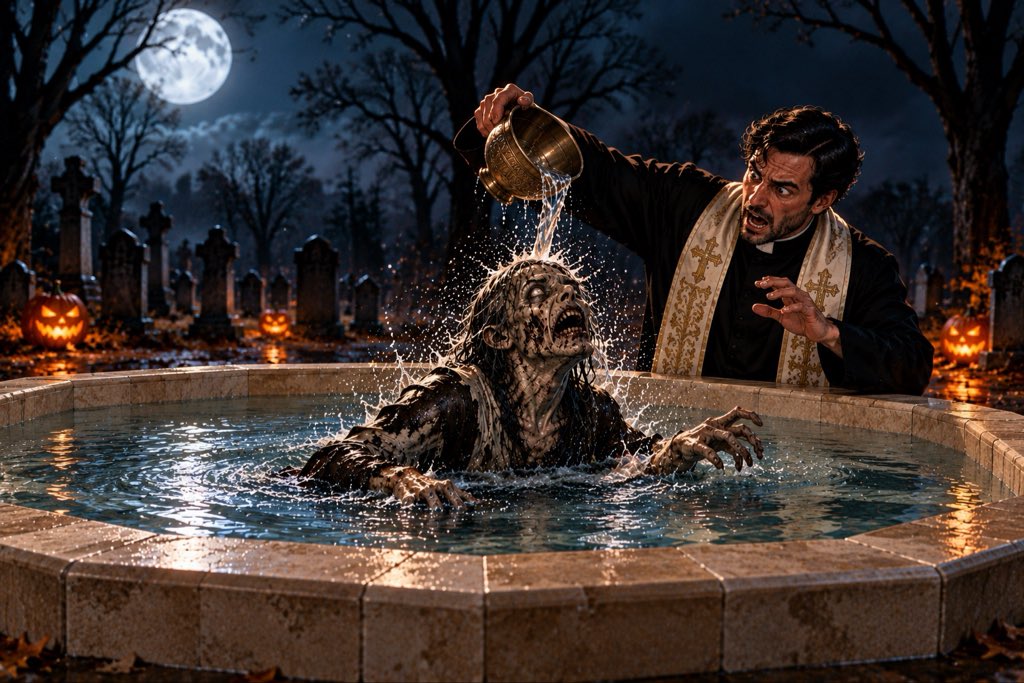
Did Paul really teach Christians to baptize dead people? 🧟♂️
In 1 Corinthians 15:29, Paul asks:
“If the dead are not raised at all, why are people baptized on their behalf?”
Was Paul describing some kind of zombie baptism, or is there a deeper meaning?
🧵👇
Did Paul really teach Christians to baptize dead people? 🧟♂️
In 1 Corinthians 15:29, Paul asks:
“If the dead are not raised at all, why are people baptized on their behalf?”
Was Paul describing some kind of zombie baptism, or is there a deeper meaning?
🧵👇
@rockreborn22@FrMatthewLC You didn’t answer my question.
“why does rejecting your explanation of the atonement mean someone is rejecting Christ’s sacrifice itself?”
Another question, what about Erik Ibarra who is Catholic, but believes in PSA, what does that mean about his soul?
But I say, walk by the Spirit, and you will not gratify the desires of the flesh.
For the desires of the flesh are against the Spirit, and the desires of the Spirit are against the flesh, for these are opposed to each other, to keep you from doing the things you want to do. But if you are led by the Spirit, you are not under the law. Now the works of the flesh are evident:
- sexual immorality,
- impurity,
- sensuality,
- idolatry,
- sorcery,
- enmity,
- strife,
- jealousy,
- fits of anger,
- rivalries,
- dissensions,
- divisions,
- envy,
- drunkenness,
- orgies,
- and things like these.
I warn you, as I warned you before, that those who do such things will not inherit the kingdom of God.
But the fruit of the Spirit is
- love,
- joy,
- peace,
- patience,
- kindness,
- goodness,
- faithfulness,
- gentleness,
- self-control;
against such things there is no law.
And those who belong to Christ Jesus have crucified the flesh with its passions and desires.
— Galatians 5:16-24
But that’s precisely what Catholics believe! Christ died for our sins, suffered in our place, and made satisfaction for the punishment we deserve.
St. Thomas Aquinas taught this centuries before the Reformation.
What I disagree with is your particular explanation of HOW Christ’s sacrifice accomplished our salvation.
You keep saying your understanding of PSA is the obvious and straightforward teaching of Scripture. But that’s still your interpretation of Scripture.
I can read those same passages and arrive at a different understanding while fully believing that Christ died for my sins and that I cannot save myself.
So why does rejecting your explanation of the atonement mean someone is rejecting Christ’s sacrifice itself?
That’s the distinction I don’t think you’re making.
I do not wish to have any righteousness of my own based on the Law, but one that comes through faith in Christ, the righteousness given by God in response to faith.
Conclusion: Why Suffer for the Dead?
Putting these passages together:
Luke 12:50 establishes that Jesus describes His approaching Passion as a baptism.
Mark 10:38–39 establishes that His disciples can share in that baptism of suffering.
Romans 6:3–4 connects Christian baptism with participation in Christ’s death and resurrection.
St. Francis de Sales offers an interpretation of 1 Corinthians 15:29 in which Christians undergo penance and suffering on behalf of the departed.
And immediately afterward, Paul discusses his own suffering in light of the resurrection.
His rhetorical question could therefore be understood this way:
If the dead are never raised, why would Christians willingly undergo suffering and penance on their behalf?
This is not the only interpretation of 1 Corinthians 15:29, nor is it a definitive proof of purgatory. But it is a possible Catholic interpretation that draws upon biblical language and the immediate context of Paul’s argument.
The central point remains the same:
Christians endure suffering in hope of the resurrection, because death does not have the final word.
Did Paul really teach Christians to baptize dead people? 🧟♂️
In 1 Corinthians 15:29, Paul asks:
“If the dead are not raised at all, why are people baptized on their behalf?”
Was Paul describing some kind of zombie baptism, or is there a deeper meaning?
🧵👇
1 Corinthians 15:30–32: Paul’s Immediate Context
Now consider what Paul says immediately after mentioning baptism for the dead:
“Why are we in danger every hour?” (1 Cor 15:30)
He continues by describing the dangers and hardships he endures, even asking:
“If with merely human hopes I fought with wild animals at Ephesus, what would I have gained by it?” (1 Cor 15:32)
Notice the connection.
Paul moves directly from discussing baptism for the dead to describing his own suffering and sacrifices.
His entire argument centers on the resurrection. If the dead are not raised, what purpose is served by enduring such hardships?
This doesn’t conclusively establish that baptism for the dead refers to penitential suffering, but it provides a contextual basis for considering that interpretation.
“There are no other atonement theories, you either have the biblical one or you don’t. People can be ignorant of the details of the atonement, but those who know and reject PSA is a red flag and tells me a lot about someone.”
Other than your interpretation of the Bible, where do you base that off of?
The dam is breaking. I’m told there is more inconsistencies in Peggy Flanagan’s background.
It makes sense why Tim Walz picked her as his running mate.
These two have built their political careers on embellishments and lies.
https://t.co/NBEwr7TBza
Chris Pratt says Imax drone cameras were used for his new Vatican documentary with Pope Leo, which explores the tomb of St. Peter. He says the experience helped redefine his Catholic faith:
“It was really profound to be encountering the remains of one of Jesus’ apostles. There was prophetic word, he said that the church will be built upon that rock. And Simon Peter is the rock. To see the church some 2,000 years later, and see the prophecy of his words came true, it just was really meaningful to me.”
You said, “Faith means you’re shutting down your own mind in favor of an authority.”
Really? I challenge you to read St. Thomas Aquinas’s Summa Theologiae and repeat that with a straight face.
Aquinas systematically presents objections to Catholic teaching, examines opposing arguments, uses logic and reason to reach conclusions, and then answers each objection.
That’s hardly checking your brain at the door.
You repeatedly boast about using your brain, yet dismiss 2,000 years of Catholic intellectual tradition as mindless submission to authority.
Have you actually engaged with Aquinas’s arguments, or have you simply declared them nonsense without examining them?
Faith doesn’t require abandoning reason. It requires recognizing that your own intellect isn’t infallible.
One major observation: You describe God as “an Infinite Being of Infinite Power” who “rules Space and Time,” yet you never mention Jesus Christ. Not once.
You acknowledge that God rules over the entire universe, but apparently His authority stops when it comes to ruling over you.
You’re right about one thing. You’re not a Protestant. You’re not even a Christian. You’re much closer to a deist. You believe in a Creator but seemingly reject the idea that He has revealed Himself through Jesus Christ and established commandments you’re obligated to obey.
And most importantly, do you believe Jesus Christ is God incarnate, or do you simply regard Him as another religious philosopher alongside Buddha?
Because if Christ is God, His commandments aren’t optional suggestions you can dismiss whenever they conflict with your personal preferences.
Christ said, “If you love me, you will keep my commandments.” (John 14:15)
And for someone who repeatedly boasts about using his brain, you seem remarkably unwilling to follow your own beliefs to their logical conclusions.
If God is infinitely powerful and wise, why should your finite intellect be the ultimate authority on good and evil? If God created you, don’t you owe Him something?
This brings us to another contradiction in your worldview.
You claim to believe in objective morality, yet your moral standards seem to change depending on whom you’re judging.
You argue that the seven deadly sins are actually qualities that make us human and independent. Yet you’ve spent this entire conversation condemning Catholic clergy for their greed, lust, pride, and sloth.
So which is it? Are these qualities virtues or vices? Or are they only virtues when you practice them and vices when someone you dislike does?
You also argue that Christianity is wrong for teaching us to resist human nature, particularly when it comes to vengeance and forgiveness.
But aggression, selfishness, and sexual violence are also natural human impulses, yet you rightly condemn murder and rape.
So by what objective standard do you distinguish between natural impulses we should embrace and those we should resist?
You can’t appeal to human nature to justify your own desires while condemning those same tendencies in others.
And you certainly can’t dismiss 2,000 years of Catholic moral teaching as nonsense without explaining what makes your own moral framework objectively superior.
You repeatedly insist that you live in the “REAL WORLD” and possess the intellectual capacity to judge these matters for yourself. But simply declaring yourself intellectually superior isn’t an argument.
You quote Thomas Paine approvingly: “My own mind is my own church.”
And that seems to be the heart of the matter.
You acknowledge an infinitely powerful Creator, but apparently recognize no divine authority over your conduct. You profess objective morality, yet seem to appoint yourself the final judge of what is good and evil.
So the fundamental question isn’t whether Catholic priests have sinned, whether Vatican II was a disaster, or whether you appreciate Catholic architecture.
It’s whether you acknowledge God’s authority over your life or whether you’ve effectively made yourself your own god.
Because so far, your standard of morality seems to be whatever you personally approve of.
And that’s not objective morality. That’s personal preference dressed up as intellectual independence.