CS prof at Penn. Amazon Scholar at AWS. Author of The Ethical Algorithm (w/ Michael Kearns). I study machine learning, privacy, game theory, and uncertainty.
A new semester, and the first lecture is in the books for my class on the "Mathematical Foundations of AI Alignment". https://t.co/9B38eQMoxT What does that mean? Good question. We have about a semester in which to figure it out.
We’re very excited to be organizing a 1-day workshop on “Recent advances in Regularity Lemmas (with and without calibration)” at Stanford on Tuesday, November 17!
Program and details: https://t.co/PV3sb5Sdb3
Do you have high quality work on the foundations of responsible computing, writ large? This covers everything from work on differential privacy to algorithmic fairness to designing mechanisms and markets to AI alignment. (Submit to FORC!) 1/ https://t.co/1O4doAQ38c
There are two submission deadlines. One is coming right up: November 11. The other is February 17. The conference itself will be held at Stanford, this summer, from June 2-4. This is always a fun event. 3/3 https://t.co/1O4doAPviE
Would you like to present it at a focused venue where it will be discussed in the hallways by the leading lights of the field, rather than lost in a cavernous poster session? Consider submitting it to FORC 2027. 2/ https://t.co/1O4doAPviE
How should two agents collaborate if they hold different information?
We are 95% certain they should communicate their uncertainty.
🚨In our new NeurIPS paper we show that communicating calibrated probabilities can benefit collaborative decision-making!
https://t.co/4rDrTljHbV
@JohnBal14046363 I once had a conversation with Akshay Venkatesh where he was explaining some result to me and I commented “wow, you read that [difficult] paper?” And he replied “well, I imagined I read it.” Made a big impression on me.
I'm speaking about getting alignment from misaligned systems today at RESI/MIT today at 3pm in Stata (G449) and tomorrow at the Harvard CS Colloquium https://t.co/5pCOr5SvM7 If you can't make it, I gave ~ 2/3 of this talk at Cornell last week: https://t.co/8LQYyAjS4D
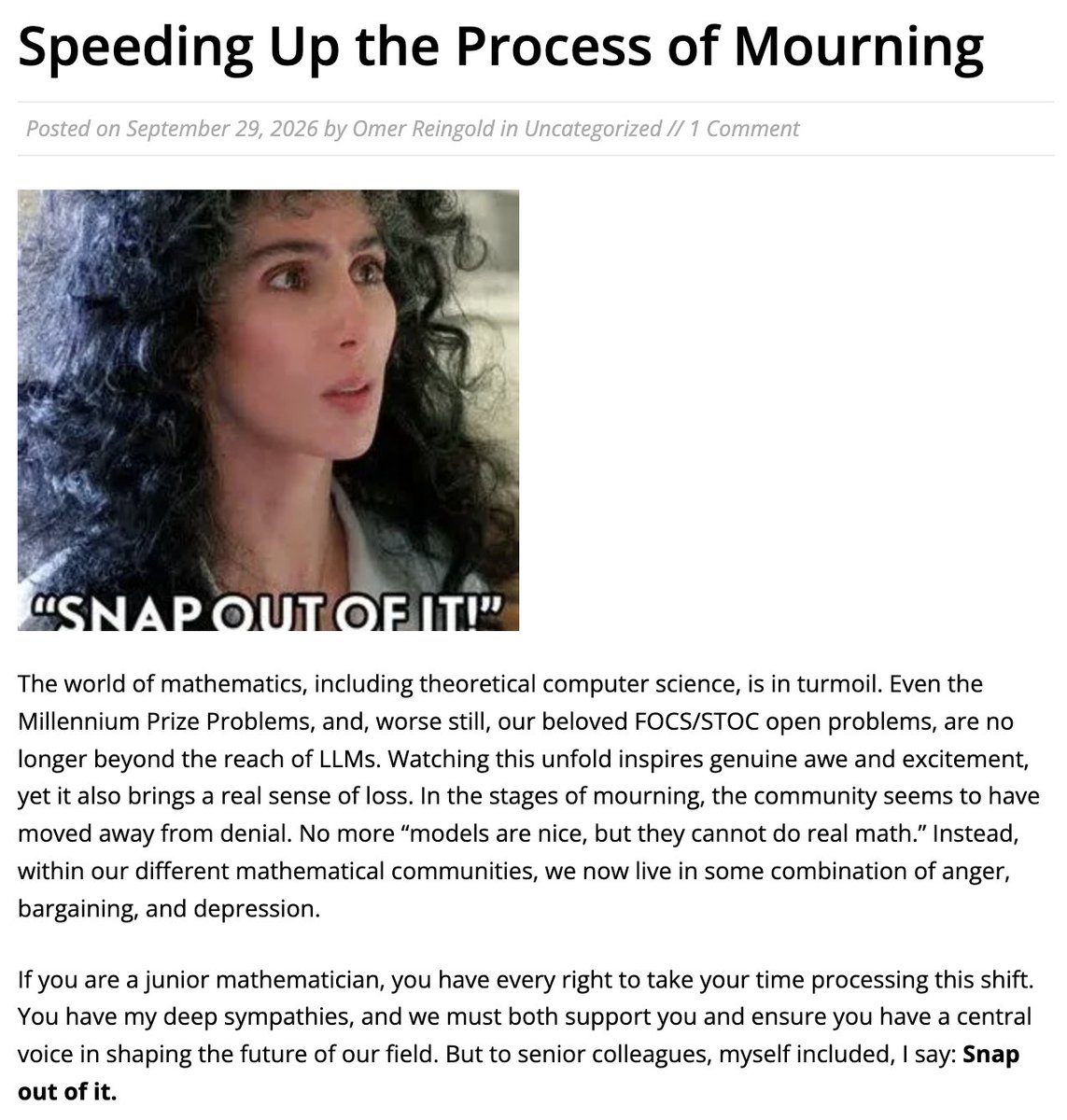
Lovely post by @OReingold26757 requesting that senior mathematicians and theoretical computer scientists jump over the stages of grief into the productive action stage. Including to try to push on alignment!
@gerardsans Sure it is a correct description of the architecture. My point is that since factored distributions are a universal representation, you cannot infer anything about the function from it.
An annoying part of the twitter/bluesky discussion of whether LLMs are "only" "next token predictor"/stochastic parrots is that "next token predictor" is contentless - all mappings from inputs to output strings can be factored into a sequence of "next token" distributions.