If you would like to know more, here is our recorded talk for FOCS: https://t.co/K8XmzMCjUY.
For an expository presentation of our results, see: https://t.co/9pnyM9bE5j.
In a previous work with Cynthia Dwork and Salil Vadhan (https://t.co/JNZfLu6fLW, presented at STOC 2024), we showed that from multicalibration we get a stronger and more general Hardcore Lemma, from which we derive the original Hardcore Lemma with optimal density 2*delta.
...other multigroup fairness notions) has recently been shown to be powerful in other settings in TCS, including in omniprediction (https://t.co/g3LWwOI5dp), in pseudoentropy characterizations (https://t.co/B4LZyZMhbA), and in robust learning (https://t.co/OJ904AfmP2).
A similar picture emerges in the setting of complexity theory. We know, from the work of Trevisan, Tulsiani, and Vadhan, that from the Regularity Lemma (= multiaccuracy theorem) we can prove Impagliazzo’s Hardcore Lemma, albeit with suboptimal density delta.
That is, in certain cases there is no way to post-process a multiaccurate predictor to get a weak learner, even assuming the best hypothesis in C has high correlation. However, when we also require p to be calibrated, we recover not just weak, but strong agnostic learning.
We show that for many classes C we can construct a predictor p that is perfectly C-multiaccurate, yet p is completely uncorrelated with the labels (even though some concepts in C do have high correlation with the labels).
We know that we can construct multiaccurate and multicalibrated predictors from weak agnostic learning, and that a C-multicalibrated predictor is a strong agnostic learner for C. But what learning guarantees does multiaccuracy (= computational indistinguishability) offer?
It was great to attend FORC at Harvard this past week!
I gave a talk on our paper “How Global Calibration Strengthens Multiaccuracy” (joint work with Parikshit Gopalan, Varun Kanade, and Omer Reingold), which we presented at FOCS this past December.
https://t.co/lMtsYB2XRl
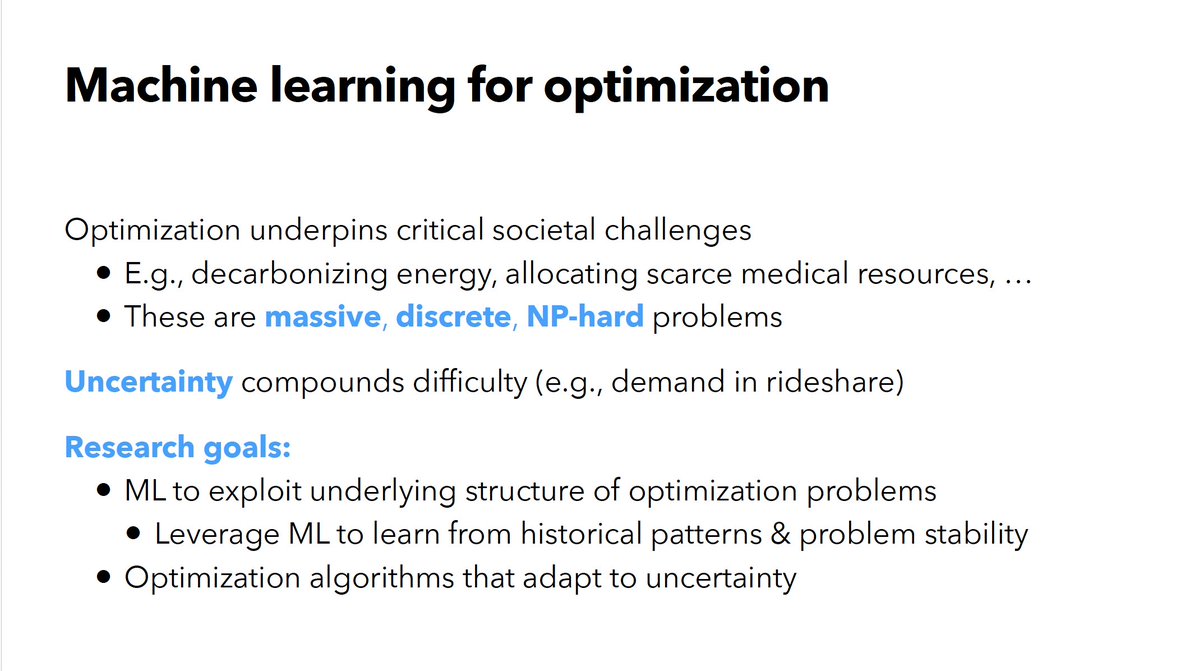
Can machine learning improve discrete optimization algorithms without sacrificing theoretical guarantees?
This was the central question of the talk I gave this spring at a few schools (UCSD, UIC, Yale, Penn): Machine Learning for Discrete Optimization: Theoretical Foundations.
How many samples do you need from an unknown distribution in order to train a model with multicalibration error at most epsilon?
Answer: 1/epsilon^3 samples is both necessary and sufficient.
If you’re interested in prediction vs downstream decision-making, calibration (in the predictive or generative setting), uncertainty quantification, multigroup learning, or any related problems, I would love to chat!
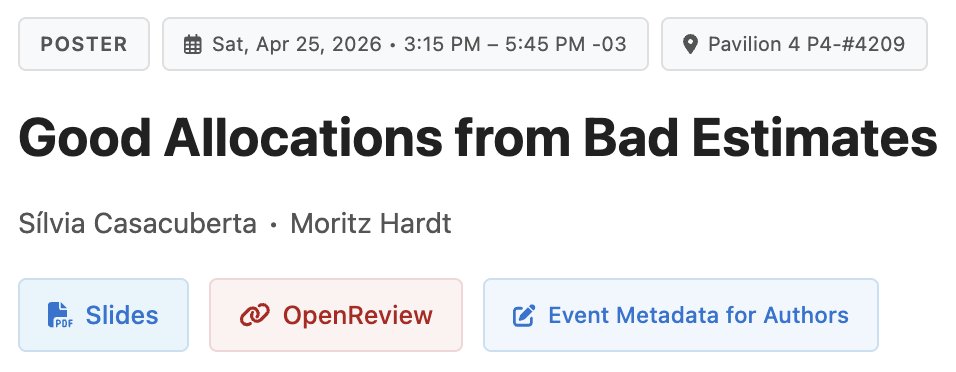
Excited to be attending #ICLR in Rio this week! I will be presenting our paper (joint with Moritz Hardt) on the sample complexity of treatment allocation.
I will be at Pavilion 4 on Saturday 3:15-5:45 pm (poster session 4, #4209).
https://t.co/QOVrXTJ7CP
Harvard researchers have launched the Differential Privacy Deployments Registry, a public database that catalogs real-world uses of differential privacy by companies and agencies to better protect individuals’ data. https://t.co/obF8y2kQKq
New award: Trevisan Award for Expository Work. Love the idea of awarding work that explains and illuminates, and it is so fitting way to honor Luca, who was a master explainer.
https://t.co/WTCu7vk2Cf
The successes of generative AI and LLMs involve deep internal representations of the world. In his Theoretically Speaking lecture, Jon Kleinberg explored how these work, and how they relate to the representations of the world that we build as humans.
https://t.co/SHnsPDjDUQ