Agree credit now favours non-AI cash flows. But if even SpaceX's CDS hit records on the $40B news, is the real filter revenue or power + cooling execution?
Which neocloud survives: the one with the cheapest GPUs or the one with the cheapest electrons?
Pretty much.
As of the past few weeks, debt markets have almost entirely shut off access to money for any company that doesn’t have substantial revenue independent of AI data centers.
SpaceX closed $40B of debt for GPUs, but we’re investment grade and have Starlink & launch revenue.
That means the 200+ neoclouds are going to see guppy-level death and consolidation. Some will make it through, but not many.
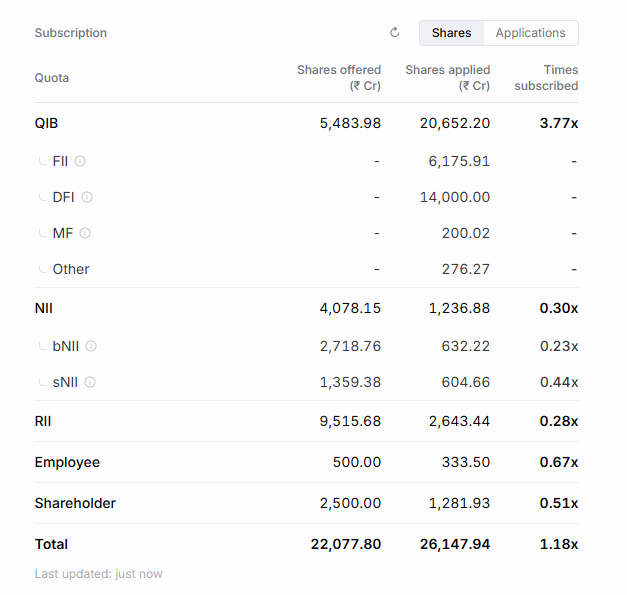
🚨 JIO IPO ALLOTMENT: TONIGHT 🚨
📌 BOOKMARK this post and save the link below. Allotment pages get crowded fast.
🔗 https://t.co/gheMxEC3JQ
✅ KEEP READY:
▪️ PAN number
▪️ Application number
▪️ Demat account details
✅ HOW TO CHECK:
1️⃣ Open the link
2️⃣ Select "Jio Platforms" from the IPO list
3️⃣ Enter your PAN or application number
4️⃣ Submit and see your status
⏳ If it says "Waiting", don't panic. The registrar activates the page once allotment is finalised. Try again in a bit.
📅 Listing Date: 28 Oct
💬 Did you apply? Comment YES or NO 👇
🔁 Repost so your friends see it!
Follow @AashishAuti for daily IPO and market updates.
(Educational only, not financial advice. Dates may change.)
#JioIPO #JioPlatforms #IPOAllotment #IPO #StockMarket
Coforge is now a Leader in Everest Group's QE Services for AI Applications and Systems assessment.
Key Highlights:
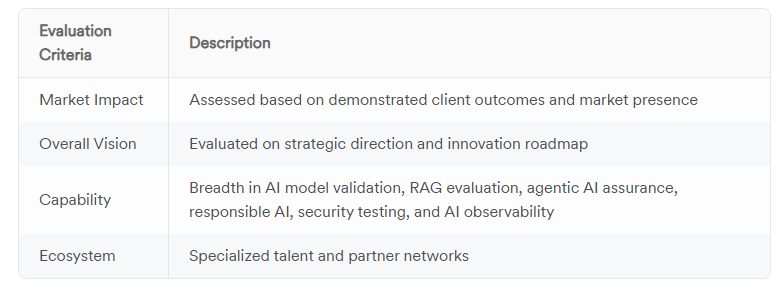
Coforge Limited recognized as a Leader in the Everest Group QE Services for AI Applications and Systems PEAK Matrix® Assessment 2026.
Evaluation covered 40 service providers based on market impact, vision, and capability.
Key criteria included AI model validation, RAG evaluation, agentic AI assurance, and security testing
Recognition highlights Coforge's ability to validate, secure, and govern production AI systems.
#Coforge
Breaking: ISRO to have four functional launch pads by 2029, says Chairman V Narayanan. 🚀 The roadmap includes a 2,000-acre SSLV complex at Kulasekarapattinam, Tamil Nadu. ISRO won’t be privatised, but will partner with private firms to meet rising satellite demand. #ISRO #SpaceTech #India
Breaking: Cancer drug prices can rise despite margin cap.
Overview
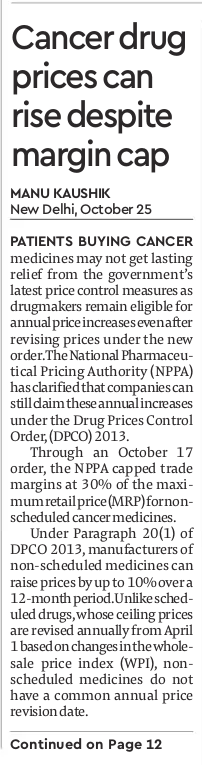
Patients buying cancer medicines may not get lasting relief from the government’s latest price control measures. Drugmakers remain eligible for annual price increases even after the new order, as clarified by the National Pharmaceutical Pricing Authority (NPPA) under the Drug Prices Control Order (DPCO) 2013.
The October 17 order
The NPPA capped trade margins at 30% of the maximum retail price (MRP) for non-scheduled cancer medicines.
The government estimates the cap on 137 non-scheduled anti-cancer drugs could cut MRPs by up to 70%, generating annual savings of about ₹2,500 crore for patients.
How the annual price hike works:
Under Paragraph 20(1) of DPCO 2013, manufacturers of non-scheduled medicines can raise prices by up to 10% over a 12-month period.
Scheduled drugs have ceiling prices revised annually from April 1, based on changes in the wholesale price index (WPI). Non-scheduled medicines have no common annual revision date.
Companies that revise their MRP under the order can raise prices under the annual hike provision from the date the revised MRP takes effect, provided the revised prices are implemented by November 9.
Companies that leave their MRP unchanged become eligible only after 12 months have passed since the last revision.
This does not mean prices will automatically rise by 10%, but future increases could partly offset the initial savings, depending on the price reduction and later revisions.
Why the government intervened:
1) An official at a leading pharma association said the scale of trade mark-ups prompted the action.
2) Retailers typically earn a 16% margin on scheduled drugs under the government’s pricing formula, versus a usual 20% on non-scheduled medicines.
3) An NPPA analysis in October found trade mark-ups on non-scheduled anti-cancer medicines averaged around 170%, reaching 700% in some cases.
4) Drugmakers have no fixed prescribed profit margin for either category. Established pharma companies typically report gross margins of 50-80% and operating margins of 15-30%.
Other NPPA clarifications:
1) Existing stock: Medicines already supplied to pharmacies and hospitals need not be recalled, re-labelled or re-stickered, provided manufacturers ensure retailers charge the revised MRP rather than the higher price printed on older packs. Experts said this avoids cost and logistical challenges, but effective monitoring will be essential.
2) Wider coverage: Since the cap also covers certain medicines used to treat conditions other than cancer, the price limit applies to formulations containing drugs listed in the order, regardless of strength, form (tablets, injections) or method of administration. This could extend price-control benefits to more patients.
3) Returned medicines: Companies cannot deduct the value of returned medicines from sales when setting the prices at which stockists and distributors buy medicines. This could stop companies from lowering their reported sales by accounting for returns, though the effect on stockists’ margins and patient prices depends on how the pricing formula uses these figures.
Key takeaway
The margin cap should cut prices sharply at first, but the 10% annual hike provision means the relief may not last unless prices are monitored closely.
Cancer drug prices may not stay low. NPPA capped trade margins at 30% of MRP on 137 non-scheduled anti-cancer drugs, cutting MRPs by up to 70% (~₹2,500 crore in annual savings). But makers can still raise prices up to 10% a year. 💊 #CancerCare#DrugPricing
Average balance in PMJDY accounts hits a record ₹5,438, up from ₹5,356 in August. Deposits now total ~₹3.24 lakh crore across 595.9 million accounts. Women hold ~56% of accounts, and public sector banks account for ~77%. 🏦 #JanDhan#FinancialInclusion#India#PMJDY
Festive rush, flat pay: E-commerce firms hired 20-30% fewer seasonal workers than planned, and quick-commerce gig demand is up 18% this season. Yet per-order payouts are stuck at ₹20-30, and e-commerce delivery pay has dropped to ₹12-15 from ₹25-28 last year. 📉 #GigWorkers #FestiveSeason #Zomato #Swiggy #Amazon #Blinkit #QuickEcommerce
Pretty much.
As of the past few weeks, debt markets have almost entirely shut off access to money for any company that doesn’t have substantial revenue independent of AI data centers.
SpaceX closed $40B of debt for GPUs, but we’re investment grade and have Starlink & launch revenue.
That means the 200+ neoclouds are going to see guppy-level death and consolidation. Some will make it through, but not many.
@elonmusk@chamath@elonmusk Agree credit now favours non-AI cash flows. But if even SpaceX's CDS hit records on the $40B news, is the real filter revenue or power + cooling execution?
Which neocloud survives: the one with the cheapest GPUs or the cheapest electrons?
Reportedly, 3 Russian diesel tankers, each carrying about 300,000 barrels, are en route to the US. That is 900,000 barrels, roughly 5 hours of American diesel use: a big geopolitical signal, small supply impact.
#us#russia#geoplitical#Diesel
7/7
Reason 5: The missing AI story 🤖
Many large Indian firms are "consolidating their past," per Bernstein. India has no global AI giant yet.
Next test: this week's earnings will show how badly margins are squeezed.
Source: BBC News
#india#AI#BBC#FII#Stockmarket
1/7
India's economy is growing at 7%+, yet its stock market is among 2026's worst performers. 📉
Nifty is down ~15% this year, after 8 straight weekly losses, the longest streak in 25 years.
Why?
#economy#indianmarket#stockmarket#nifty
6/7
Reason 4: Valuations are still high 💰
Indian stocks are cheaper than their 10-year average, but still pricey next to Korea and Taiwan, whose profits are boosted by the AI boom.
#AI#korea#taiwan#stockmarket#nifty50#FII