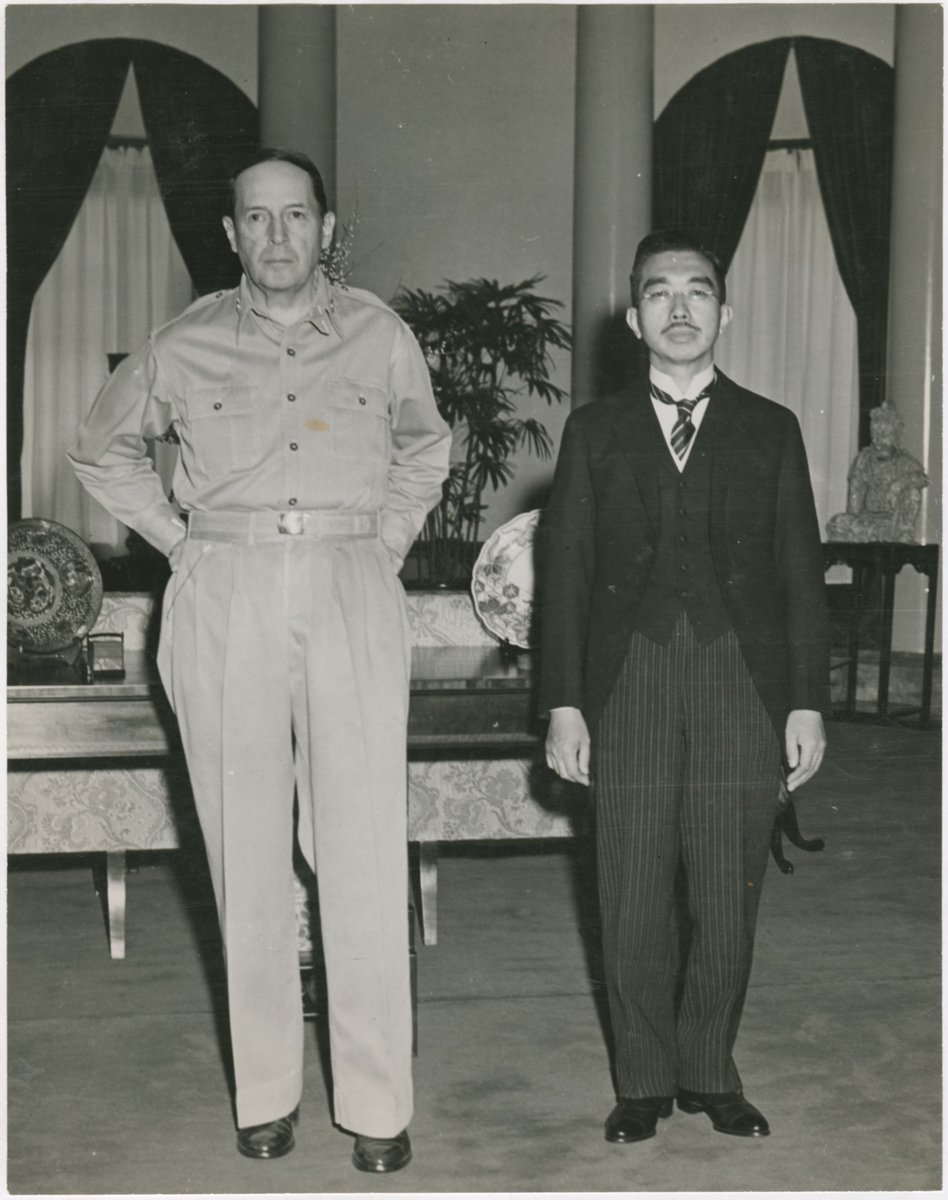
Look at the posture of the two men in this photograph, taken in Tokyo on September 27, 1945.
Twenty-five days earlier, World War II had ended. Across Allied capitals, politicians and newspapers were demanding that Emperor Hirohito be indicted as a war criminal and hanged.
When the Emperor asked to visit the U.S. Embassy in person, General Douglas MacArthur stood in an unbuttoned khaki shirt with no tie, hands on his hips. As MacArthur later confessed in his memoirs, he braced himself for an awkward plea: throughout history, conquered rulers almost always blamed their advisors and begged to save their own necks.
Everyone left the room except the Emperor's interpreter. MacArthur offered him an American cigarette and noticed the Emperor's hands trembling slightly as he lit it.
Then came the words MacArthur never forgot.
In his autobiography Reminiscences, MacArthur wrote that the Emperor told him he had come to offer himself to the judgment of the powers MacArthur represented, as the one to bear sole responsibility for every political and military decision made and action taken by his people in the conduct of the war.
MacArthur wrote that a tremendous impression swept over him, chilling the marrow of his bones. Standing before him was a man willing to lay his own life on the chopping block so his starving, bombed-out nation would not be torn apart.
In that single thirty-five-minute meeting, the Supreme Commander decided no trial would touch him. When their talk ended, breaking his own initial protocol, MacArthur personally escorted the Emperor out to his car.
Two fierce enemies walked into that room in 1945. Eighty years of peace across the Pacific walked out.
@urielirigaray 제국이 망하는 이유.
1. 착취하는 제국 -> 착취는 필연적으로 착취당하는 사람을 가난하게 함 -> 부를 유지하기 위해 침략 -> 한계로 망함.
2. 포용하는 제국 -> 여러 민족을 동등하게 대함 -> 다문화로 인한 갈등 -> 분열
3. 순혈주의/고립주의 제국 -> 경쟁이 없어서 발전이 느림 -> 도태됌.
3rd wave feminism holds this weird position that women sexualizing themselves is empowering but men viewing women sexually is evil. So you end up with such schizophrenic situations, where the woman showing her bare ass in public is not a pervert, but the guy looking at it is.
@LucasSi82299374@jjuaumsccp Pior que a maioria dos esquerdistas são assim mano. Eles não deixam quem pensa diferente falar, simplesmente.
Fora o efeito Danin Krugger de achar que sabem muito do que estão falando.
@LucasSi82299374@jjuaumsccp Debater com o Jones é como jogar xadrez com um pombo. Ele vai subir no tabuleiro, derrubar as peças, cagar na mesa e sair com o peito estufado como se tivesse ganhado kkkkkk
Estou começando a ficar genuinamente preocupado com o meu fascínio por Rui Costa Pimenta.
É uma lucidez nas análises que me assusta. Será que sou trotskista?
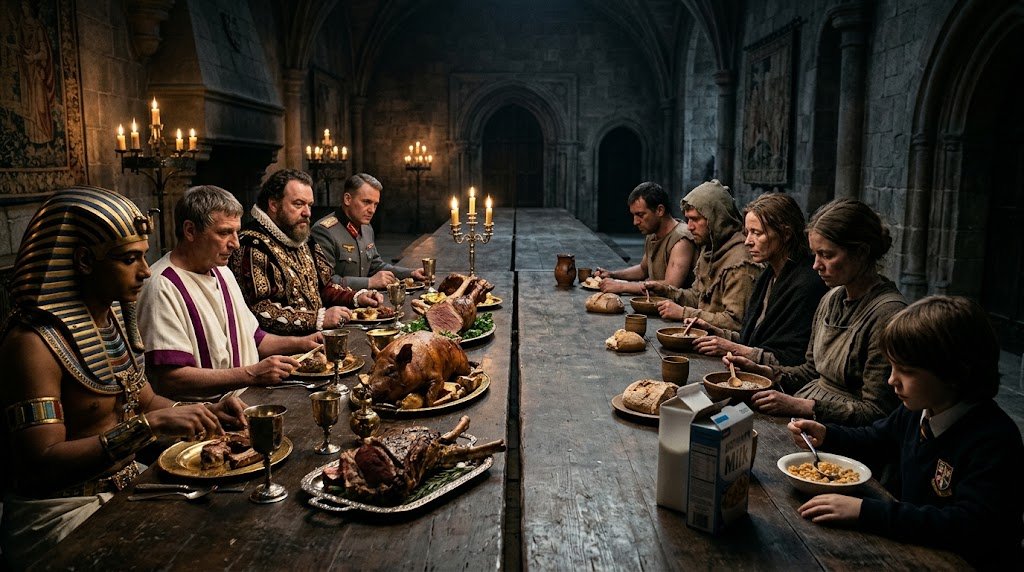
Roman slaves ate bread, olives and porridge, washed down with vinegar.
Roman senators ate boar, dormice and peacock.
Egyptian labourers raised the pyramids on bread, onions and beer.
The pharaoh ate beef.
Spartan helots ate barley and figs.
The Spartans who owned them ate a black broth of pork and blood.
Chinese peasants ate millet and rice.
Genghis Khan's horsemen rode over them on mutton and mare's milk.
Indian lower castes ate rice, lentils and flatbread.
The Mughal emperors ate lamb off gold plates.
Japanese peasants ate rice and pickles.
The samurai ate fish and game.
Medieval serfs ate pottage and black bread.
The lord ate venison, and blinded a serf for touching a deer.
Tudor commoners ate bread cut with chalk.
Henry VIII's court went through thousands of cattle a year.
Irish cottiers ate potatoes, and in 1847 they ate grass.
Their landlords ate beef, and shipped the rest to England past the dying.
Plantation slaves ate cornmeal and a weekly scrap of fatback.
The planter ate ham, oysters and cream.
Victorian mill hands ate bread, tea and jam.
The Victorian aristocracy ate beef, game and butter.
Soviet collective farmers ate black bread and cabbage soup.
Stalin served his inner circle roast meat and caviar until four in the morning.
Every civilisation. Every century. Every continent.
The poor got the plants.
The powerful took the animals.
Nobody in five thousand years ran a trial on it. They watched which men grew tall and which men obeyed, and kept the meat for themselves.
Then in 1977 a wheat-state senator, a Harvard professor on sugar money and a reporter with no training told the world the slave's plate had been the healthy one all along.
No pharaoh ever fed the pottage to his own son.
They fed it to yours.
Madurar es entender que el Imperio es orden, progreso y seguridad a lo Bukele mientras que la república era multicultunegrismo gay y anti-humano que importaba a gorillones de aliens violadores y delincuentes
Early Christians baffled the Roman world because their counter-cultural way of life, radical compassion, and refusal to conform to civic religion turned traditional Roman values upside down...
Christians worshipped only one God and refused to burn incense to Caesar or participate in state polytheistic rituals. Romans viewed this as a dangerous form of atheism and treason that could anger the gods and destabilize the empire. Roman society was deeply hierarchical and honor-driven, built on class, slavery, and status. Christians treated slaves, masters, the poor, and elites as spiritual equals before Christ. Romans routinely exposed unwanted or disabled infants to die of exposure. Christians actively combed public dumpsters and streets to rescue these babies and raise them as their own—an act so foreign to Romans that they falsely accused Christians of bizarre rituals like child sacrifice. While Roman culture prized honor, strength, and retribution against enemies, Christians practiced radical forgiveness and charity. They cared for widows, orphans, the poor, and even plague victims regardless of whether they were believers, prompting early writers like Tertullian to note observers saying, "See how they love one another!" Unlike other oppressed groups or zealots who fought the Roman legions with the sword, Christians refused violent revolution. When dragged before magistrates or executed in the arenas, many faced death with calm resolve or song rather than armed resistance, which baffled authorities who only understood power backed by military might.
. . .
Early Christians in Roman Empire showed a high level of devotion to their God that made their persecution backfire. On many occasions, the martyrs sang while awaiting execution in arenas. While Roman authorities at the time intended for public executions to serve as a warning to anyone who refused to honor traditional gods, the strategy did not work. Roman Emperor Nero started the trend in 64 CE after a great fire destroyed much of Rome. At the time, he needed people to blame for the disaster and chose the Christians as they were a small group of secretive people that lived on the fringes of society. The plan to scare the public away from the new faith failed as instead of fear, the lurid sights of their devotion to their faith even in the face of death, created curiosity among Roman citizens.
The public executions of Christians were meant to humiliate victims, their displays of courage when facing persecution were rare in a society built on power and self-interest. As a result, many Romans began to wonder what kind of god could give a person such strength. Tertullian, a famous writer from that era, notably wrote that the blood of martyrs acted as the seed of the church. Every time the state killed a believer, more people signed up to join the movement. While most people in the empire easily added the Roman Emperor to their list of gods in order to avoid trouble, the Christians refused to burn incense to the image of the ruler. Over time, the church became more organized and created a welfare system that the Roman government simply did not provide. When the Plague of Cyprian that emerged in 251 CE killed thousands of people, pagan priests and wealthy citizens fled to their country estates to avoid the sickness. Christians by contrast stayed in the cities to nurse the sick and bury the dead regardless of whether the victims were believers or not. This level of kindness earned them deep respect among the poor and middle classes. The actions also helped to earn the trust of the people.
📷 : Faithful unto Death (Christianae ad Leones!) or Christians to the Lions; an 1888 oil-on-canvas work by British artist Herbert Gustave Schmalz (1856-1935) that depicts Christian martyrs awaiting their fate in the Colosseum.
#archaeohistories
@jjuaumsccp o Arthur é mto fdp, eu só reparei q o jones fazia essa boca depois de ver ele imitando. Imagina a mente do cara pra memorizar o jeito q sua boca fica qdo vc fala só pra te zoar depois kkkkkkk