Unsecured leveraged lending does not exist for retail. Most are either securities-backed or mortgage-backed, but 7x to 10x leverage is unheard of. On top, there is debt service ratios levied by banks. @deepakshenoy views?
@Ankit_Quant Most so-called Fin-Influencers are doing these clickbait posts saying 20% IRR return on revised FCNR deposit rates across 3-5 Yrs. Pure BS for 80-90% of NRI's. No FI provides that kind of leverage to retail folks. Shows how shallow the influencers are
@Ankit_Quant Most so-called Fin-Influencers are doing these clickbait posts saying 20% IRR return on revised FCNR deposit rates across 3-5 Yrs. Pure BS for 80-90% of NRI's. No FI provides that kind of leverage to retail folks. Shows how shallow the influencers are
If big companies can't make a net return on their LLM token costs, that doesn't mean it's impossible to. In fact this is exactly what you'd expect to happen with a new technology. Incumbents can't use it well, and are replaced by upstarts who can.
Anthropic has Interesting choice of deal structuring between equity and private credit just before IPO, prudent and measured unlike it's competitor https://t.co/rvbhYgnylK
Jensen nails it with task vs purpose, Tasks are what you do (code, draft, analyze, schedule). Purpose is why it matters - judgment, creativity, relationships, and discovering new problems. Master the “why.” Use AI to crush the “how.”
This is a fantastic post about why jobs aren’t going away in the way some predict. We are constantly making the mistake of confusing task completion with AI with being able to eliminate the whole job.
Even as we can automate one or many tasks within a job, the definition of the job almost inevitably just expands to do vastly more of those tasks, do them at a higher quality, or move on to the type of task that hasn’t been automated yet.
And as a result of being able to do more of the tasks or at a higher quality level, the job becomes valuable in a new way. And in many cases for now an entirely new audience as well.
This will be true for coding, legal work, sales, or marketing. The small business or non-tech company that wants to now take on larger software projects finally can, and they’ll hire to do so. The small business that couldn’t afford a full marketing agency can hire or contract out to a marketer that can do as much as an agency did before now with agents. And so on.
Don’t fall into the trap of confusing tasks with jobs.
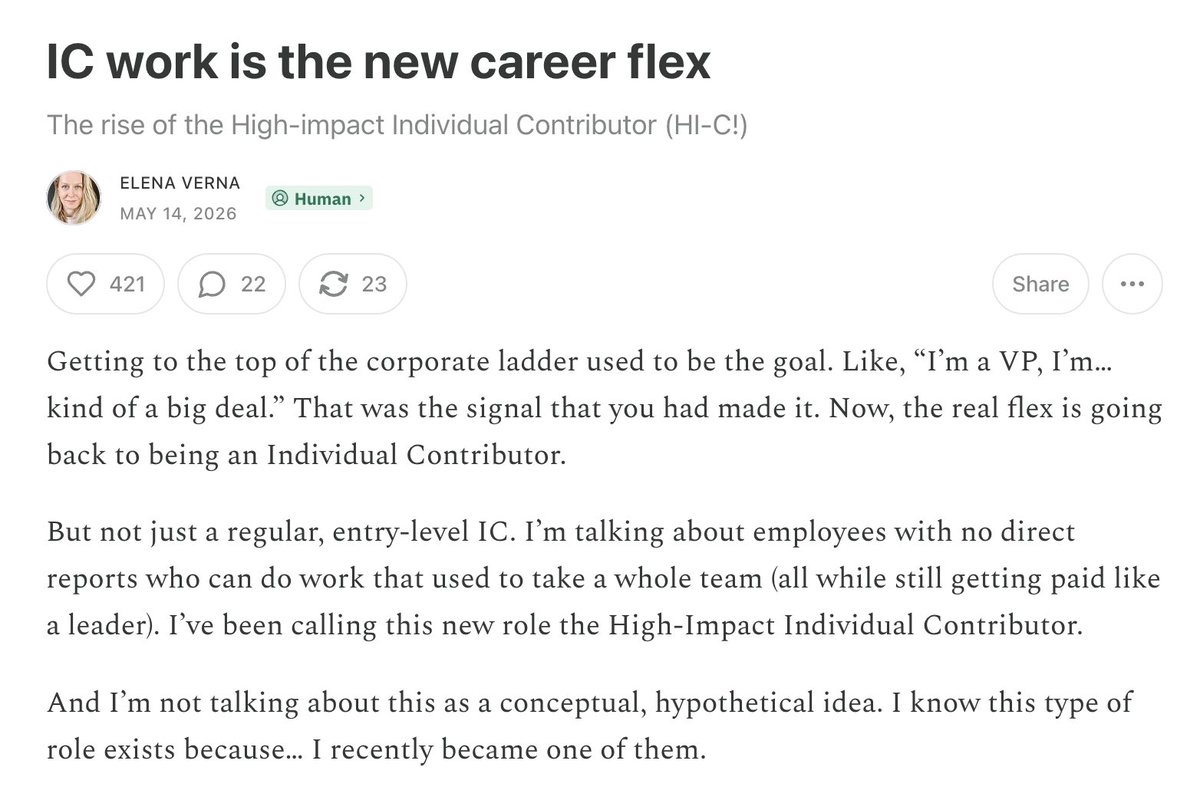
For all those who are not working at frontier, trend is moving towards ICs combining domain expertise and adopting codex / cc / cursor agents with self built skills and workflows to cut weeks to days and punch above. The bar has gotten higher
The vibes in SF feel pretty frenetic right now. The divide in outcomes is the worst I've ever seen.
Over the last 5yrs, a group of ~10k people - employees at Anthropic, OpenAI, xAI, Nvidia, Meta TBD, founders - have hit retirement wealth of well above $20M (back of the envelope AI estimation).
Everyone outside that group feels like they can work their well-paying (but <$500k) job for their whole life and never get there.
Worse yet, layoffs are in full swing. Many software engineers feel like their life's skill is no longer useful. The day to day role of most jobs has changed overnight with AI.
As a result,
1. The corporate ladder looks like the wrong building to climb.
Everyone's trying to align with a new set of career "paths": should I be a founder? Is it too late to join Anthropic / OpenAI? should I get into AI? what company stock will 10x next? People are demanding higher salaries and switching jobs more and more.
2. There’s a deep malaise about work (and its future).
Why even work at all for “peanuts”? Will my job even exist in a few years? Many feel helpless. You hear the “permanent underclass” conversation a lot, esp from young people. It's hard to focus on doing good work when you think "man, if I joined Anthropic 2yrs ago, I could retire"
3. The mid to late middle managers feel paralyzed.
Many have families and don't feel like they have the energy or network to just "start a company". They don't particularly have any AI skills. They see the writing on the wall: middle management is being hollowed out in many companies.
4. The rich aren’t particularly happy either.
No one is shedding tears for them (and rightfully so). But those who have "made it" experience a profound lack of purpose too. Some have gone from <$150k to >$50M in a few years with no ramp. It flips your life plans upside down. For some, comparison is the thief of joy. For some, they escape to NYC to "live life". For others still, they start companies "just cuz", often to win status points. They never imagined that by age 30, they'd be set. I once asked a post-economic founder friend why they didn't just sell the co and they said "and do what? right now, everyone wants to talk to me. if i sell, I will only have money."
I understand that many reading this scoff at the champagne problems of the valley. Society is warped in this tech bubble. What is often well-off anywhere else in the world is bang average here.
Unlike many other places, tenure, intelligence and hard work can be loosely correlated with outcomes in the Bay. Living through a societally transformative gold rush in that environment can be paralyzing. "Am I in the right place? Should I move? Is there time still left? Am I gonna make it?" It psychologically torments many who have moved here in search of "success".
Ironically, a frequent side effect of this torment is to spin up the very products making everyone rich in hopes that you too can vibecode your path to economic enlightenment.
300,000 AI builders have already added their hardware to HF to instantly see what model they can run locally.
To do so, go to https://t.co/dqD1bcXisv and add your hardware specs.
You can even show off publicly by adding it to your HF profile!
Let's go local AI!
Singapore's Foreign Minister published the architecture for his "second brain for a diplomat" yesterday. Architecture diagrams, design rationale, the works. A developer-style writeup of his own system.
It runs on a Raspberry Pi. It connects to his WhatsApp and Gmail, transcribes voice notes locally, ingests speeches and articles, and builds up a knowledge graph over time. It answers questions, drafts speeches, condenses information. He says he doesn't dare switch it off.
What @VivianBala built is one-of-one. There's no other setup like it. But what he built it from isn't.
He composed four open-source pieces:
- @NanoClaw_AI , the agent framework: https://t.co/JlIJqOVBFG
- Mnemon, the persistent memory layer: https://t.co/ugrB7uF6XL
- OneCLI, the credential proxy that keeps API keys out of the containers: https://t.co/sTGn59abpF
- The LLM Wiki pattern by Andrej Karpathy, the synthesis approach: https://t.co/wqvlVzcnyk
None of them are his. The composition is his. And then he published the composition: https://t.co/azzfijyzPs
He didn't keep it internal as Singapore's edge. He didn't spin it into a product. He didn't gatekeep. He wrote it up and put it on GitHub.
There are tens of thousands of doctors, lawyers, researchers, investors, and operators building one-of-one setups for themselves right now. Some simpler than Vivian's, some more elaborate. The impulse will be to sit on it. Treat it as your edge. Think about what product or company you could spin out of it. Resist that impulse.
Vivian put it directly: "The diplomat who learns to work with AI will have a meaningful edge. I think that edge is now."
The specific thing Vivian composed will be obsolete in months. His real edge isn't the system. It's his ability to build it. Being plugged in, up to speed, able to cut through the noise and connect the right pieces into something that brings real value.
Sharing the blueprint doesn't give that away. It amplifies it.
You become a beacon. Other people working on the same things find you. They share what they're building, suggest improvements, point at things you didn't know existed. You learn faster. You stay in the center of where things are happening. Publishing isn't giving away your edge. It's doubling down on it.
I vibe code watching @MaxComedian, thanks @nikhyl@lennysan for this wonderful podcast, feel it truly reflects the state of the workforce https://t.co/L7brKDN2mp
So much meat here. Pick a niche and build something that solves for agent adoption. UX is key for adoption. Headless is already the norm to leverage existing UX flows. The one-size-fits-all SaaS paradigm is being rewritten
Another week on the road meeting with a couple dozen IT and AI leaders from large enterprises across banking, media, retail, healthcare, consulting, tech, and sports, to discuss agents in the enterprise.
Some quick takeaways:
* Clear that we’re moving from chat era of AI to agents that use tools, process data, and start to execute real work in the enterprise. Complementing this, enterprises are often evolving from “let a thousand flowers bloom” approach to adoption to targeted automation efforts applied to specific areas of work and workflow.
* Change management still will remain one of the biggest topics for enterprises. Most workflows aren’t setup to just drop agents directly in, and enterprises will need a ton of help to drive these efforts (both internally and from partners). One company has a head of AI in every business unit that roles up to a central team, just to keep all the functions coordinated.
* Tokenmaxxing! Most companies operate with very strict OpEx budgets get locked in for the year ahead, so they’re going through very real trade-off discussions right now on how to budget for tokens. One company recently had an idea for a “shark tank” style way of pitching for compute budget. Others are trying to figure out how to ration compute to the best use-cases internally through some hierarchy of needs (my words not theirs).
* Fixing fragmented and legacy systems remain a huge priority right now. Most enterprises are dealing with decades of either on-prem systems or systems they moved to the cloud but that still haven’t been modernized in any meaningful way. This means agents can’t easily tap into these data sources in a unified way yet, so companies are focused on how they modernize these.
* Most companies are *not* talking about replacing jobs due to agents. The major use-cases for agents are things that the company wasn’t able to do before or couldn’t prioritize. Software upgrades, automating back office processes that were constraining other workflows, processing large amounts of documents to get new business or client insights, and so on. More emphasis on ways to make money vs. cut costs.
* Headless software dominated my conversations. Enterprises need to be able to ensure all of their software works across any set of agents they choose. They will kick out vendors that don’t make this technically or economically easy.
* Clear sense that it can be hard to standardize on anything right now given how fast things are moving. Blessing and a curse of the innovation curve right now - no one wants to get stuck in a paradigm that locks them into the wrong architecture. One other result of this is that companies realize they’re in a multi-agent world, which means that interoperability becomes paramount across systems.
* Unanimous sense that everyone is working more than ever before. AI is not causing anyone to do less work right now, and similar to Silicon Valley people feel their teams are the busiest they’ve ever been.
One final meta observation not called out explicitly. It seems that despite Silicon Valley’s sense that AI has made hard things easy, the most powerful ways to use agents is more “technical” than prior eras of software. Skills, MCP, CLIs, etc. may be simple concepts for tech, but in the real world these are all esoteric concepts that will require technical people to help bring to life in the enterprise.
This both means diffusion will take real work and time, but also everyone’s estimation of engineering jobs is totally off. Engineers may not be “writing” software, but they will certainly be the ones to setup and operate the systems that actually automate most work in the enterprise.