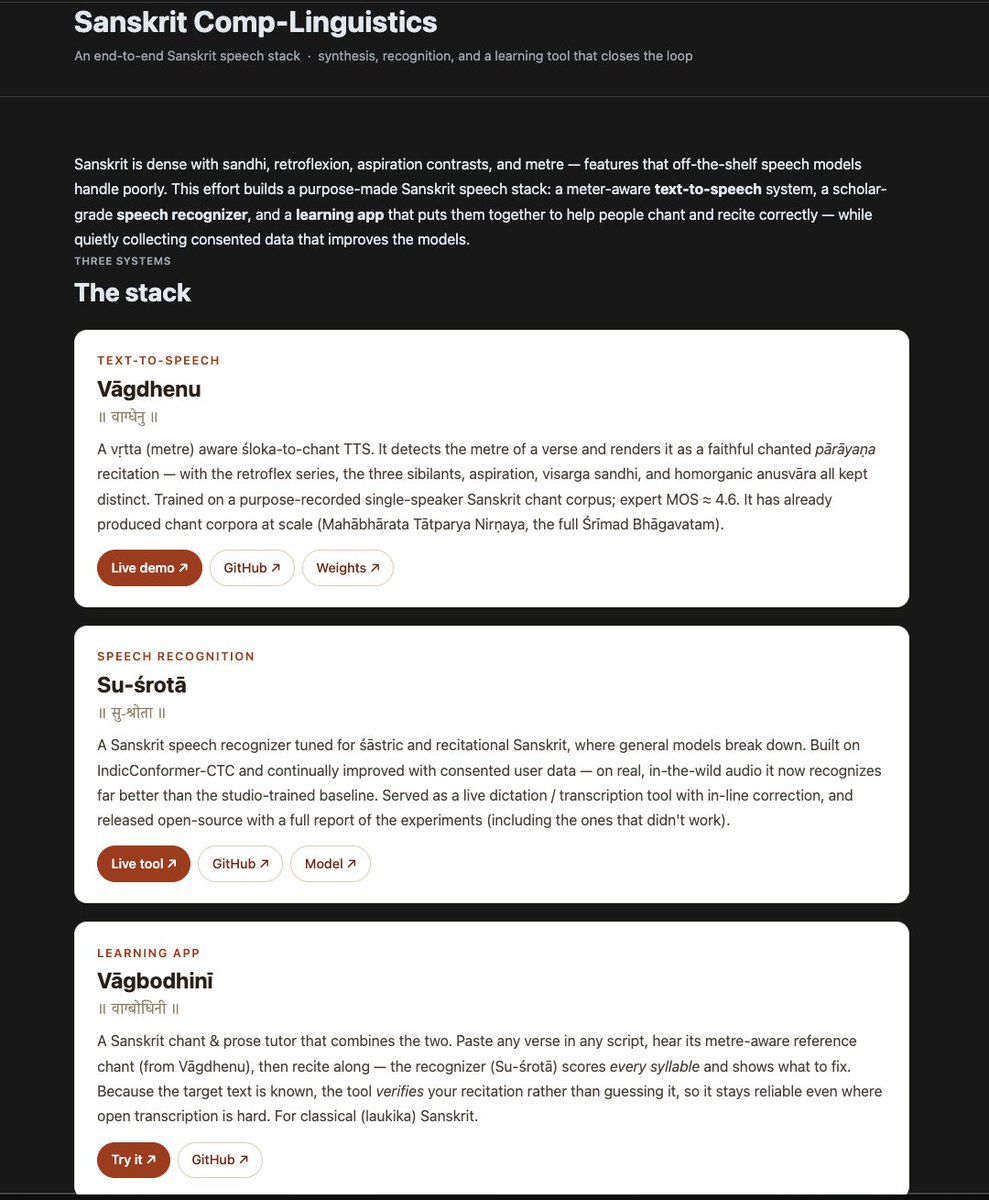
This summer, I worked on a few interesting use cases of AI for Sanskrit - a chant TTS, ASR, chant-learning feedback tool, and several apps, including Bhagavatam and Sarvamula. I just collated all of them in one place: https://t.co/H23qjXPapu. May be of interest to a few here.
Navier-Stokes Millennium saga continues. Here are my slides and a summary from a recent talk. Disclaimer: this is a physicists view of the problem & solution! 🧵
HydroGym: A Reinforcement Learning Platform for Fluid Dynamics
Now published in Nature!! https://t.co/o1zTn2DIHg
GitHub: https://t.co/9MLBzJAMiJ
Amazing collaboration with Christian Lagemann, S Mokbel, M Gondrum, M Rüttgers, Y Wang, P Suárez, L Paehler, D A Bezgin, A B Buhendwa, J L Callaham, S Ahnert, N Zolman, X Shao, J-Ch Loiseau, N A. Adams, M Meinke, W Schröder, K Lagemann, E Lagemann, R Vinuesa & S L Brunton
NEW AI MODEL TARGETS PHYSICS AT MASSIVE SCALE
Accelerated Understanding, founded by former NVIDIA scientist Anima Anandkumar and Benedikt Jenik, unveiled an AI model designed to predict physical phenomena, rather than language.
The company says it processed 5 trillion data points in one prompt, far beyond typical AI context sizes.
Using neural operators instead of Transformers, the technology targets chip design, robotics, extreme weather and energy applications, with an initial focus on enterprise customers.
Mesopotamia was never the cradle of civilisation. India was.
I spent forty years in international shipping, not academia. When I began researching the history of maritime trade, I had no orthodoxy to defend. I followed the evidence, and it kept arriving in the same place: the Indian subcontinent.
Nineteenth century archaeologists dug in Mesopotamia because the climate preserved artefacts, the biblical sources pointed them there, and the Ottomans allowed the excavations. That is the entire basis for the myth of Mesopotamia as "the cradle of civilisation."
Nobody applied the same rigour to India. Mohenjo-daro was not discovered until 1922. By then the narrative had already hardened.
What was actually there was the largest civilisation of the ancient world. Three hundred cities. Fifty thousand people in each, by 2600 BC. Two thirds of them stood on the banks of the Sarasvati, the central and greatest of the seven rivers described in the Rig Veda, flowing down from the Himalayas before the river vanished entirely by 1900 BC. The Vedic kings claimed territory stretching "sea to sea," from Afghanistan to Maharashtra, some 1.5 million square miles, against Egypt's 13,000. A dock at Lothal built to handle thirty ships of sixty tons, unmatched in Europe for four thousand years. When it was first excavated, it was recorded as a bathing pool.
When the scale became impossible to dismiss, the theory was not corrected. It was replaced with a story of pale-skinned nomads from the steppe who supposedly arrived around 1500 BC and brought civilisation with them. There is no evidence. The chronology doesn't work. The Vedas describe no invasion.
In 2019 a Harvard-led genetic study revived the claim, and the press reported it as confirmation. It was not. The same study found the builders of these cities were indigenous. The Sarasvati river that the Rig Veda described had already dried up before these newcomers arrived. What the study also found is that a small group of men, arriving after the Sarasvati had already dried up, interbred with the existing population and left a genetic signature. That is all.
So, where they chose to dig was mostly an accident of climate and access. The Aryan invasion theory was constructed because an Indian civilisation that owed nothing to Caucasians was a fact the late nineteenth century could not accommodate.
Link to full Substack essay with sources in the comments below.
🌱 IIT Kanpur to establish Centre of Excellence on Green Hydrogen under the Uttar Pradesh Green Hydrogen Policy 2024
The Proposal for Centre of Excellence on Innovative and Integrated Ecosystem for Green Hydrogen (ECOGEN) is approved from the authorised committee constituted by the @UPGovt and has been sanctioned by @UPNEDA_Agency.
The Centre of Excellence aims to promote research and innovation across the green hydrogen value chain and contribute to the state's vision of achieving net-zero pollution through green hydrogen technologies.
The CoE will undertake interdisciplinary and collaborative research activities to establish the complete value chain of the Green Hydrogen (GH2) ecosystem, from generation to utilization. The establishment of the CoE is expected to strengthen research and innovation in green hydrogen technologies and contribute to the development of sustainable, clean energy solutions in the country.
The major focus of the CoE will be on advancing research and development in hydrogen energy generation, storage, utilisation, and system integration, to reduce the production cost of green hydrogen and support sustainable energy solutions. The Centre will be led by Dr. @PrabodhBajpai, Professor in the @iit_see, as Principal Investigator. All investigators have proven track records with interdisciplinary backgrounds necessary for end-to-end collaborative research and development, along with strong collaborations with leading industrial organizations.
@mnreindia | @EduMinOfIndia | @PIB_Edu |
#IITKanpur #GreenHydrogen #ECOGEN #CleanEnergy #Sustainability #RenewableEnergy #Research #Innovation #NetZero #EnergyTransition #UPNEDA