HydroGym: A Reinforcement Learning Platform for Fluid Dynamics
Now published in Nature!! https://t.co/o1zTn2DIHg
GitHub: https://t.co/9MLBzJAMiJ
Amazing collaboration with Christian Lagemann, S Mokbel, M Gondrum, M Rüttgers, Y Wang, P Suárez, L Paehler, D A Bezgin, A B Buhendwa, J L Callaham, S Ahnert, N Zolman, X Shao, J-Ch Loiseau, N A. Adams, M Meinke, W Schröder, K Lagemann, E Lagemann, R Vinuesa & S L Brunton
Hi Udub friends!
I'm here to talk to you at the NSF AI Institute in Dynamic Systems seminar. 11:00am PST today in the Interdisciplinary Engineering Building (IEB).
Come say hi 😊 and thanks @eigensteve for the invite!
https://t.co/5YBWvGOSwV
new red-letter edition of Elementary Applied Topology!
full pdf on my website -- physical book for $15 from amazon...
https://t.co/vvBN2AcZBW
short story:
* new chapter on background material (chapter 0)
* new chapter on persistence (chapter 6)
* so many errors... fixed!
* some new artwork...
this book, begun in 2009 when the field was emerging, means a great deal to me. it was always an art project more than a textbook; indeed, the minimalist images were and are the only exercises in the text. if you can figure out what the image means, you have figured out the math behind it.
i hope that keeping the pdf available on my site encourages a new generation of students to learn topology. though it might take some time, as the page count went up by a third. also, the bibliography has grown quite a bit, given the developments in the field...
Next week, the national math Olympiad (Mexico) will take place at Monterrey, it would be cool to organize a math community mingle/party🍸 (just adults, no Olympiad topics nor board/cards games allowed, it’s a party! 🥃).
Well, let’s see who would join.
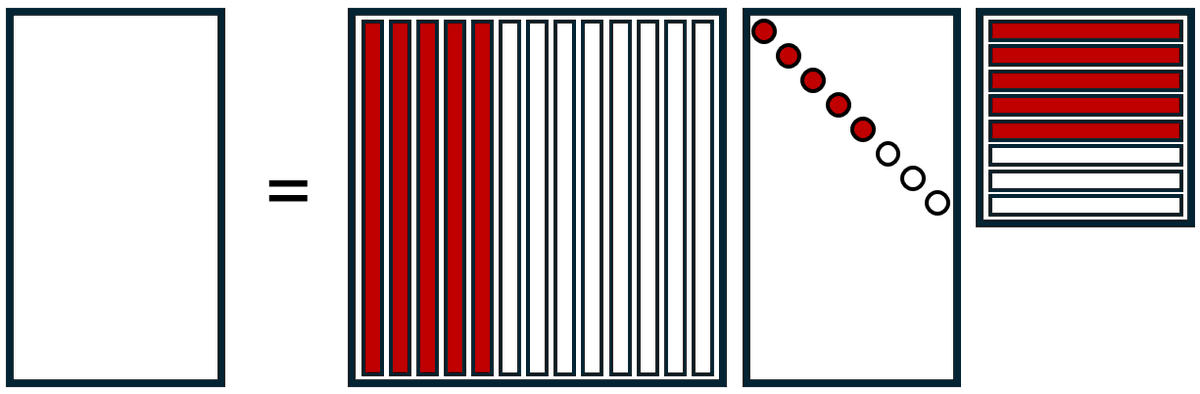
teaching the SVD this week.
some historical elements i've learned...
beltrami wrote the decomposition down in 1873.
jordan found it independently the next year.
sylvester called the stretches canonical multipliers in 1889.
schmidt proved the best low-rank approximation property in 1907.
by the time eckart & young put the same theorem in psychometrika in 1936, it was already decades old.
what was missing was a way to compute it that didn’t square every number in sight: golub & kahan fixed that in 1965. the version that ran for the next twenty years was golub & reinsch, 1970.
golub drove a car whose license plate read PROF SVD. lol...
This is an incredible moment in this history of mathematics, computer science, physics & science with some of the hardest problems in human history being solved by AI over a period of weeks. Depending on your perspective, it's either a crisis, a triumph, or both. I don't think anyone knows for sure. We're all trying to make sense of it. I oscillate between fear/dread and optimism/excitement on a daily basis. The rate of progress is insane, including today's announcement from OpenAI of more problems solved.
To help make sense of all of it, here's my conversation with three mathematicians about this moment. Each of them is an expert in the field of each of the biggest problems solved: Navier-Stokes, quasi-Riemann hypothesis, the unique games conjecture and complexity theory more generally.
Ankur Moitra is a mathematician and theoretical computer scientist at MIT, visiting the Institute for Advanced Study in Princeton. Steven Brunton (@eigensteve) is a mathematician and fluid dynamics expert at UW. Alex Kontorovich (@AlexKontorovich) is a mathematician at Rutgers specializing in number theory.
A bestiary of chaotic attractors, each carrying its own dihedral Dₙ symmetry.
Every disk holds a different attractor of the generalized Field–Golubitsky map:
z ↦ {a₀ + a₁|z|² + a₂ Re(zⁿ) + a₃|z| Re[(z/|z|)ⁿᵖ]} z + a₄ z̄ⁿ⁻¹
#builtWithMarimo
This is an incredible moment in this history of mathematics, computer science, physics & science with some of the hardest problems in human history being solved by AI over a period of weeks. Depending on your perspective, it's either a crisis, a triumph, or both. I don't think anyone knows for sure. We're all trying to make sense of it. I oscillate between fear/dread and optimism/excitement on a daily basis. The rate of progress is insane, including today's announcement from OpenAI of more problems solved.
To help make sense of all of it, here's my conversation with three mathematicians about this moment. Each of them is an expert in the field of each of the biggest problems solved: Navier-Stokes, quasi-Riemann hypothesis, the unique games conjecture and complexity theory more generally.
Ankur Moitra is a mathematician and theoretical computer scientist at MIT, visiting the Institute for Advanced Study in Princeton. Steven Brunton (@eigensteve) is a mathematician and fluid dynamics expert at UW. Alex Kontorovich (@AlexKontorovich) is a mathematician at Rutgers specializing in number theory.
This is a fantastic video explaining orbital dynamics and the resulting economics, and security considerations of cislunar space. Well worth the 8.5 minutes to watch. https://t.co/tub6ZTBCW1
Nice to see the Earth-Moon cycler orbits our lab recently discovered featured in @GarretsonPeter's overview of the cislunar space economy. Lots of interesting possibilities for transportation, surveillance, and infrastructure.
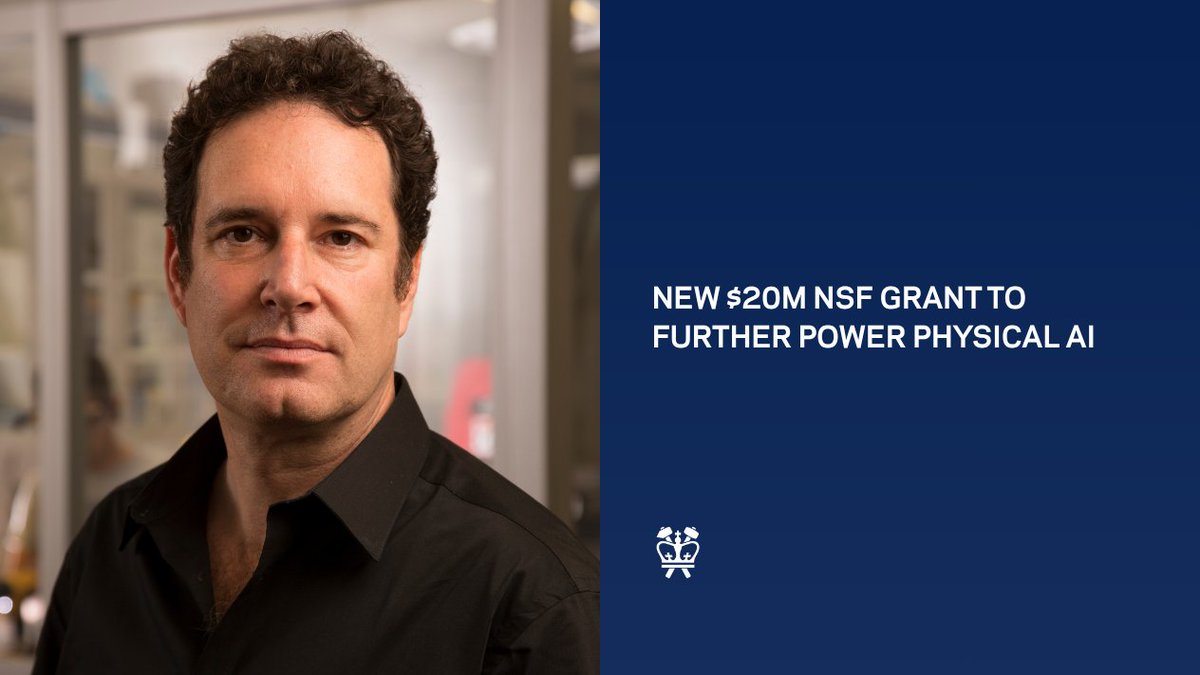
Launched our new AI Institute in Dynamic Systems, funded with $20M by @NSF! We will push generative AI methods to dramatically reduce the aerodynamic design cycle, together with @Boeing!
https://t.co/Xq9jqVRFkc
#AI4Science#GoBlue!
@eigensteve 🔵 🟡
U-M Prof. @ricardovinuesa is one of the leaders of a new $20M NSF grant to support the AI Institute in Dynamic Systems. Led by the University of Washington, the institute brings together academic and industry partners to develop new ways to model and simulate complex systems.
The @NSF has awarded $20 million to the AI Institute in Dynamic Systems to advance fundamental research on complex robotic manufacturing systems, with an emphasis on aerospace applications.
https://t.co/HgBZ9p6tAU
The passing of a legend. Less well known is that she coded and simulated the ODEs that Lorenz ended up using for the “Lorenz” system (with Linda Fetter).
We’ve lost an icon. Margaret Hamilton, a computer science pioneer best known for her work at MIT leading development of the flight software for the Apollo missions to the moon, has died at 90. Read about her legacy via MIT News: https://t.co/ODkbdIsoHw
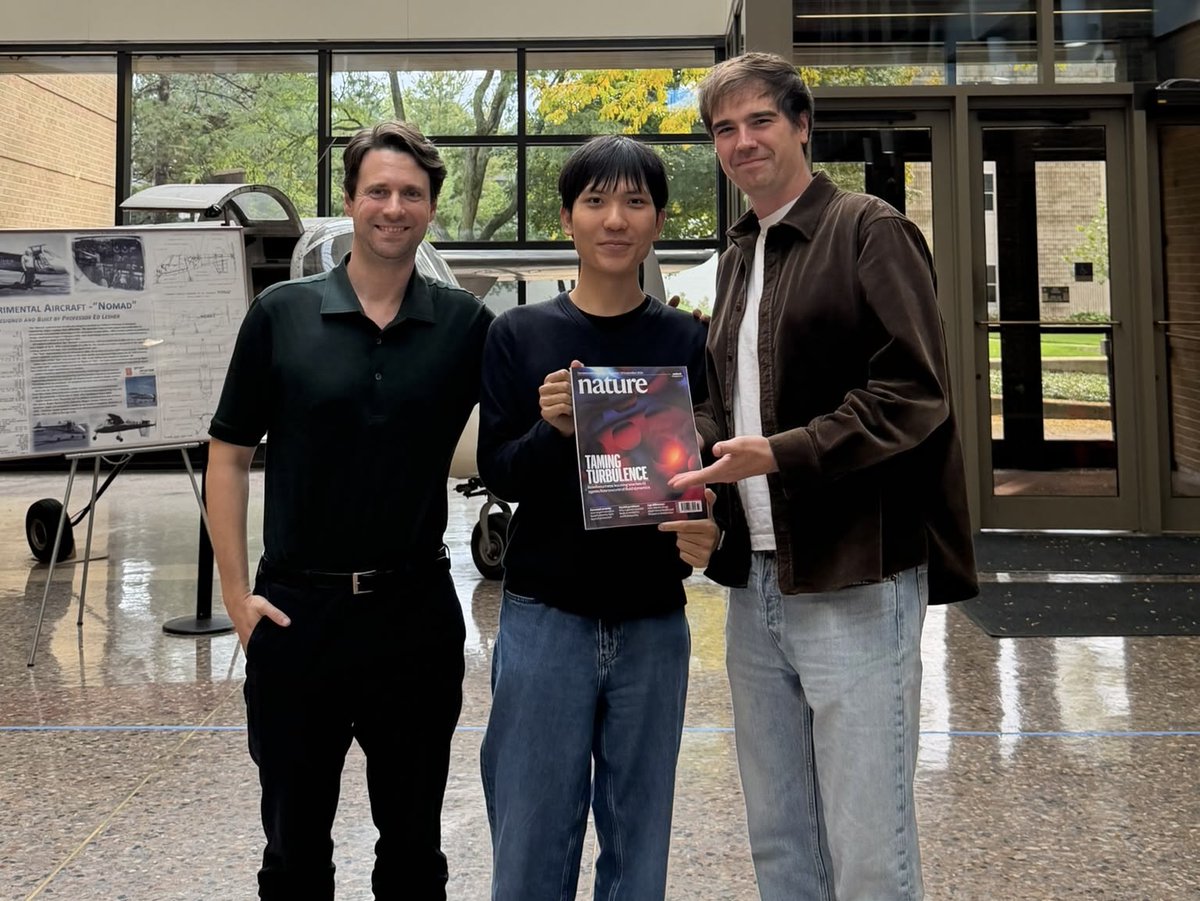
Very proud of my PhD students Yuning Wang and Pol Suárez Morales. Our recent work on #DRL for turbulence control, HydroGym, has made it to the cover of @Nature!!
Paper: https://t.co/XWo19nOqx8
#AI4SCience
It's Fortran Thursday! 🔥
Why does my OpenMP Jacobi stop scaling past 2 threads on a 2048² grid? A roofline model built from 3 likwid numbers predicts it: 279 sweeps/s vs 272 measured. Memory-bound, not a bug.
https://t.co/LiXHIxuhl6
#Fortran#HPC