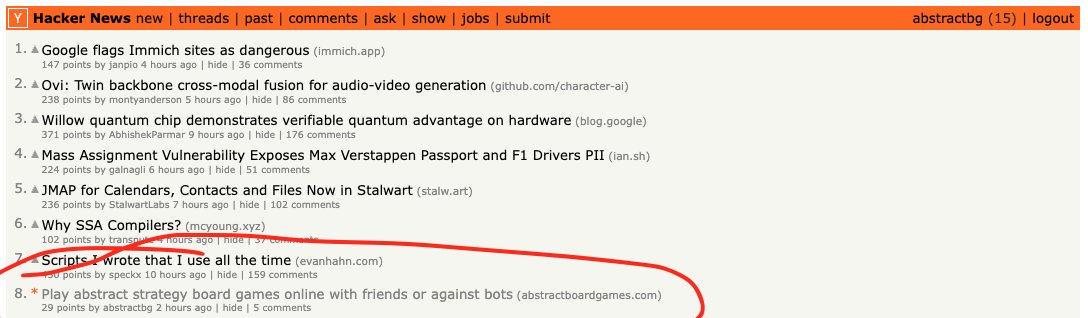
Celebrating 1 year of my website coming online! Check out the games that are supported!
1. Tumbleweed - A territorial area game by Michał Zapała. Place or capture stacks based on visibility to other stacks of your color; player who controls the most area (by vis) wins the game.
4. Connect 6 - A n-in-a-row game by I-Chen Wu. Place two stones at a time, form 6-in-a-row to win. Wu invented C6 to be a more fair game than Gomoku (5-in-a-row) where there is a large first player advantage.
This is strong evidence that my model is overfitting to the most recent self-play games. I'll need to include older data in the future. Lesson learned!, albeit very late. 😅 n/🧵
If you've followed my posts, you might have noticed an unusual obsession with computing Elo ratings between AI checkpoints.
The massive rating differences always bugged me and I'm happy to say that I've finally solved the Elo rating mystery 1/🧵
Let's try with +-30 checkpoints. Holy smokes, Elo graph is finally useable! What does this mean? It means that checkpoint n doesn't necessarily beat checkpoint n - k, for k in [1, 30]. This fact drastically flattens out the curve. 4/🧵
There's other things I could work on of course, such as an actual lobby page, tournaments, a mobile version, adding more abstract strategy games, etc.
Of course, I'll add those, all in due time :). And some of those will bring recurring users because of community support, recurring events, ability to play while distracted (on the toilet).
After a big release, it's always good to go back and plan out what to do next.
To get users to come back to my website, I'll need to focus on habit forming features and external reminders.
Which means, it's time to create daily puzzles and short-form content!
I use the Gumbel MuZero cost function and it has two components:
Value Target:
Predict the game outcome (who wins) from the current state.
Policy Target:
1. During self-play, the AI uses the network's prior policy to guide its search.
2. The search produces an improved policy (posterior) based on child state evaluations.
3. The network is trained to shift its prior policy toward this posterior policy.
https://t.co/pU9O5fKJc8







![Abstract_BG's tweet photo. Let's try with +-30 checkpoints. Holy smokes, Elo graph is finally useable! What does this mean? It means that checkpoint n doesn't necessarily beat checkpoint n - k, for k in [1, 30]. This fact drastically flattens out the curve. 4/🧵 https://t.co/0TbVQGTeFN](https://pbs.twimg.com/media/GtgsPAraEAAiAjf.jpg)


