للمهتمين بالبحث العلمي 📚
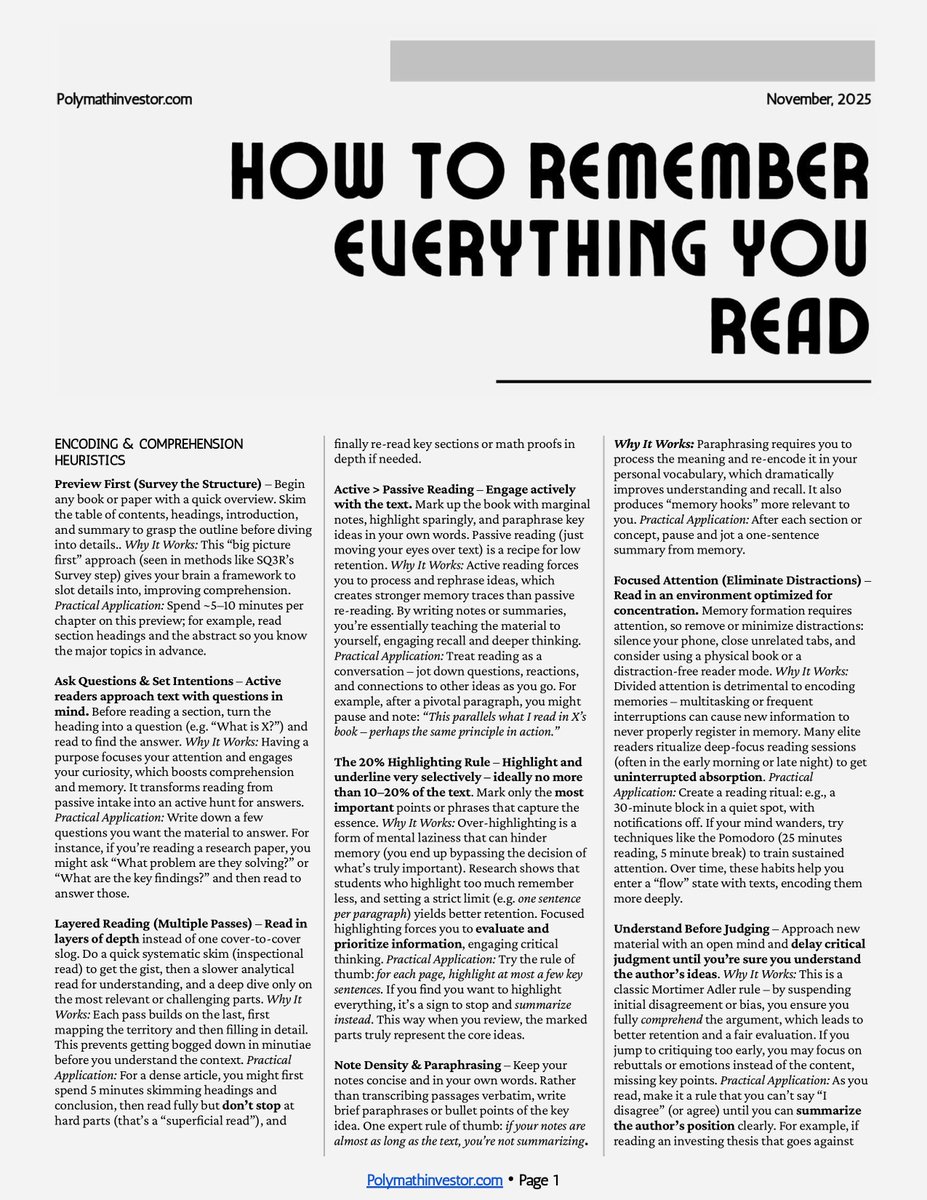
هذه من أفضل الأوراق اللي قرأتها عن كتابة ونشر الأبحاث. 👌
3 محررين من مجلات طبية كبرى يشرحون بشكل عملي ماذا يريد المحرر فعلًا من الباحث، وأبرز الأخطاء اللي تسبب رفض الورقة.
مفيدة جدًا لأي شخص يبدأ بالنشر العلمي أو يطور طريقة كتابته للأبحاث.
A MUST-READ!
This is probably one of my most important papers where I try to teach how to fish rather than offer fish.
How I Read a Clinical Trial Report?
BG’s primer for Busy Clinicians.
Thank you @JCOOP_ASCO@EthicsdoctorP for the kind invitation. I hope the readers will find this useful.
https://t.co/HJhZlsBpU2
Professor Jonathan Glover dismantles one of philosophy's most charged arguments with a smirk:
John Finnis's research argues that the human embryo deserves full moral respect from the moment of fertilisation. His central claim being that all the genes are there.
Glover's response here is not a counter-argument. It's a reductio ad absurdum delivered with a smile.
"Now of course on this argument a tadpole or even a bit of frog spawn would count as a frog — because there all the genes are present."
He continues, warming to the theme:
"And if you're ever invited by Dr Finnis to go and see his butterfly collection, don't be totally disappointed if it turns out to be a jar of caterpillars — because once again, all the genes are there."
And once more:
"If after that he invites you to stay on for a chicken dinner, don't be surprised if what you get is scrambled egg."
The joke itself does the philosophical work.
Glover's point is that genetic completeness alone cannot confer moral status — otherwise we'd be morally obligated to treat caterpillars as butterflies and frog spawn as frogs. The presence of a full genetic blueprint tells you what something will become, not what it currently is.
The distinction between potential and actuality is one of the oldest in philosophy.
Glover resurrects it here not with dense argument, but with three images so vivid they're almost impossible to argue against.
What makes a human being morally significant?
What it is, or what it will become?
Quantum entanglement and the illusion of time, in 79 minutes | Jim Al-Khalili: Full Interview @jimalkhalili
0:00 Chapter 1: Does time flow?
2:42 Why Time Feels Faster as We Age
3:56 Time and Change in Philosophy and Physics
5:28 Einstein and the End of Absolute Time
6:19 Time in the Equations of Physics
7:50 Chapter 2: How do we reconcile quantum field theory with the general theory of relativity?
12:10 Evidence for Time Dilation: Muons
14:29 Gravity Slows Time: General Relativity
19:22 Space-Time and the Block Universe
21:55 Does Time Really Exist?
26:33 The Debate: Eternalism vs Presentism
34:12 Chapter 3: Is There a “Now”?
40:40 Chapter 4: Why Does Thermodynamics Have a Direction in Time?
49:38 Quantum Entanglement and the Direction of Time
55:10 Did Time Begin at the Big Bang?
45:00 Will Time End?
1:05:40 Chapter 5: Is Time Travel Possible?
Vanessa Van Edwards just shared the 3 “magic phrases” that make people instantly like you more — and they’re stupidly simple:
1. “I was just thinking of you.”
(Text it when someone pops into your head — it lands like a warm hug.)
2. “You’re always so…”
(Fill in the blank with something positive and specific: “You’re always so interesting,” “You’re always so funny,” “You’re always so thoughtful.” People remember labels forever.)
3. “Last time we talked, you mentioned…”
(Bring back one detail they were excited about. Nothing says “you matter to me” like remembering what lit them up.)
These three lines fight our brain’s natural negativity bias and signal: “You are seen. You are valued.”
Try one today — who are you sending “I was just thinking of you” to right now?
If you are a naturally kind, generous, empathic person…
At some point you have or will cross paths with someone scoring high on psychopathy.
If you have a framework of this concept it might help.
The Highest Resolution Image of the Moon Ever Captured"
More info from the author:
This is the most advance moon photography ever, featuring interesting surface details and maybe no one has ever seen it before ,it’s also my clearest and sharpest moon image I’ve capture, it require 4 days of continuous moon observation and shooting, below are some facts about this image:
1- the image size is 708 gigabytes
2- over 81000 images were stacked
3- by merging 4 different moon phases and merging the shadow area it reveals an interesting topography of Lunar surface.
4- telescope : Skywatcher Flextube 250p dobsonian modified on equatorial mount NEQ6 pro.
5- camera : Canon EOS 1200D for
The Milky Way travels through space at 600 kilometers per second, oscillating slightly, as if it were flapping its wings through the cosmos. https://t.co/ek4PdrJxPc
I’m Ken Ono. After a long stretch in university administration, I made a personal pivot: back to math, back to education, and into the AI moment with a lot of hope (and a lot of care).
If AI is going to matter, it should give humans time back for the parts of learning that are deeply human.
More in thread 👇