1/3
Our paper 'from association to function' (or as I call it, Road to Perdition): Functional analysis and fine mapping of the 9p22.2 ovarian cancer susceptibility locus is now out:
https://t.co/ajntaefuN2
Special thanks to over 45,000 women who generously provided their DNA!
Very happy to report that our paper on the functional analysis of missense variants in the PALB2 WD40 domain is out! Great collaboration led by Thiago Gomes with @NepomucenoTC@FergusCouch and Marcelo Carvalho.
https://t.co/KCHeeNlu1P
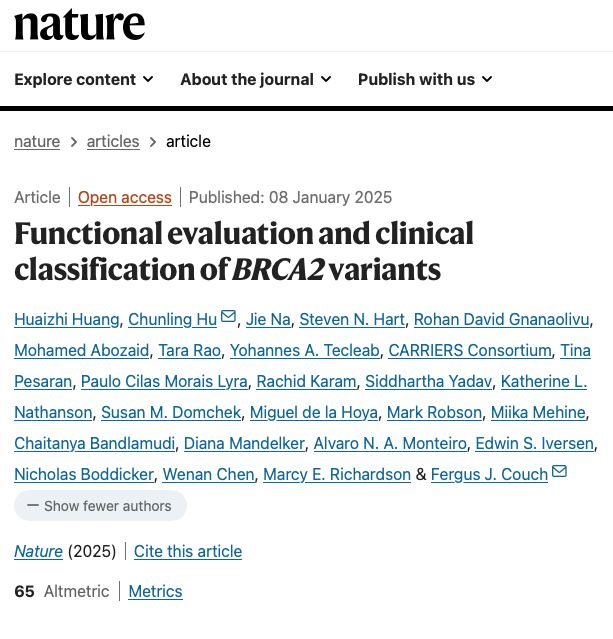
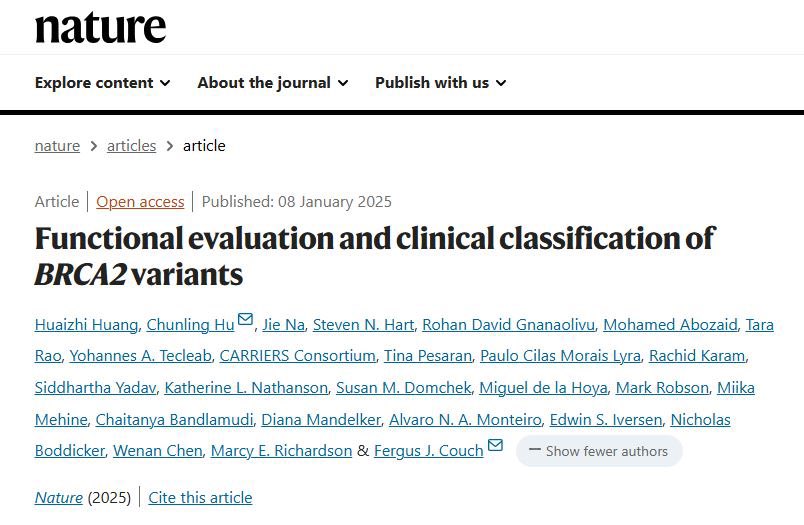
Functional evaluation and clinical classification of BRCA2 variants out on Nature
This study focuses on the functional characterization and clinical classification of BRCA2 variants, specifically those within exons 15 to 26, which encode a DNA-binding domain commonly associated with pathogenic missense variants. By using CRISPR–Cas9-based saturation genome editing in human haploid HAP1 cells, the researchers evaluated 6,959 single-nucleotide variants to determine their pathogenicity. The assay, calibrated with known pathogenic and benign standards, was integrated with models from ClinGen and other authoritative groups for clinical classification. Ultimately, 91% of the variants were classified as pathogenic or benign, offering enhanced guidance for clinical management of individuals carrying BRCA2 variants and addressing the challenge posed by variants of uncertain significance.
https://t.co/1metflU2Lv
@FergusCouch@rohavavidg@AmbryGenetics@paulocilasjr@AccidentalGenet@SidYadavMD@KLNathanson@ChrisHaiman@GENES_PK
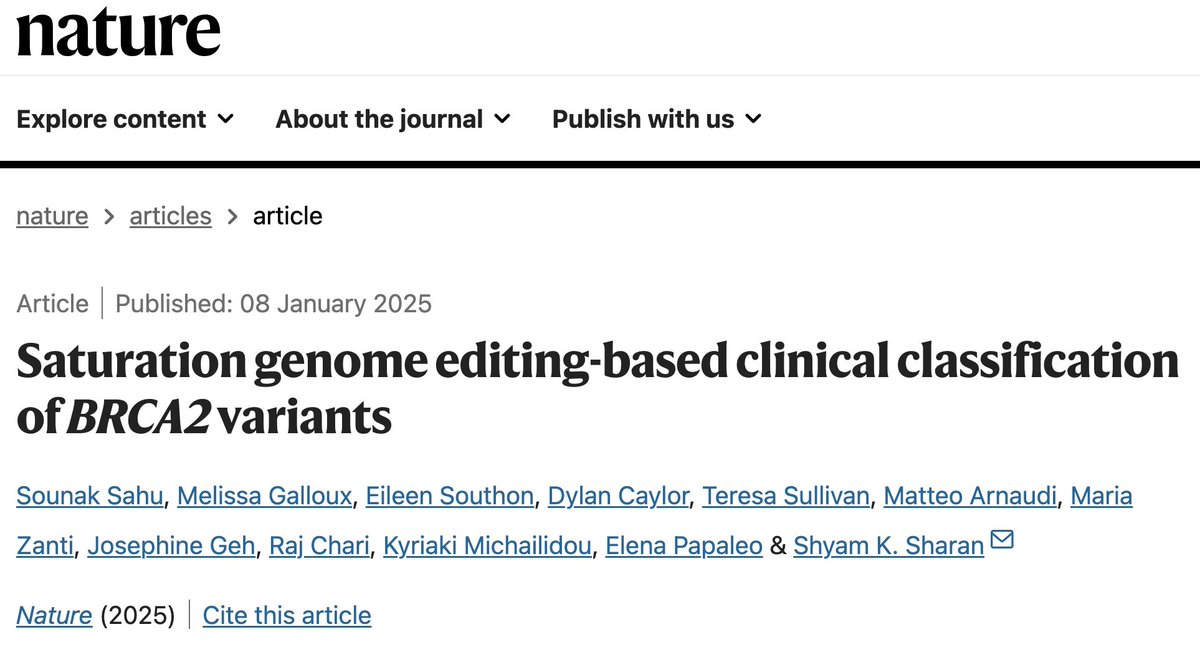
Excited to share our latest study in @Nature! We used a humanized-mouse ES cell model to explore the functional consequences of all possible BRCA2 missense variants. We've clinically classified >6,500 variants and >1,200 reported in ClinVar! @ShyamKSharan@theNCI
Congratulations @SounakSahu, Mélissa Galloux, members of our BRCA Variant Analysis Unit @theNCI for this outstanding work. Sincere thanks to our collaborators Drs. Chari, Papaleo, Michailidou and their team members.
A dream come true- published in @Nature
Using CRISPR–Cas9, we analyzed the functional effect of >6500 missense Variants of Uncertain Signficance (VUS) lBRCA2, and reclassified >90% of variants as pathogenic, likely pathogenic, benign, or likely benign. This work changes the landscape of VUS in BRCA2, providing clinically actionable results to patients to guide risk management strategies or treatment with targeted therapies such as PARP inhibitors.
I am immensely grateful to my mentor, Dr. Fergus Couch, for this opportunity, and many thanks to @ConquerCancerFd , Mayo Clinic K12 grant, Halt Cancer at X and @MayoCancerCare Breast and Ovarian SPORE for supporting my work.
Link to the article (Open Access):
https://t.co/Hrdebx9f85
Press release from Mayo Clinic:
https://t.co/WDhjs2EWpF
Mark your calendar: the next Egmond DNA repair meeting will take place in 2026 from April 19 - 24!
You can pre-register to receive announcement here: https://t.co/wbHRlPDDib
Registration will open by June 2025.
INHERITED: a subset of pathogenic variants in BRCA1/2 are low penetrance, imparting only a moderate risk of cancer to carriers.
https://t.co/P2JRoMqNwm
Our latest paper with Joan @BruggeMe is now out @NatureGenetics! We explore hidden mechanisms of BRCA1 hereditary breast cancer using new mouse models, revealing unexpected tumor-like chromatin changes in Brca1-heterozygous normal mammary cells.
https://t.co/SadDgqeRMC
Great collaboration with @TuyaPalMD @FergusCouch Erin Mundt, T.J. Slavin @myriadgenetics Marcy Richardson, Tina Pesaran, Elizabeth Chao @AmbryGenetics
To be read listening (very loud) to The Who https://t.co/NSItdpTRQG