National Bureau of Economic Research finds approx 1.4M excess deaths among Americans 25 and older between 2020-2023 due to COVID, saving Social Security over $200 Billion.
‘Social Security financial health improved due to excess deaths, driven primarily by the premature death.’
Reminder: Long COVID's disability & suffering will be the pandemic's most devastating long-term global legacy. Neither GBD supporters nor critics anticipated its scale or included it in their policy calculus -and “let er rip” strategies prioritizing widespread exposure clearly worsen the toll. Millions affected, with real costs in lives and productivity (on top of 20 million direct deaths globally, which we should never forget or minimize). https://t.co/I48h2XxxfS
NEW: After I tracked down a passenger from the MV Hondius traveling through several countries after leaving the ship after the hantavirus outbreak began, I discovered New York hadn't been alerted to the Manhattan resident as a possible contact case.
How that happened, and how the CDC has been monitoring the passengers who left the ship on April 24, --with another American woman only appearing on public health authorities' radars after she showed up on a South Pacific island--raises questions about contact tracking in a critical window for outbreak tracking, experts said.
The dual national New Zealand and American was in Taiwan, after attending a global conference in Vietnam, and got into contact with New Zealand on Tuesday, after I had begun making inquiries, having previously not responded to New Zealand's attempts to contact her. It's unknown if the CDC was aware of her locations around the globe.
With @NoahHurowitz
https://t.co/Ap6Oy9yrCr
Why Covid could be to blame for the rise in deadly meningitis, according to scientists - and the early symptoms of the disease that patients must act on https://t.co/HhMZfXPAe5
🇨🇩 NEW: Ebola kills 65 people in DR Congo
The World Health Organization (WHO) and Africa's Center for Disease Control and Prevention declared an Ebola outbreak in the Democratic Republic of Congo's eastern Ituri province on Friday.
246 cases and 65 deaths have been reported, they said, mainly in the gold-mining towns of Mongbwalu and Rwampara in Ituri province, which shares a border with Uganda and south Sudan.
Speaking at a press briefing in Geneva, WHO chief Tedros Adhanom Ghebreyesus said the cases were confirmed by the National Institute of Biomedical Research (INRB) in Kinshasa after samples collected in the field were initially found negative.
"On 5 May,” he said, “WHO received a signal of suspected cases and sent a team to Ituri to support DRC health officials in their investigation of the outbreak and collect samples in the field.”
CDC said it was convening a meeting with DR Congo, neighboring Uganda and South Sudan, and other international partners to discuss priorities, including response efforts and cross-border surveillance.
Early symptoms of Ebola include fever, muscle pain, fatigue, headache and sore throat, and are followed by vomiting, diarrhoea, a rash and bleeding. Tests are also being carried out to identify which strain of the virus is causing the epidemic.
Virus in the vents: Study traces COVID spread in high-rise apartment
According to a study, a COVID-19 outbreak in a residential building in Spain during the early months of the pandemic likely spread through shared bathroom ventilation ducts.
Read more: https://t.co/VZwl5pYy6s
There's a new Ebola outbreak in the DR Congo.
I'm already getting lots of questions, so let me tell you what you should know:
* This one is already big — "over 246 suspected cases and 65 deaths have been reported". This means we're just learning about this outbreak long after its already been spreading. This makes it harder to find contacts and all the cases. Most outbreaks don't get this big by the time they're over, let alone this big by the time we even recognize them.
* This one is in a really tough place — the outbreak is centered around the east of DR Congo, in a place with a lot of conflict, cross-border traffic, and instability. There may also be cases in the big city here, meaning worry for more/faster spread in an urban environment. I've worked up here, it's a tough spot to get to and work in, due to transport and conflict. There was an Ebola outbreak here in 2018-2019 that grew to over 3,000 cases.
* This is on a few borders — this outbreak is close to the Uganda and South Sudan borders. Uganda has a lot of experience with Ebola outbreaks, South Sudan less. Very possible there's already been cross-border cases, given size of the outbreak already. WHO and countries will be stepping up surveillance, but again, this is a place with a lot of conflict and instability.
* This is not your normal Ebola — most outbreaks have been of the Zaire strain of Ebola. That's the one we have vaccines and treatments for. But this outbreak appears to be due to the Bundyibugyo strain. This has caused a few outbreaks in DR Congo in the past, as well as over the border in Uganda. BUT there is no vaccine, and no treatment for this strain.
My initial reaction here is that this isn't good, at all. I'm glad Africa CDC is on it, as is WHO. But delayed recognition means this has already gotten big, at a confluence of borders with a lot of instability, and for a strain that we don't have any vaccines or treatments for.
I'll share updates as I hear them
@LauraMiers I can’t imagine having read that about anything, even a common cold, a decade ago. It just seems so funny.
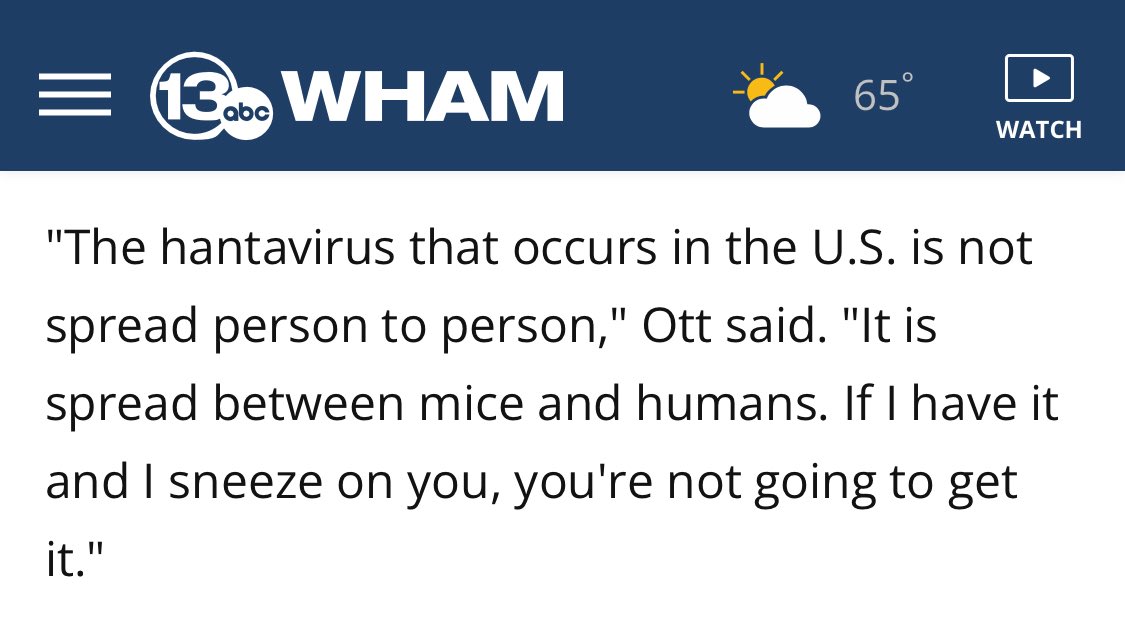
What possible downside would there be to saying; “in the USA, it’s traditionally not human to human, but if you suspect you’re sick or have it, don’t sneeze on people.”
“People don’t want to work” has always been a weird argument.
Offer $350K a year to flip burgers and watch how fast applications start pouring in.
The problem isn’t work.
It’s pay.
In Texas, our droughts are so bad that whole bridges are burning. How exactly are we supposed to handle dozens of datacenters when we don't have enough water already, even for emergencies?
The CDC confirms no cases of the Andes virus (a type of hantavirus) related to the current cruise ship outbreak have been confirmed in the United States.
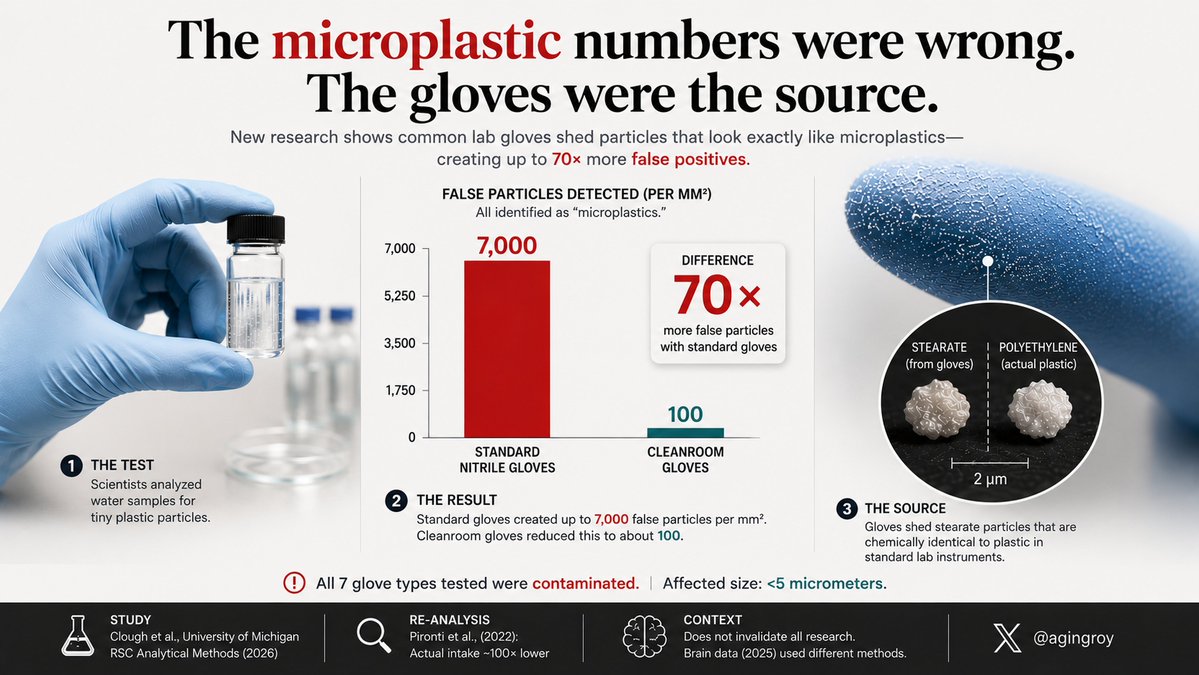
7,000 false positives per square millimeter. The culprit was the lab gloves.
University of Michigan researchers just upended a core assumption in microplastics science. Latex and nitrile gloves, worn by the scientists doing the measuring, shed stearate particles that look chemically identical to polyethylene. Standard infrared and Raman instruments can't tell them apart. The gloves were counting as plastic.
Seven glove types tested. All contaminated. The cheapest fix: switch to cleanroom gloves, which dropped false positives to around 100 per mm² vs. 7,000.
The "credit card per week" headline (5 grams, WWF/Newcastle 2019) has separate problems. A 2022 re-analysis found severe methodological errors in the original estimate. Actual measured intake is likely 100x lower.
None of this means microplastics are harmless. Last month's data on brain accumulation still stands. But the numbers driving the panic may have been measuring the scientists, not the environment.
Science catching its own errors is exactly how it's supposed to work.
Ensitrelvir succeeded where Paxlovid had failed to show efficacy, in post exposure prophylaxis. It’s also been known for years that it prevents severe late disease in those already symptomatic as well as Paxlovid.
Ensitrelvir should have been approved long ago. If it were from an American rather than Japanese pharma, it would have been.
@DebHolloway Cool. Let’s add in alcohol addiction and eating disorders as well. Both can include joint and muscle pain, fatigue, exertion issues, all nothing new.