Click the thread below to get to my SARS-CoV-2 mega-metathread.
That thread previously had its own intro tweet, but I deleted it by mistake. This being Twitter, there are no free undos. So instead this tweet will parachute you into it.
https://t.co/f0Fev0zI9M
And that's what funding academic research gets you, folks.
Yes both the initial designs for drugs that can bind to mutant Ras, and the designs of drugs that link two proteins together, were done in universities. Same for the discovery of Ras itself.
Big pharma with that supposed cure-all profit motive? They said the market was too small, and the science too risky and unproven.
It's cases like these that have made the US a biotechnology leader, one of the few fields it actually does better than all other countries.
If we want that dominance to continue, we need the funding of mechanism- and creativity-driven basic research to continue.
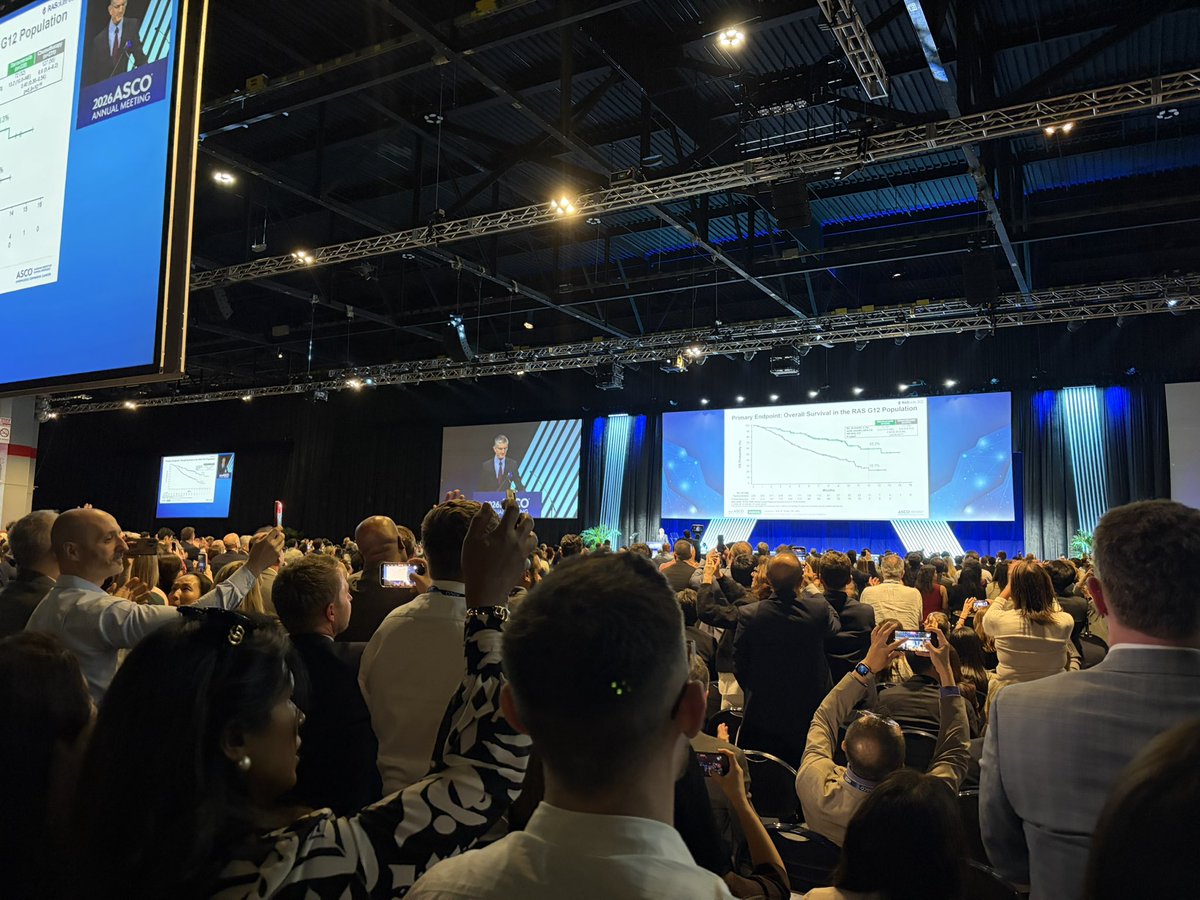
Incredible #ASCO26 moment.
Dr. Brian Wolpin, presenter of the daraxonrasib study, received a standing ovation DURING his talk after he stated the survival benefit for PDAC patients. It was sustained. Cheering. I have never see anything like it in the middle of a talk. $RVMD
🚨💊HUGE news: @US_FDA has finally granted approval to @ShionogiUS’s Xocova (Ensitrelvir), a 2nd-generation antiviral targeting SARS-CoV-2.
The approval is for the indication of “post-exposure prophylaxis of COVID-19 following contact with an individual who has COVID-19”. However, just like with any drug, it can obviously also be used off-label (e.g. treatment of both acute COVID or Long COVID).
In Japan, Xocova received Emergency Use Authorization for the treatment of acute COVID all the way back in November 2022, received full approval in March 2024, and an expansion to include post-exposure prophylaxis in March 2026.
The post-exposure prophylaxis indications are based on the SCORPIO-PEP trial (https://t.co/Dxv0lhS2CM), where Xocova reduced the incidence of COVID-19 after household exposure by 67%, from 9.0% down to 2.9%.
Mechanically, Xocova is the same class of drug as Paxlovid - a 3C-like protease inhibitor that inhibits viral replication. From our best understanding, Xocova is probably slightly more potent than Paxlovid, but the more definitive advantage is that it comes with less side effects and less drug interactions (which are caused by the Ritonavir component of Paxlovid, added to boost the concentration of the actual antiviral, Nirmatrelvir).
Xocova should be useful for lowering viral load during an acute infection, especially if taken within a couple or days of symptom onset, which may help shorten the duration of acute symptoms. Will it do anything to prevent long-term damage or the development of Long COVID? Almost certainly not, just like Paxlovid, but I’d be more inclined to tell people that it’s worth trying if we’re no longer dealing with the side effect profile of Paxlovid.
Where it makes the most sense to use Xocova, just like with Paxlovid, is as a component of polytherapy for Long COVID driven by viral persistence. The big issue there, however, is that you need a longer course of these antivirals than most physicians are willing to prescribe and/or most insurance companies are willing to cover. And they’re generally not very effective as a monotherapy, you need to pair these oral antivirals with other therapies for better coverage and tissue penetration (eg. monoclonal antibodies and Nuvaxovid, and potentially even a 2nd antiviral like Remdesivir).
All in all, this is a very important and long overdue approval. It’s not a game-changing silver bullet, and notably, nobody should really be expecting to use or rely on Xocova in a way that they wouldn’t be open to using or relying on Paxlovid in the present. But there are plenty of applications for it, and Xocova should absolutely be seen as another Swiss cheese layer / tool in the toolbox for COVID conscious community members and any allied medical providers.
Katy, I appreciate your loyalty to Dr. Makary and I truly believe he wanted to reform a broken system. But as someone from the Huntington’s disease community, I need people to understand why so many families were deeply hurt by how we were characterized.
We were not “Big Pharma.” We were not paid lobbyists. We were families drowning in generational trauma because our loved ones are dying from one of the cruelest neurodegenerative diseases on earth.
And the hardest part? While many Huntington’s families, caregivers, and at-risk individuals were literally on Capitol Hill during Rare Disease Week meeting with lawmakers after paying our own way there, Dr. Makary was simultaneously speaking to reporters about “moneyed interests” and outside pressure surrounding AMT-130.
There were no corporate-funded advocacy campaigns behind us. Just families carrying decades of trauma, grief, and fear into congressional offices because we are terrified of running out of time. Nearly 50,000 signatures were gathered from HD families, grassroots advocates, caregivers, and supporters demanding urgency for AMT-130, and those petitions were hand-delivered directly to the FDA by members of the Huntington’s community themselves. Over 10,000 emails were also sent to FDA and members of Congress. Nobody paid us to do that. Fear did. Love did. Desperation did.
At the 2024 EL-PFDD meeting in Maryland, FDA sat across from more than 100 HD families and listened as we described watching parents, grandparents, siblings, and children slowly lose movement, speech, cognition, personality, and independence. People in those rooms cried with us. We were told urgency mattered.
Soon after we learned FDA aligned with uniQure on an accelerated pathway, many of us finally felt hope for the first time in our lives.
So yes, families became loud. Because this disease does not wait.
What also deeply damaged trust was watching Dr. Vinay Prasad speak anonymously to reporters about an active therapy. If someone cannot publicly face the people they serve during moments of crisis and scrutiny, they should not be leading CBER.
Leadership requires courage, transparency, and accountability. This is especially true in rare disease communities where every delay carries irreversible consequences.
Many of us respected Dr. Prasad intellectually. We respected his focus on scientific rigor. But from the patient/family side, much of what we experienced felt dismissive, detached, and at times unnecessarily combative toward a dying community simply asking to be heard.
And Dr. Makary protected that approach far too long.
The Huntington’s community is not asking for reckless science. FDA itself asked our community what level of risk we would accept, and nearly three-quarters of respondents said they would accept treatment risks for even a chance at 5 years without progression.
Because this disease does not wait for “perfect data.”
For families living with Huntington’s, every year means more neurons lost, more memories erased, more independence gone, and more people disappearing in front of us. AMT-130 showed the possibility of dramatically slowing that decline over three years. That is time with children. That is dignity. That is life itself.
We are not a lobbying machine. We are human beings trying to stop generations of suffering from continuing.
💙💜
#Huntingtonsdisease
@TheIncomeIT@sciencegirl Yes those things are trivial compared to the complexity of biological systems (the genome sequence itself is not a biological system)
I tried the Edison system developed by the first team (futurehouse) and it was barely usable. Perhaps they have improved but it would be a long way from replacing scientists.
Interesting contrast to the recent papers on AI co-scientists.
"Codex, Claude Code, Autoresearch recover only 9.3% of human progress, mostly tuning hyperparams & ignoring algorithmic research" 1/
@JasonSynaptic Just another ML bro self-impressed with their algorithm to put out something that looks somewhat right to their eye, when they themselves don't know enough to pass AP biology
@gamestoneai Yes AI is perfect for searching available data and finding associations that would have required a long time to find using a human brain or bespoke deterministic search algorithms
It seems quite the fad these days, even among scientists, to assert how well AI can perform "science". Or maybe that's just what X amplifies.
In any case these obligatory genuflections to AI just accept the definition of science as being mundane literature reading, run-of-the-mill associative hypothesis testing, and brute-force data gathering and model fitting.
They don't differentiate competent but iterative work from the truly out of the ordinary and creative. Both are important, but only one is emulated by AI.
Today we all lost our jobs.....
Three Nature papers showing that scientists in the conventional sense are obsolete
At least read the first one.... the AI replaced all things that the scientist does ....
https://t.co/zMsRLaaRDU
That's right. I have yet to see an AI output that isn't obvious (to me) pattern matching or association, i.e. fancy statistics, even after being told "this output will remove all your doubts". Makes me wonder if those most enthusiastically posting about AI have particularly low bars for what they consider creative.
Maybe 90%, and the part after the dash I definitely disagree with. There's very much reason to think that a model based on pattern matching and associations in datasets does not really learn logic with its hierarchies and dependencies necessary for fundamental breakthroughs, e.g. relativity by Einstein
@statesdj@AppleHelix And there needs to be three arms, no mask and double-blinded between real masks and placebo masks. Placebos look like the real thing but are made with material with a larger mesh size. Important to know if the mechanism of any benefit is actually physical or more behavioral.
Protein/enzyme engineering has a severe bottleneck — and it's not in AI modeling or compute time.
It's in actually building and testing protein variants.
Proud to introduce our latest work, MIDAS: a way to go from primers to protein assays in mammalian cells in one day. 🧵
Proud to announce that Pengli's work and that of co-first author Yan Wu was featured in this news article
They developed a method for rapid generation and screening of protein variants that will greatly accelerate the development of better molecular medicines and enzymes.
https://t.co/WOa7MTTkK5
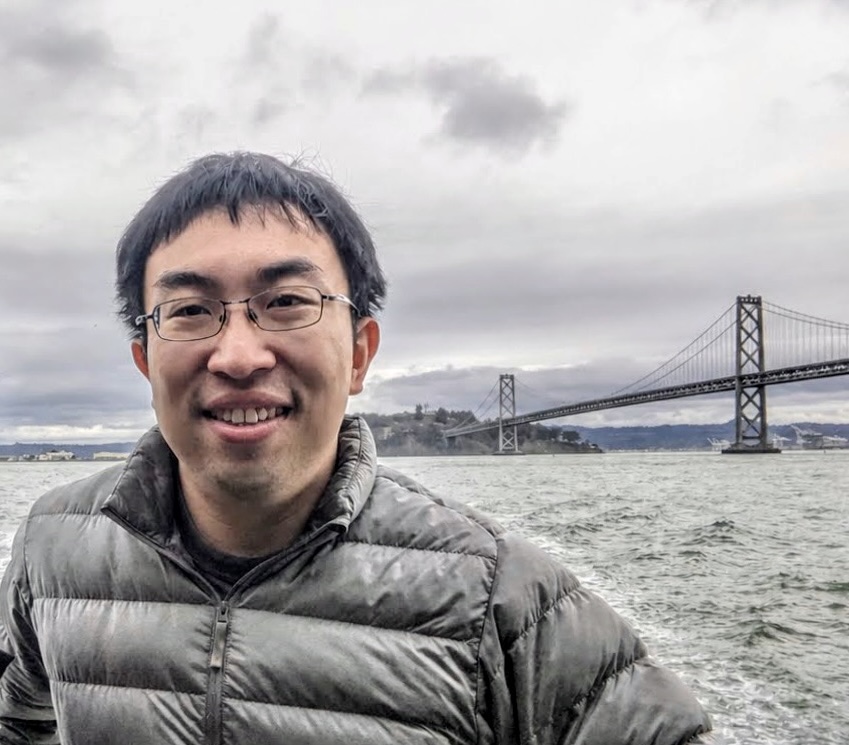
It is with a heavy heart that I share the sad news that one of my lab members, Pengli Wang, PhD student in chemical engineering, has passed away on Friday, May 1, at the age of 28, in an unexpected accident.
I’ve struggled to write this because it is hard to put into words just how much Pengli meant to our lab, his friends, the Stanford graduate student community, and of course his family.
From my own limited perspective, Pengli was any advisor’s dream student: creative, insightful, courageous, and an extraordinarily gifted experimentalist. He was a true polymath, self-taught in everything from computational protein structural modeling to high-throughput protein engineering to animal behavioral testing.
In only 3.5 years in the lab, Pengli had already made an enormous and lasting impact on the field of protein engineering. He has a co-first-author paper in press describing a new method that will transform both empirical and AI-based protein engineering. He also recently submitted a first-author paper on imaging neurotransmitters through enzymatic light emission, enabling us to observe cellular communication in living animals completely noninvasively. I expect this work will lead to new ways of investigating and understanding neurological and metabolic disease.
Arthur C. Clarke wrote that “any sufficiently advanced technology is indistinguishable from magic.” Pengli was the best magician, producing eye-opening tricks, each better than the last. The loss of his future contributions is immeasurable, but the technologies he already created will continue to benefit science and medicine for years to come.
What truly made Pengli special, though, was his kindness and joy for life. He never hesitated to help others, and he generously mentored many newer lab members, all of whom spoke about what an exceptional teacher he was. He also had an unforgettable spirit — the loudest and funniest laugh in the room, and an ability to eat astonishing amounts of food while somehow remaining skinny. He is deeply missed by everyone who knew him.
Pengli, may you rest in peace and in the lasting glow of your accomplishments. You represented the very best of humanity and will forever remain an inspiration to all of us.
💔
Sincere thanks to everyone for their condolences and support. I will pass it on to Pengli's parents. It reminds us that we are all subject to the fragility and randomness of life, and should make the best of our limited time on earth.