Develop advanced and efficient AI agents that can communicate, see, and take actions. 👥
Unlock the next level of #agenticAI with the new Llama Nemotron and Cosmos Nemotron model families, serving various agentic needs ➡️ https://t.co/NvHQtIXw2s
The industry is moving from "AI-copilots" to "AI-Agents". @ActionLayer believes data annotation plays a crucial role in the development and performance of AI agents.
Enabling Machine Understanding: Data annotation provides context and meaning to raw data, allowing AI models to recognize patterns, make predictions, and perform complex tasks. By labeling datasets, we enable machines to interpret and classify new, unseen data in a way that mimics human understanding.
Improving Model Accuracy and Performance: Well-annotated data leads to more precise and reliable AI models. The quality of annotated data directly impacts the fate of AI and ML projects, as accurately labeled datasets are essential for training models to recognize patterns and relationships between variables.
Enabling Scalability: Annotated data can accommodate sentiments, intents, and actions from multiple requests, facilitating the creation of accurate training datasets. This imparts AI engineers and data scientists the ability to scale mathematical models for diverse datasets of any volume.
#aiagent #actionlayer #webagent
The Sam Altman Interview
You know him as the CEO of OpenAI — but he's also an avid writer.
We spoke not once but twice about how Sam captures ideas, clarifies his thinking, edits his writing, decides what to work on, and uses ChatGPT.
Timestamps:
1:47 Will LLMs change how we write?
8:39 How does Sam use ChatGPT?
11:26 How Sam became less anxious
17:24 Sam once dreamed of being a novelist
18:37 Lessons from Peter Thiel
21:35 Lessons from Paul Graham
26:02 The book Sam Altman wants to write
28:37 Advice for startup founders
30:20 How Y Combinator shapes OpenAI
35:55 How Sam chose to work on AGI
37:35 Writing strategy memos at OpenAI
41:34 Why isn’t ChatGPT a better storyteller?
44:20 Sam's obsessive note-taking method
47:12 Will AI put writers out of work?
🎮 We're helping shape the future of gaming through our partnership with @solanalabs! At the center of this collaboration is Gameshift, which provides the full slate of Web3 primitives and actions that games require.
Learn more → https://t.co/HcyaWTXYS1
How can #robots remember?
🤖 💭 For robots to understand and respond to questions that require complex multi-step reasoning in scenarios over long periods of time, we built ReMEmbR, a retrieval-augmented memory for embodied robots.
👀 Technical deep dive from #NVIDIAResearch
➡️ https://t.co/9hpQzmXtUW
Transformer by hand✍️ Excel ~ I designed this exercise to show the core math of a Transformer model is to combine columns (attention), combine rows (feed forward), and repeat.👇Join the 'AI Math' community. 👇Download xlsx.
We’re excited to announce that IntentAGI is now ActionLayer! This new name better reflects our vision moving forward.🎉
Check out our updated channels:👇
https://t.co/PFWJlEaoss
Thanks for your support! 🌟Stay tuned for more updates!🌟
Can LLMs learn to "phone a friend?" 🧵
MIT CSAIL’s new "Co-LLM" algorithm can pair a general-purpose base LLM w/a more specialized model & help them work together. It reviews each token & sees where it needs to call upon an expert, leading to more accurate & efficient replies to medical prompts and math & reasoning problems: https://t.co/RNYaUyfmXL
How does OpenAI train the Strawberry🍓 (o1) model to spend more time thinking?
I read the report. The report is mostly about 𝘸𝘩𝘢𝘵 impressive benchmark results they got. But in term of the 𝘩𝘰𝘸, the report only offers one sentence:
"Through reinforcement learning, o1 learns to hone its chain of thought and refine the strategies it uses."
I did my best to understand this sentence. I drew this animation to share my best understanding with you.
The two key phrases in this sentence are: Reinforcement Learning (RL) and Chain of Thought (CoT).
Among the contributors listed in the report, two individuals stood out to me:
Ilya Sutskever, the inventor of RL with Human Feedback (RLHF). He left OpenAI and just started a new company, Safe Superintelligence. Listing Ilya tells me that RLHF still plays a role in training the Strawberry model.
Jason Wei, the author of the famous Chain of Thought paper. He left Google Brain to join OpenAI last year. Listing Jason tells me that CoT is now a big part of RLHF alignment process.
Here are the points I hope to get across in my animation:
💡In RLHF+CoT, the CoT tokens are also fed to the reward model to get a score to update the LLM for better alignment, whereas in the traditional RLHF, only the prompt and response are fed to the reward model to align the LLM.
💡At the inference time, the model has learned to always start by generating CoT tokens, which can take up to 30 seconds, before starting to generate the final response. That's how the model is spending more time to think!
There are other important technical details missing, like how the reward model was trained, how human preferences for the "thinking process" were elicited...etc.
Finally, as a disclaimer, this animation represents my best educated guess. I can't verify the accuracy. I do wish someone from OpenAI can jump out to correct me. Because if they do, we will all learn something useful! 🙌
Today would have been the 83rd birthday of Dennis Ritchie, inventor of C and co-creator of Unix: https://t.co/a08zJuwngH
(Image v/@SanderFocus, article v/@jperlow & @ZDNET)
Why is decentralization a necessary step for agents to achieve AGI?
"For example, even though Google owns the Chrome browser and has access to the most comprehensive web-based temporal action sequence data, lacking annotations for tasks, processes, and reasoning, Gemini cannot effectively complete web agent tasks. Through our practice, even a small amount of high-quality task-to-action query data can effectively improve the accuracy of target tasks."
These training data, annotations of experience and knowledge can only be digitized and achieved through community incentivization of users in specific scenarios and tasks. #ai #aiagent #decentralized #intentagi #actionlayer #AGI
Protect your swaps from sandwich attacks. 🛡️
You can now safeguard your swap transactions on Jupiter with one click.
By turning on ‘MEV Protect’, your transactions will be sent directly to a @jito_labs validator, reducing the chances of your transactions getting frontrun.
Here’s how: 👇
LLMs struggle with fine-grained in-line citations in long-context scenarios.
This is a really useful capability but current long-context LLMs don't do so well on fine-grained in-line citations.
This new work synthesizes a large-scale SFT dataset with off-the-shelf LLMs to improve long-context question answering with citations.
It trains 8B and 9B parameter models that enhance citation generation capabilities from lengthy contexts while improving response correctness.
Claims to even surpass GPT-4o on their proposed LongBench-Cite benchmark.
76-page survey paper on Prompting Techniques ✨
Explores structured understanding and taxonomy of 58 text-only prompting techniques, and 40 techniques for other modalities.
📌 The paper focuses on discrete prefix prompts rather than cloze prompts, because prefix prompts are widely used with modern LLM architectures like decoder-only models. It excludes soft prompts and techniques using gradient-based updates.
📌 The paper identifies 58 text-based prompting techniques broken into 6 major categories:
1) In-Context Learning (ICL) - learning from exemplars/instructions in the prompt
2) Zero-Shot - prompting without exemplars
3) Thought Generation - prompting the LLM to articulate reasoning
4) Decomposition - breaking down complex problems
5) Ensembling - using multiple prompts and aggregating outputs
6) Self-Criticism - having the LLM critique its own outputs
📌 For ICL, it discusses key design decisions like exemplar quantity, ordering, label quality, format, and similarity that critically influence output quality. It also covers ICL techniques like K-Nearest Neighbor exemplar selection.
📌 Extends the taxonomy to multilingual prompts, discussing techniques like translate-first prompting and cross-lingual ICL. It also covers multimodal prompts spanning image, audio, video, segmentation, and 3D modalities.
📌 More complex techniques like agents that access external tools, code generation, and retrieval augmented generation are also taxonomized. Evaluation techniques using LLMs are discussed.
📌 Prompting issues like security (prompt hacking), overconfidence, biases, and ambiguity are highlighted. Two case studies - benchmarking techniques on MMLU and an entrapment detection prompt engineering exercise - are presented.
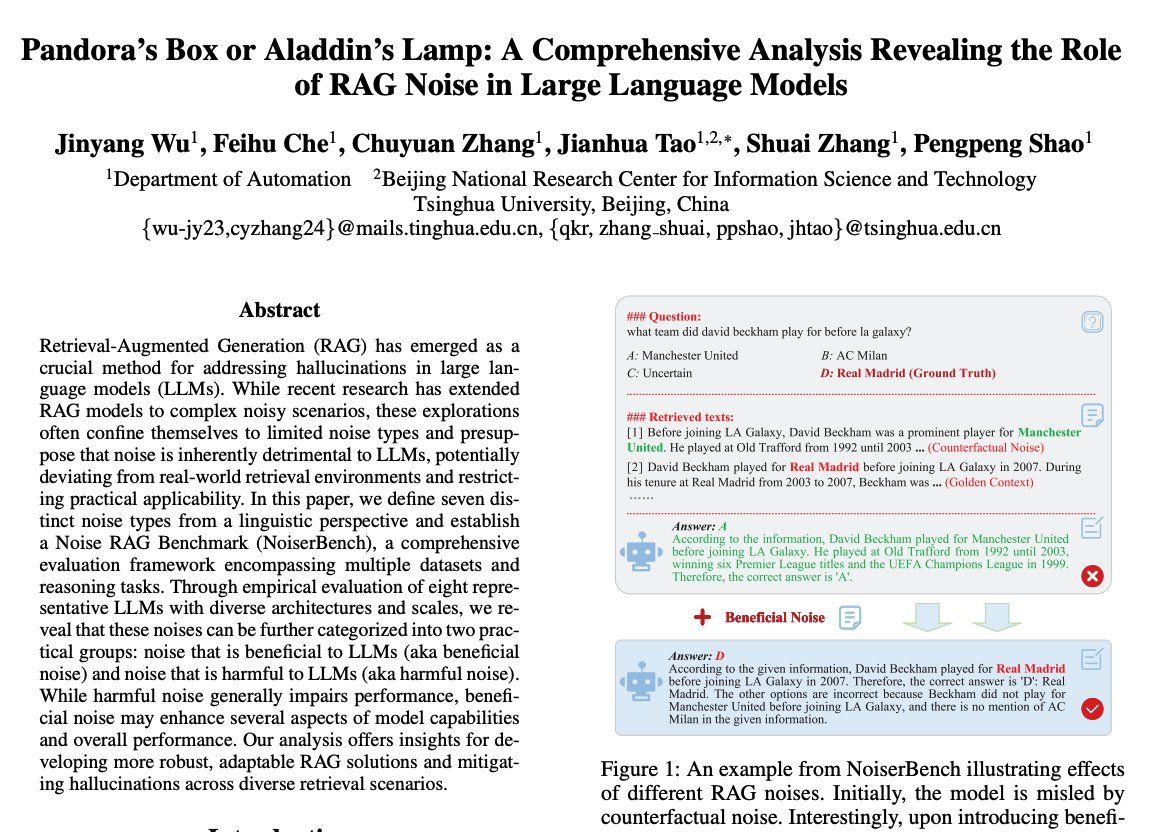
Noisy information is not always bad for RAG systems.
Well, it depends on what kind of noise. Finally, there is a benchmark (NoiserBench) to measure how different kinds of noisy information affect RAG's performance.
It's interesting that out of the different kinds of beneficial noise (e.g., semantic, datatype, and illegal sentence), illegal sentence noise exhibits the most improved model performance across models and datasets.
There are many other interesting results in the paper that you will find useful if you are building RAG systems.
"While harmful noise generally impairs performance, beneficial noise may enhance several aspects of model capabilities and overall performance"