@GuyDealership I have a friend with Volvo XC90 that he leased from the dealership in July. He forgot to make the payments and the car was repossessed. They now say he must buy the car for $75k by December 8th or let the car go to auction and they pay the difference. What can do?
Today I urged Mayor @LondonBreed to reallocate $18.9M in funding currently budgeted for Wellness Hubs to jail-based treatment and recovery services, which will better serve detainees arrested for public drug use. Here’s my letter and news release. (1/5)
https://t.co/fhiubvkw5J
Hello from Wyoming! On a national park road trip and thought I’d jot down a few random thoughts since I haven’t in a while.
Today’s topic:
The next big tech hub looks like it’ll be in… San Francisco?
Maybe an obvious reversion to the mean that was bound to happen. But many friends moved to secondary tech hubs (including myself!) now find ourselves perpetually headed back to SF on a monthly basis. We’re all drawn to the inescapable pull of fresh new startups, interesting new people, etc…
Couple reasons:
1) the generative AI boom
2) slowdowns in many emerging sectors
3) tourists are out
4) the nomadic tribes are settling down
5) maybe remote work just isn’t as good?
Let’s discuss each.
The AI boom is obvious so I won’t spend too much time on it, but the more interesting point is the source of the talent. Because a lot of the work right now is at the level of infra and foundational models, the top companies draw from top-flight engineering skillset that’s often closely aligned to infra/platforms, big data, machine learning, academia, etc. These aren’t the design-centric frontend engineers that powered the final stage of the S-curve for Web 2.0 and mobile. Where are these folks located? Mostly in SF, and often from FAANG/universities/etc who have been working on AI research for the past decades
At the same time as the AI boom that draws on SF-specific talent, a lot of the new tech hubs had various specializations - like fintech in London or creator economy in LA, etc. These sectors, while still attracting top founders, just aren’t quite as hot as they were a few years ago. This in turn leads to these magnetic tech hubs becoming less of a draw. If a lot of founders who would have done fintech/creators/web3/etc end up getting excited about AI, they might choose a different city in which to base their operations
Many of the the newer tech hubs have more angels/founders/others who dabble in tech, but risk being labeled tourists when the macro economy gets tough. In LA, for instance, you might have a large swath of the entertainment/media industry experimenting with VR/web3/otherwise when the market was hot — now that there’s been a slowdown, many are turtling up, focused on their core businesses, and there’s less interest in tech. I think the same is happening across many of the new tech hubs.
In the year after COVID, there was a big nomadic tribe of ex-SF techies who would jump from city to city. They put their personal items in storage in SF, and then would rotate from spending a few months in NYC followed by Austin, then LA in the winter, etc — doing some Airbnb hopping. My personal observation is that this group has settled down quite a lot, some heading back to SF and others staying in a city. This has made the second tier of tech hubs less dynamic as a result.
Finally- I think now that we’ve been doing endless Zoom meetings for two years now, we can agree that sometimes the experience of working remote simply isn’t as good, nor as productive, particularly for early pre-product/market fit startups. When iteration cycles have to be tight, and you need a small group to mind-meld with each other, there’s just a big plus to being in person. And if you’re going to be in person, there’s a good chance a big chunk of your team is already based in SF.
And thus, a lot of us are spending a good chunk of time in SF, on a regular basis.
This doesn’t mean that the new tech hubs will fail. They got a big growth spurt, a ton of people, press coverage (and capital). Many companies ended up being started in these towns that won’t leave, and just will just grow up instead. That’s all great.
But I do think the SF tech community has proved to be very resilient, and we’re seeing a big countertrend to the past few years.
Most life hacks suck.
So I crowdsourced the best from 22.1 million people on Reddit.
Here are 11 life pro tips.
1. Airplane mode to get off annoying calls:
Very excited to announce that we have closed FTV VII at $2.3B enabling us to continue partnering with today’s most innovative, high-growth companies to help them accelerate growth.✨🚀Read more here: https://t.co/EMgepgBlRy
TL;DR
We are relaunching The $1K Project to focus exclusively on the crisis in Ukraine 🇺🇦
Sponsor a family:
https://t.co/sCoSJPuJro
Подайте заявку на спонсорство: https://t.co/3gCfFqkpy1
NEW: California has now administered 39 MILLION vaccines.
71% of our adult population has received at least one vaccine.
And we have the lowest #COVID19 case rate in the country.
@replyall Hey folks, you do great work and should be proud of the long history of amazing shows you’ve produced. @PJVogt let’s get you back. I appreciate you made a mistake, but you owned up to it, and we would like you back!
90% of the world’s data is unstructured. @WoflowHQ is creating tools to structure it. You’ve probably already used Woflow because it powers menu data on most of the online food ordering apps. Excited to lead their seed round.
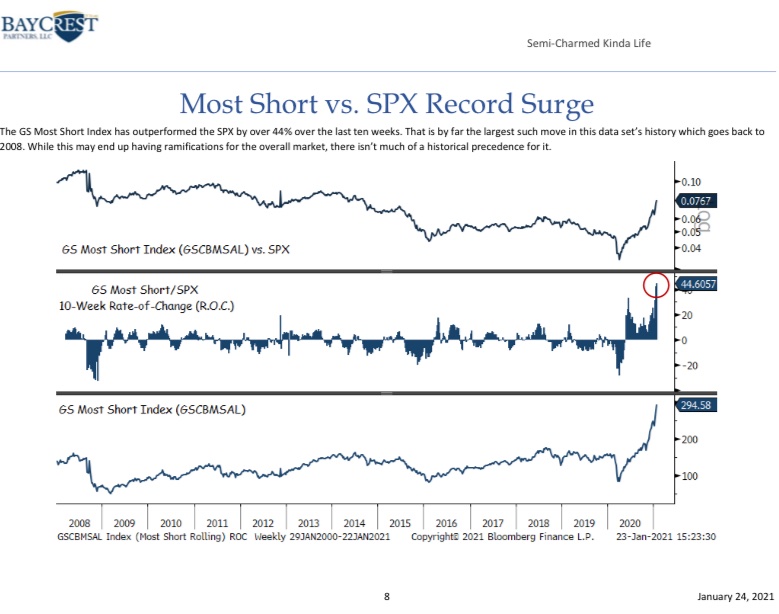
“The GS Most Short Index has outperformed the SPX by over 44% over the last ten weeks. That is by far the largest such move in this data set’s history which goes back to 2008.”
👀
Via @jkrinskypga