1/ This week has evoked many memories of the Mosul offensive which I was a minor participant in while embedded with an Iraqi Army brigade. It was a very formative experience for me as a younger lad and one that colors my perception of what’s likely to come in Gaza. https://t.co/TEa00mZGd5
@Edeaulx Disagree. It’s a prison camp in which Israel guards only the outside, lets terrorists run riot within, and missiles are lobbed over the fence from both sides.
Hamas’ actions are horrific, but the continued suppression of Gaza only fuels recruitment from the desperate & hopeless
You can all help us preserve the memory of victims of #Auschwitz.
Your engagement is a a powerful act of remembrance. Every click matters, as it amplifies our voice.
Take a moment to RT or QT this post. Encourage others to follow @AuschwitzMuseum.
It's our duty not to forget.
Today's map is all land over 300m in 3D, everything else flat - using Ordnance Survey terrain data, and now I'm googling "highest point in Gloucestershire" to find out what that dot is
Is Britain getting a bad deal? @Ben_A_Hopkinson and I looked at 242 infrastructure projects across 14 different countries.
Our conclusion? It costs more to build new tram systems, railways, and roads in Britain than almost anywhere else in the world. 🧵
https://t.co/Di7JfWGQjC
What the hell is an ampersand and why does it look like that?!
The first thing you need to know is that "&" used to be the 27th letter of the alphabet...
But there are three parts to this story. And the first begins over two thousand years ago in Ancient Rome with a single word: et. It's the Latin for "and". At some point Roman scribes started combining the two letters of et into a single symbol, which was the ancestor of our modern &.
The earliest example of the "et" symbol is actually from graffiti in Pompeii. In any case, it did not disappear with the fall of the Roman Empire.
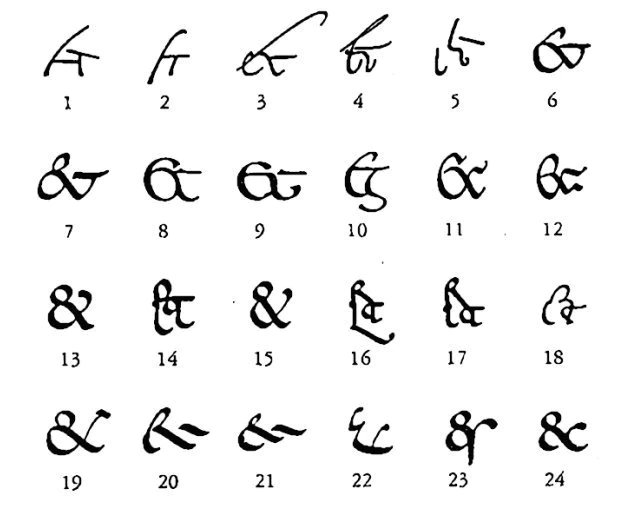
Latin survived as the language of the Catholic Church and of scholarship in Medieval Europe. Scribes during the Dark Ages continued to use the & symbol. It evolved down the centuries, in places losing any semblance of the letters e and t whatsoever.
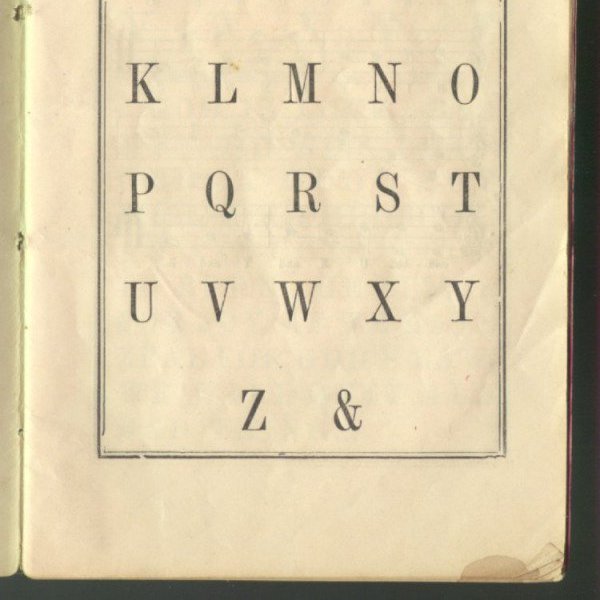
The second part of the story is that during the 18th and 19th centuries, as education and the teaching of literacy spread, & was added to the end of the alphabet as a sort of 27th letter.
On a related note, although "et cetera" is now usually just abbreviated as etc., for a long time it was instead abbreviated as "&c". The & was for et and the c for cetera.
The third and final part of the story is about how the alphabet was taught to children — and how it was read out loud.
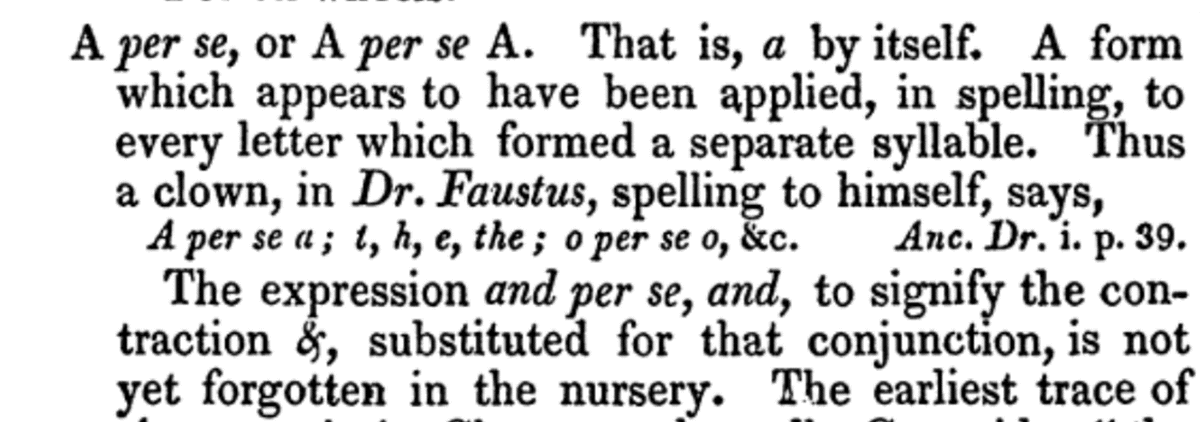
As this 1822 Glossary of Words and Phrases explains, it had been normal during the Renaissance, when speaking the alphabet, to add "per se" before any letter which could also be a word on its own — "per se" means "by itself" in Latin.
Take the letter A, which can also be a word of its own. When reading out the alphabet people would say "A, per se A, B, C, D, E, F, G, H, I, per se I..." and so on. O was also considered a word of its own.
Which means, when people got to the end of the alphabet, with & being the 27th letter, they would say: "S, T, U, V, W, X, Y, Z, and per se &."
When this old way of reading the alphabet was taught to children in the 18th century and they were reciting it aloud, they would garble "and per se " into what eventually became... ampersand.
A Dictionary of Slang and Colloquial English from 1905 relates some of the many other pronunciations school children apparently came up with:
"Ampersand. The sign &; ampersand. Variants: Ann Passy Ann; anpasty; andpassy; anparse; apersie; per-se; ampassy; am-passy-ana; ampene-and; ampus-and; ampsyand; ampazad; amsiam; ampus-end; apperse-and; empersiand; amperzed; and zumzy-zan."
Well, of all the many pronunciations that might have stuck, it was "ampersand" which came to be accepted and is now the official name for &... rather than zumzy-zan. So, from hurried Roman scribes to unruly school children, that's where "&" came from.
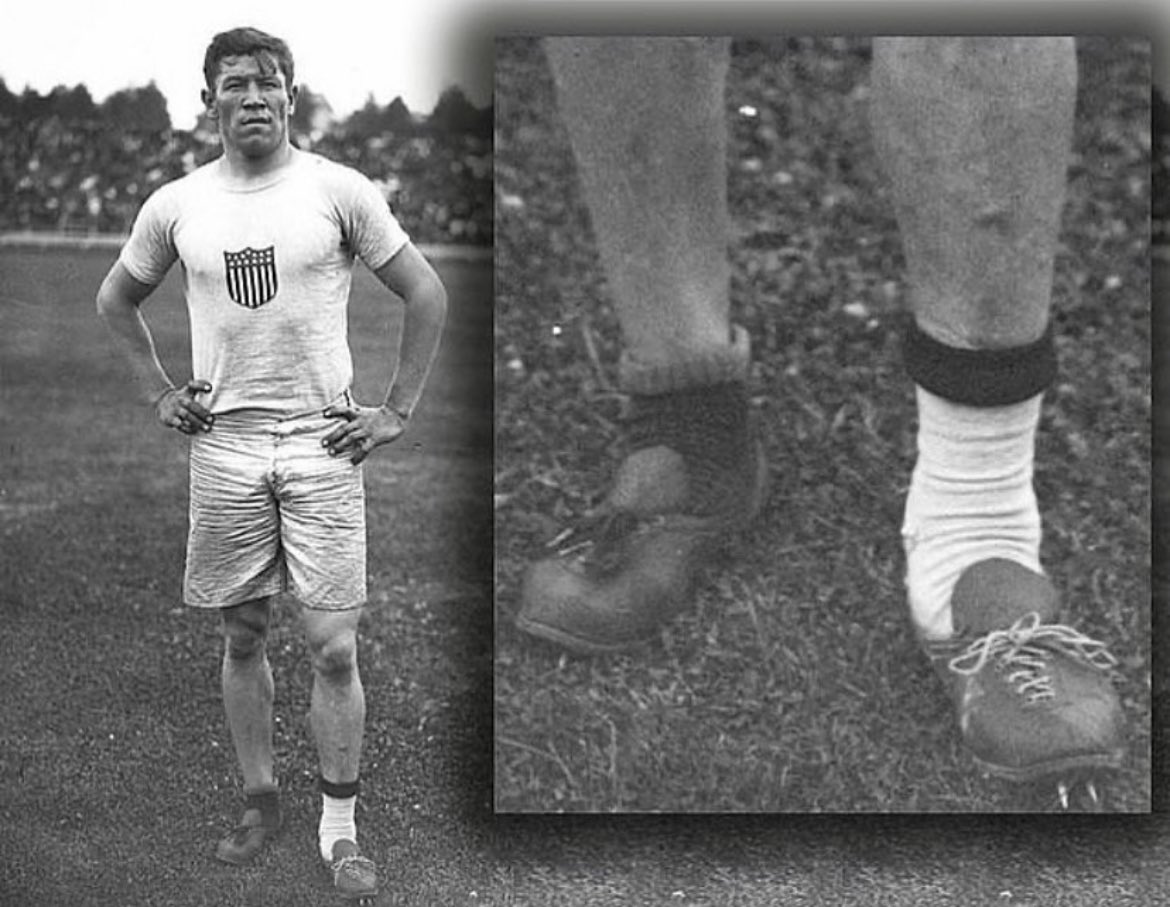
Jim Thorpe, a celebrated Native American athlete hailing from Oklahoma, achieved fame as an Olympic Gold medalist and is often regarded as one of the greatest athletes in history. In 1912, he represented the United States in the Olympics held in Sweden, where he was joined by future General George Patton as a teammate.
Before conquering the three-day decathlon, encompassing ten track and field events, Thorpe had already secured a gold medal in the pentathlon with remarkable ease. However, during the second day of the decathlon, just before the 1500 meters race, Thorpe encountered a setback – his shoes had disappeared, likely stolen. In a desperate search for a solution, he turned to his teammates and managed to find an extra shoe, though it was too small. Nevertheless, he squeezed his foot into it. He then stumbled upon the other shoe in a trash bin, which, conversely, was too big for him. To make it fit, he ingeniously padded it with a couple of pairs of socks.
Undeterred by this footwear predicament, Thorpe faced off against the world's finest decathletes and remarkably won the 1500 meters race. During the decathlon, he demonstrated his exceptional talent by securing first place in four events and finishing no lower than fourth in the remaining six events, all while wearing mismatched shoes. Consequently, he clinched yet another gold medal.
Upon receiving the prestigious accolades, King Gustav V of Sweden bestowed two Olympic gold medals upon Thorpe and declared him the world's greatest athlete. Graciously, Thorpe replied with a simple "Thanks."
After the Olympics, this versatile athlete pursued an illustrious career, excelling in various sports. He ventured into the National Football League as a two-time All-American college football player, briefly played professional basketball, and enjoyed a fruitful seven-season stint in Major League Baseball. Thorpe's legacy as an extraordinary athlete and his inspiring feat with the mismatched shoes have left an indelible mark on the world of sports.
@Mr_Andrew_Fox And even if we did want to be primarily a mentoring organisation, how much credibility would we have for that? Hard to claim to be a reference army.
Below is a brief description of Prigozhin's mutiny and the factors that contributed to its outcome. We, as observers, initially missed important details due to the scarcity of information and lack of time for in-depth analysis. Here's the perspective that currently seems most plausible:
1️⃣ Prigozhin's rebellion wasn't a bid for power or an attempt to overtake the Kremlin. It arose from a sense of desperation; Prigozhin was forced out of Ukraine and found himself unable to sustain Wagner the way he did before, while the state machinery was turning against him. To top it off, Putin was ignoring him and publicly supporting his most dangerous adversaries.
2️⃣ Prigozhin's objective was to draw Putin's attention and to impose a discussion about conditions to preserve his activities - a defined role, security, and funding. These weren't demands for a governmental overthrow; they were a desperate bid to save the enterprise, hoping that Prigozhin's merits in taking Bakhmut (that's why he needed it!) would be taken into account and the concerns would catch Putin's serious attention. Now it appears that these merits helped Prigozhin to get out of this crisis alive, but without a political future in Russia (at least while Putin is in power).
3️⃣ Prigozhin was caught off-guard by Putin's reaction and found himself unprepared to assume the role of a revolutionary. He also wasn't prepared for the fact that Wagner was about to reach Moscow where his only option remained - to "take the Kremlin" - an action that would inevitably result in him and his fighters being eradicated.
4️⃣ Those in the elites who were able reached out to Prigozhin with offers to surrender. This likely added to his sense of impending doom. However, I don't believe any high-level negotiations took place. Lukashenko presented Prigozhin with a Putin-endorsed offer to retreat on the condition that Prigozhin would leave Russia and Wagner would be dissolved.
5️⃣ I don't think Prigozhin was in a position to make demands (such as the resignation of Shoigu or Gerasimov - something many observers expect today. If that happens, it will be due to another reason.) After Putin's address in the morning of June 24th, Prigozhin's primary concern was to find an off-ramp. The situation would have led to inevitable death in merely a few hours. It is possible that Putin has promised him safety on the condition that Prigozhin remains quietly in Belarus.
I stand by my previous assertion that Putin and the state have been dealt a severe blow (which will have significant repercussions for the regime). However, I want to emphasize that image has always been a secondary concern for Putin. Setting optics aside, Putin objectively resolved the Wagner and Prigozhin problem by dissolving the former and expelling the latter. The situation would have been far worse if it had culminated in a bloody mess in the outskirts of Moscow.
And no, Putin doesn't need Wagner or Prigozhin. He can manage with his own forces. He's now certainly convinced of that.
I will disclose many more details in my bulletin to be issued tomorrow evening.
Last night dozens of settlers attacked the villages of A Luban a-Sharqia, Qablan, Huwwara, Baytin, and at several junctions. Reported damage so far: 9 homes, a gas station & several businesses destroyed, 11 cars & tens of dunams of agricultural lands burned, several injuries.
It's World Ocean Day, and with Wasteland out in just two weeks, it's the perfect time for a thread one of my favourite greenwashing myths: products made with 'recycled ocean plastic'. 🧵
1/ Sergei Shoigu's chestful of medals has been highlighted by @rshereme, who points out that the Russian Defence Minister has never served in the military despite his uniform and decorations. But the full story is both ridiculous and revealing. ⬇️
https://t.co/WgUf3nTesJ
The permafrost monitoring on Janssonhaugen, Svalbard, was established 25 years ago, on 9 May 1998. The data series document the transformation of the once cold permafrost