700,000 YEARS
Yes, the internet moves so much video every day that, if you stacked it end-to-end, it’s the equivalent of watching HD video nonstop for 700,000 years.
And every one of those videos has to be:
• Processed (encoded, edited, optimized),
• Stored (kept on servers),
• Streamed (delivered to devices without lagging).
We built Vidaio to make that video load lighter and more efficient. We use a decentralized network to:
• Compress videos more efficiently (smaller files means cheaper storage and cheaper delivery),
• Upscale when needed (so you can stream lower-res content and enhance intelligently),
• Improve streaming workflows so platforms can deliver better video easily.
Bittensor has given us the infrastructure to power the next generation of video processing.
And we intend to save the internet a lot of stress.
Process videos, cheaper, better and faster with vidaio.
It’s a new month, and we’re only in the third month of the year.
Which means there’s still time to do meaningful things, like:
• Exploring one of the largest decentralized intelligence networks (Bittensor) as a builder, investor, or contributor
• Using Vidaio’s decentralized AI video processing tools to upscale low-resolution videos or compress files while preserving perceptual quality
Intelligence was never meant to be centralized, and neither was video processing.
You may not realize how early we are.
Happy new month from Vidaio.
What does upscaling mean to you?
At Vidaio, we see upscaling as more than a simple enhancement.
It’s BREATHING new life into low-resolution videos.
It could be an old clip of your child’s first steps, or a video from the beach 10 years ago. Those memories shouldn’t fade.
With one click, you can restore and preserve the visual quality of your videos.
Our upscaling model supports resolutions up to 8K.
So, start the week by upscaling on Vidaio.
https://t.co/lGFrF0DYhC
Compression is easy.
Maintaining perceptual quality while reducing size aggressively is not.
Here’s a direct comparison between traditional encoding and Vidaio.
Example 1
Original: 110.76 MB
Traditional encoding: 50.84 MB
Vidaio: 37.38 MB
At nearly 25% smaller than traditional encoding, Vidaio achieved a VMAF score of 99.99 versus 80.3.
Example 2
Original: 231.59 MB
Traditional encoding: 2.42 MB
Vidaio: 0.82 MB
With a perceptual quality score of 97.8, outperforming traditional encoding at a fraction of the size.
This is content-aware compression in practice.
Not just smaller files.
Better perceptual outcomes at lower bitrates.
Built on Subnet 85.
Most compression tools treat every frame the same.
We don’t.
Vidaio splits videos into semantic scenes, analyzes motion, texture, and perceptual importance, then applies scene-specific encoding through our distributed miner network.
Less redundant data.
More efficient bandwidth.
Preserved visual quality.
This is content-aware compression powered by Subnet 85 on Bittensor
ICYMI: Worth reading 👇
One pain point almost every filmmaker and creator mentions:
"Compression ruins the mood of their shots".
Subtle lighting gradients get banded.
Skin texture flattens.
Delicate motion becomes jerky or blocky.
Vidaio fixes exactly that.
The content-aware model protects what carries the emotion:
• Prioritizes faces for natural skin tones
• Allocates extra bits to motion and lighting
• Compresses backgrounds intelligently without harming the story
Files become up to 96% smaller, while the visual quality and emotional impact remains intact.
Creators shouldn’t have to choose between artistic intent and practical file size.
That’s the problem Subnet 85 solves.
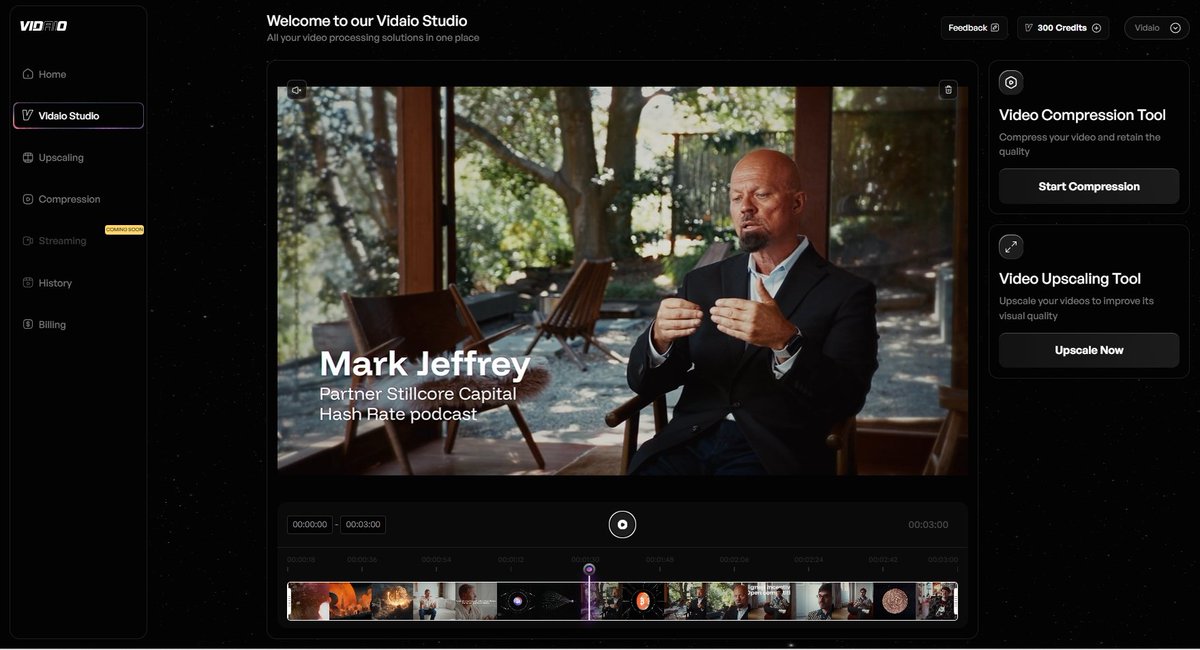
Vidaio Studio is one of the greatest tools we’ve built for video processing.
We added it as a feature, so that users can control how their videos are compressed or upscaled, instead of relying on default settings.
So basically, you can upload a video, and edit how it's processed.
With Vidaio Studio, you can:
1/ Clip your video: process only a selected section instead of the entire file.
2/ Choose the format (codec): use modern compression formats like AV1 or HEVC
3/ Pick the resolution: pick the quality you want for your video, resolutions from SD up to 4k
4/ Select encoding mode: choose between CBR (Constant Bitrate) and VBR (Variable Bitrate)
• CBR keeps bitrate stable
• VBR adjusts bitrate based on scene complexity
5/ Set the bitrate: control how much data per second the video uses, which affects size and quality.
This is way more than any centralized platform could offer you.
On Vidaio, you have real choice and control.
Most video compression tools apply the same encoding rules from frame 1 to frame N.
We believe that's fundamentally the wrong approach.
At Vidaio we built an intelligent, scene-aware compression engine that actually understands what it's compressing.
Here's how it works:
1. Input: full video
First step: we don't just start encoding.
We intelligently split the video into semantic scenes.
A talking head segment is very different from fast action, a slow pan, text overlays or scene changes, so they shouldn't be forced into identical encoding decisions.
2. Deep scene analysis
For each scene we:
• extract representative frames
• analyze motion patterns, texture complexity, semantic content
• classify frames (e.g. high-motion, low-texture, face-heavy, etc.)
3. Perceptual quality metrics
We don't just look at pixels.
We compute human-relevant scores measuring how perceptually important each region is and which details matter most to viewers.(faces, text, edges, motion).
4. Dynamic, scene-specific encoding
Only now do we decide encoding parameters:
• bitrate allocation
• quantization strength
• GOP structure
• keyframe placement
• even codec-level decisions
Each scene gets exactly what it needs, nothing more, nothing less.
The result: significantly better compression efficiency while preserving (or even improving) perceived quality where it matters most.This isn't uniform CRF or fixed presets.
This is content-aware, intelligent compression running live on Bittensor Subnet 85.
Bittensor will eventually outperform every other chain.
I say this confidently because it’s one of the few networks that is truly adaptable.
You can integrate almost any industry into it.
Score alone has already integrated at least three into the network.
That's the whole concept of Reed's law
The fact that TAO doesn’t just connect users.
It connects subnets, and each subnet is its own mini-network, product, and economy.
So value doesn’t only grow from more people joining.
It grows from:
• More subnets launching
• Subnets collaborating
• Subnets building on top of other subnets
• New sub-groups forming inside the ecosystem
So the next time you complain about price, think about this
Bittensor Post 🚨
It took a while, but Void 2.0 is now live
Instead of just staking and holding inside Bittensor, you can now bridge assets across chains, use them in other DeFi eco, and keep earning while doing so.
I think the best thing about this update is how @v0idai | Subnet 106 now works economically.
Instead of renting liquidity and rewarding farmers (via emissions), the protocol will own its liquidity permanently. VoidAI now uses its 18% owner allocation to build Protocol-Owned Liquidity (POL).
Other changes include:
• Fees generated from trades are now used to buyback SN106 and burn it, so no more inflation
• Instead of distributing miner emissions, they’re burned. That reduces sell pressure and less new supply entering the market
• When users swap, if they set a referrer, that person earns the fee but if not, the fee goes into the buyback and burn model
VoidAI is not abandoning Bittensor.
Native Bittensor pools remain the main settlement layer, but now:
> Router handles subnet swaps through native pools
> Bridge exports assets cross-chain
> LSD layer turns staking yield into a DeFi primitive
So congratulations to the ecosystem
TAO + subnet assets can now be bridged to other ecosystems (like Ethereum or solana), without fragmenting liquidity.
That also means you can interact with TAO and subnet tokens directly from wallets like MetaMask, no CLI, no native wallet setup.
This is actually very cool. Enter the VOID
This image came to mind 👇
I saw @DrocksAlex2 comparing what Vidaio offers to Resolve, and I’m not going to lie, he has a point.
But there’s a big difference between creative tools and processing infra.
Creative tools are built for humans to sit down and craft something. You tweak clips, adjust details, polish scenes.
Processing is different. It’s designed to handle large volumes automatically and efficiently. It’s specific and built for scale.
Vidaio’s compression tool, for example, splits video into scenes, analyzes motion and detail, and applies scene-specific encoding.
That means you can throw hundreds or thousands of videos at it, and it processes them consistently without manual input.
Only possible on Bittensor $TAO.
It has been a tough couple of days on the Nuance subnet 🤫
But if I’ve learned anything at all from the debacle these past few days, it’s what the power of community can do, and not just any community, the Bittensor community.
Complaints were made, and the team responded.
Nuance has always been about adding value to the Bittensor ecosystem.
Not everybody knows how to use GPUs or perform compute mining,
but Nuance has allowed users to earn for every meaningful post and mine by contributing ideas.
@dxcryptosol and I decided to update the Nuance Leaderboard Vercel platform to make it more transparent, because Bittensor is about transparency.
Here are a few updates:
➡️ Nuance users can now monitor their dTAO emissions in real time on the miner profile dashboard.
➡️ There’s now a Quality Check page to determine how much value your post adds. We used the endpoint provided by the Nuance team.
Coming soon: we’re currently working on the Submission API. If it works, you won’t need IDs for submissions, just the post link.
The Quality Check was an update made by the Nuance subnet team to promote factual contributions.
Posts that pass the check get a 1.2x–1.5x multiplier.
Other updates made by the Nuance team include:
➡️ QRT scoring disabled
➡️ Followers’ weight adjustment from 1.5 to 1.2
➡️ A deterministic LLM that can scan posts more accurately, no matter the length
There’s been a bit of FUD around @NuanceSubnet from the wider ecosystem, but I’m confident the team will clear those doubts soon.
We’ll keep assisting in every way we can, and we’ll keep building to make our fellow miners’ work easier.
Stay Nuanced.
Tether has frozen over $𝟮.𝟱 𝗯𝗶𝗹𝗹𝗶𝗼𝗻 worth of USDT to date, after working with global authorities.
Ponder on that number 🤔
That could be your funds at anytime
Use a private and uncensored stablecoin.
Use fUSD.
Learn more 🧵👇