It will be very interesting to test these devices in blind-from-birth people, given the seemingly permanent reduced metabolic activity of neurons in the their primary visual cortex due to sensory deprivation.
🚨 THIS IS GOING TO BREAK THE INTERNET!
Elon Musk just dropped Neuralink's craziest bombshell:
“In the next 6 to 12 months, we're going to implant the first vision devices. Even if you're 100% blind from birth, we're going to write directly to your visual cortex… and you're going to see.”
“And that's just the beginning. In the long term, you'll have ultra-HD resolution and real superpowers: you'll see in infrared, ultraviolet, and even radar. Literally like a superhero.”
The future is no longer science fiction. It's Neuralink.
@Osy_VP@AttoGladys …lol, then that post is terrible way of describing immune privilege of the eye. And the eye is not the only immune privilege organ of the body. So the statement is not well-written at all. It’s a scientific clickbait.
Scientific fact:
Your body does not know that you have eyes. The moment it gets to know, it will make you blind.
Your entire life is about maintaining that secret!
Today, America wakes 250 years later as a beacon of hope, a republic entrusted to its people, an idea that changed the world.
A nation worth preserving. A dream worth pursuing. A freedom defended by every generation.
Happy 250th, America! 🇺🇸
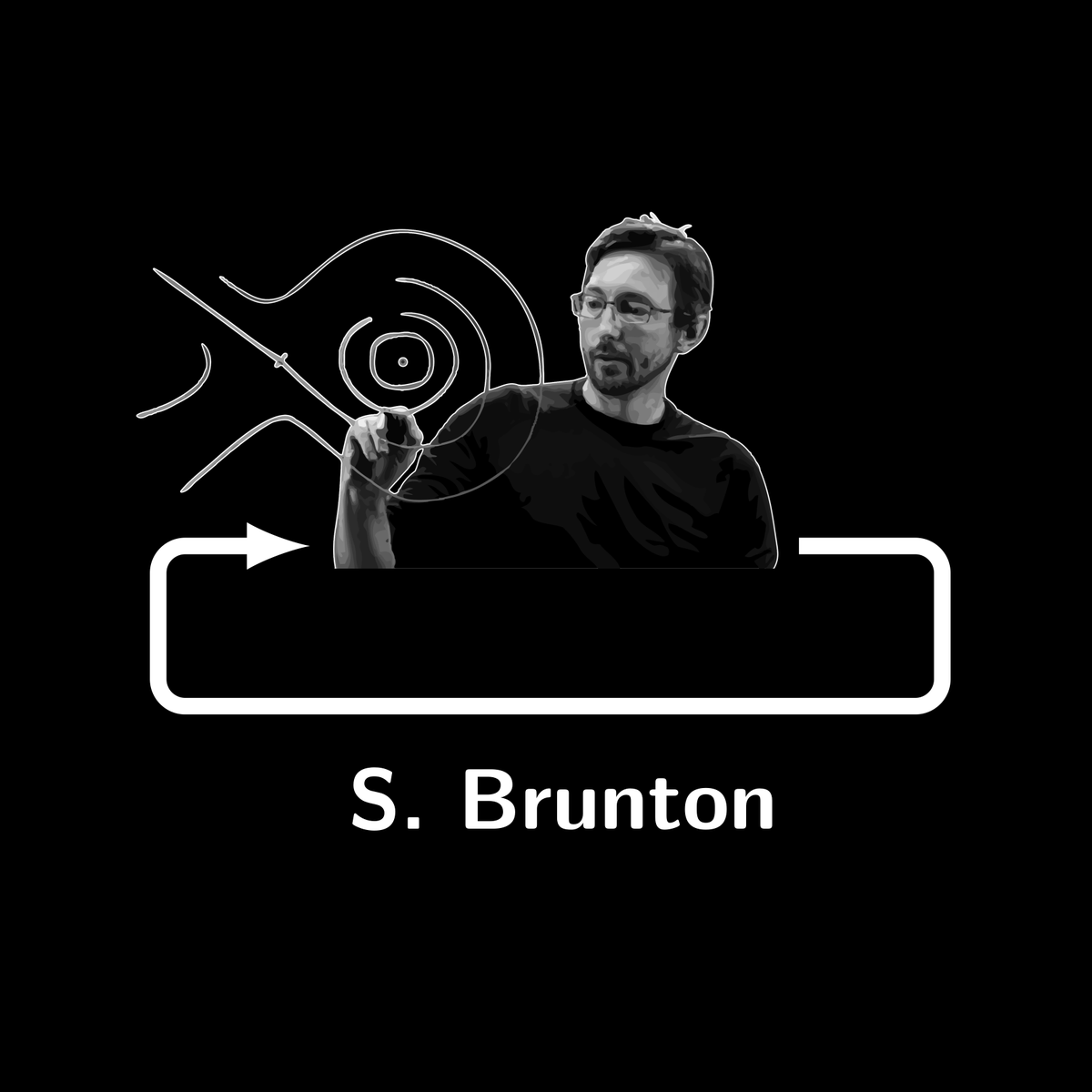
New inControl episode out! 🎙 This time Steve Brunton, aka @eigensteve 🎥, walks us through data-driven modeling and control: from DMD and Koopman operator theory, to SINDy, explainable AI 🤖, HydroGym 🌊, and how to teach math to half a million people! 🚀
your nose can detect a single molecule of certain thiols. one molecule. no mass spec on earth is that sensitive. you are already the most advanced instrument in the room and nobody told you
New paper from my lab (not an author): Even though there are gap junctions n lateral connections (horizontal or amacrine cells) between neighboring cones and neighboring downstream neurons. Visual information captured by individual cones do not mix up, at least up to the LGN 1/2
The Terence Tao episode.
We begin with the absolutely ingenious and surprising way in which Kepler discovered the laws of planetary motion.
People sometimes say that AI will make especially fast progress at scientific discovery because of tight verification loops.
But the story of how we discovered the shape of our solar system shows how the verification loop for correct ideas can be decades (or even millennia) long.
During this time, what we know today as the better theory can often actually make worse predictions (Copernicus's model of circular orbits around the sun was actually less accurate than Ptolemy's geocentric model).
And the reasons it survives this epistemic hell is some mixture of judgment and heuristics that we don’t even understand well enough to actually articulate, much less codify into an RL loop.
Hope you enjoy!
0:00:00 – Kepler was a high temperature LLM
0:11:44 – How would we know if there’s a new unifying concept within heaps of AI slop?
0:26:10 – The deductive overhang
0:30:31 – Selection bias in reported AI discoveries
0:46:43 – AI makes papers richer and broader, but not deeper
0:53:00 – If AI solves a problem, can humans get understanding out of it?
0:59:20 – We need a semi-formal language for the way that scientists actually talk to each other
1:09:48 – How Terry uses his time
1:17:05 – Human-AI hybrids will dominate math for a lot longer
Look up Dwarkesh Podcast on YouTube, Apple Podcasts, or Spotify.
My experience: 3b1b is not to learn from scratch, it’s to get the intuition to build and manipulate ideas. Eg. the moment you get to know that matrix operations are just transformation of spaces, it gives you a powerful framework to formalize and solve your own problems.
Yesterday, I asked ChatGPT 5.2 to modify an existing code. It basically rewrote the whole code, added fxns.Worked on first try. I later noticed a bug. Deleted all the codes, thought about the problem for a few mins, modified 3 lines of my old code, problem was solved with no bug.
Yesterday, I asked ChatGPT 5.2 to modify an existing code. It basically rewrote the whole code, added fxns.Worked on first try. I later noticed a bug. Deleted all the codes, thought about the problem for a few mins, modified 3 lines of my old code, problem was solved with no bug.
Experience no longer really matters in software engineering. Opus 4.5 basically levelled the playing field. Jesus - 10 years of my life were for nothing