There are moments when the most useful thing we can do is set aside what we think we know and simply ask a better question.
This is one such thought experiment.
Not a prediction.
Not a price target.
Not investment advice.
A vision to examine, challenge and discern.
For most of XRP’s history, people have understandably viewed its price through the familiar lens of markets:
How many people want to buy it?
But what if that eventually becomes the wrong question?
Imagine a world in which securities, Treasuries, currencies, real estate, commodities and other forms of legally recognized value increasingly become tokenized and capable of moving around the clock.
Those assets still have to settle.
Different currencies still have to exchange.
Different pools of liquidity still have to meet.
Market makers still have to provision capital.
And somewhere between all those assets, currencies and networks, the system may need exceptionally efficient forms of neutral bridge liquidity.
If XRP earns a meaningful role there, something subtle but profound changes.
Demand would no longer arise solely because someone believes XRP will appreciate.
Some demand could arise because value actually needs to move.
And markets do something fascinating when necessary demand encounters finite available supply:
price discovers the level at which sufficient economic capacity becomes available.
A higher XRP price would therefore not merely represent greater speculative enthusiasm.
It could allow the same number of XRP to carry substantially more value.
$10 XRP creates ten times the dollar-denominated liquidity capacity of $1 XRP.
$100 creates ten times the capacity of $10.
And so forth.
That raises an intriguing possibility.
Perhaps mature XRP price discovery would not resemble a smooth upward curve at all.
Perhaps long periods of relative equilibrium could be interrupted by sharp stair-step repricing events as successive thresholds of institutional liquidity demand are reached.
Not because somebody administratively declares what XRP should be worth.
Not because social media becomes excited.
And certainly not because a chart says so.
But because the market continually asks a brutally simple question:
At what price can the available liquidity carry the value that needs to move?
I don’t pretend to know the answer.
None of us knows what percentage of future institutional settlement XRP will capture—or whether competing technologies ultimately solve much of this problem differently.
But I believe the question itself deserves serious consideration.
Because if tokenization creates vastly more financial traffic…
if programmable settlement changes how capital moves…
if liquidity increasingly operates 24/7…
and if XRP becomes meaningful operational inventory connecting otherwise fragmented pools of value…
then we may eventually discover that we spent years debating the price of XRP when the more consequential question was always:
How much economic value must each available XRP be capable of carrying?
The graphic below is simply an attempt to visualize that possibility.
Take nothing on faith.
Challenge the assumptions.
Test the mathematics.
Study the architecture.
Then reach your own conclusion.
Knowledge → Understanding → Wisdom → Life.
Let’s Always Seek Truth.
@Ripple@X
Hedge funds are rapidly dumping chip stocks:
Semiconductor and semiconductor equipment stocks now account for ~16% of total global hedge fund market exposure, near their lowest in 6 months.
This percentage has declined -8 points since its June peak.
However, exposure still remains double the levels seen in November 2025.
To put this into perspective, semiconductor stocks accounted for ~6% of global hedge fund exposure on average in 2024 and 2025.
Meanwhile, software and services stocks now account for just ~2% of hedge funds' portfolios, near the lowest level on record.
Hedge funds are locking-in massive profits in chip stocks.
NEW: 🇺🇸 "This is money... Of course, it needs to have a regulated path," says BitGo CEO Mike Belshe.
Belshe warns that without a framework, the U.S. cannot begin the process: "If you don't put the CLARITY Act in or something like it, then you don't even get to get started." 📜
LATEST: 🇺🇸 The SEC has sent proposed crypto custody rule changes to the White House for review, aiming to clarify how investment advisers can hold digital assets for clients.
There are no doubts we are in cycle bottom territory when it comes to momentum on $XRP's 3 month RSI. Yet we still haven't touched down on prior cycle bottom readings of 47 (2020/2022). The RSI did however tag early 2024 levels, and has since bounced. Will this time be different?
XRP is doing what Bitcoin did in prior cycles, violent upside, sharp pullback, then higher lows while real capital accumulates.
(fiscal pressure + yield management) are now hitting the best payments rail in crypto.
Don’t sleep on this.
🚨 $XRP LOST $1.46 AS EXPECTED — NOW $1.34 IS THE CRITICAL BOUNCE ZONE BEFORE A POTENTIAL RUN TOWARD $2.60 😳🔥📈
The $1.46 support failed, and XRP has now dropped to roughly $1.38, putting the $1.34–$1.36 zone directly in play.
👉 4H RSI has collapsed from 80+ to ~43. The extreme overbought conditions are gone, giving $XRP substantially more room if buyers return.
Now the setup becomes VERY clear:
🟢 $1.34–$1.36 HOLDS → potential reversal zone
🟢 Reclaim $1.46 → first confirmation buyers are taking control again
🔥 Break $1.70 → bullish continuation strengthens dramatically
🚀 Above $1.70 → $2.00 → $2.40 → ~$2.60 becomes the larger upside roadmap
🔴 LOSE $1.34 → the bullish rebound gets delayed, with $1.30–$1.29 becoming the next major support area.
The chart isn’t showing a confirmed $2.60 recovery YET — $1.34 has to prove itself first. ✅
But if buyers defend it and $XRP quickly reclaims $1.46, this dip could become the reset before the next MAJOR expansion. 🚀
$1.46 FAILED ➡️ $1.34 TEST ➡️ BOUNCE ➡️ $1.70 BREAK ➡️ $2.60? 👀🔥
🚨UPDATE: The SEC is preparing a major overhaul of crypto custody rules for investment firms.
The proposal would clarify how investment advisers and funds can hold digital assets for clients while removing custody requirements the agency considers outdated.
The rule was sent to the White House for review on August 25.
If cleared, SEC commissioners will vote to release it publicly before opening a comment period of at least 60 days.
$2B is just one measure of the momentum behind $RLUSD. From institutional partners like @BNYglobal to growing exchange adoption and real-world use cases, we’re building the infrastructure and distribution for scale.
So proud of this team - and we’re still early. LFG. 💪🏼
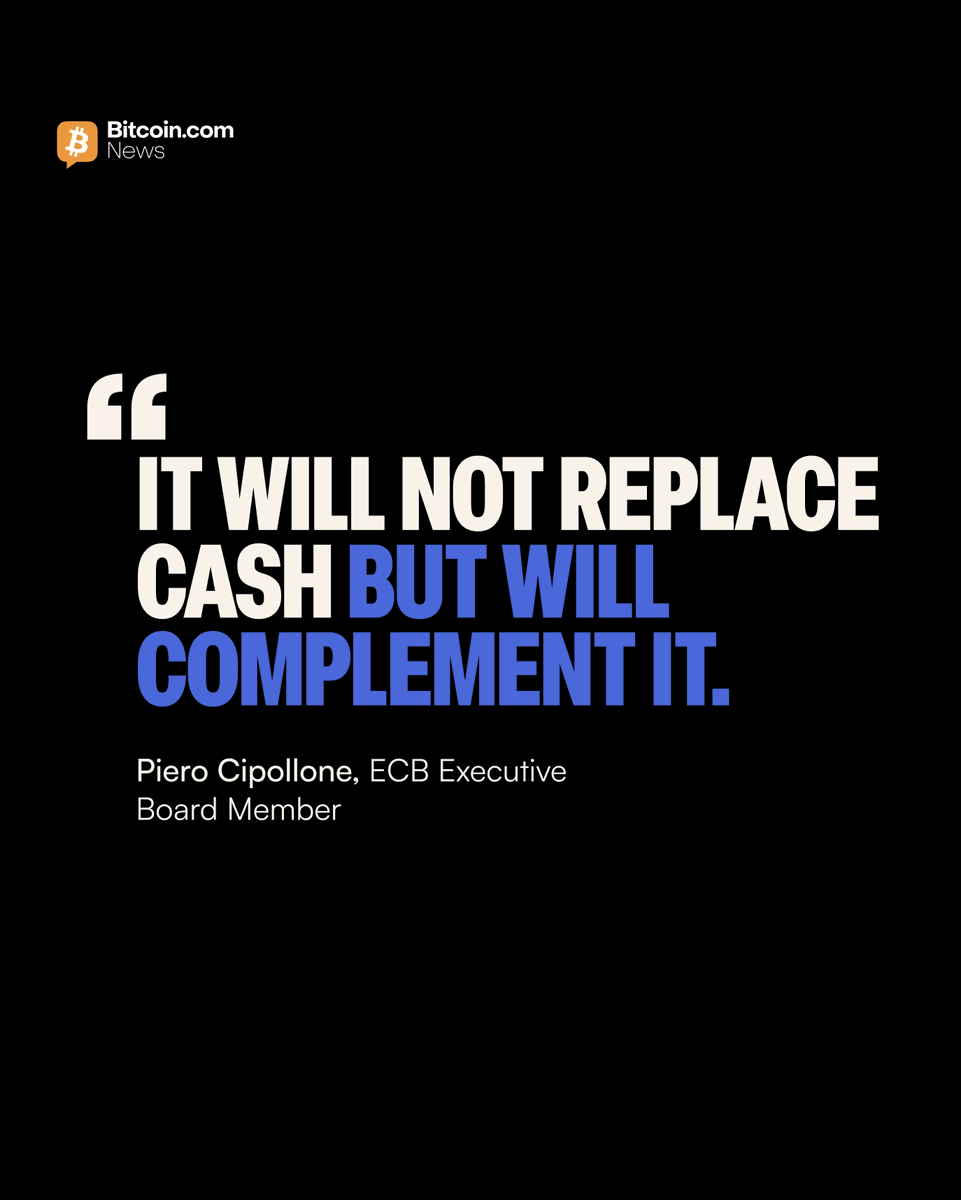
JUST IN: 🇪🇺 ECB board member Piero Cipollone says the digital euro "guarantees the maximum level of privacy that current technology can offer."
While the Eurosystem won't identify users online, commercial banks still will for AML purposes. Issuance is targeted for 2029. 💶
Markets do not transition directly from a Stage 4 contraction into a Stage 2 expansion, a structural Stage 1 accumulation phase is a historical prerequisite.
Unless central banks suddenly flood the global economy with emergency cash out of nowhere, skipping Stage 1 is historically impossible.
Full breakdown + notes in the report.
Volatility means the inability of prices to remain stable and their movement up and down.
However, using bots to move prices up and down as desired to wipe out leveraged positions is not called volatility.
Although leverage trading has been banned in many countries, it continues on most global CEXs.
Let's say leveraged trading on CEXs is banned in a country, but transferring funds from one's own wallet to Binance Global is not banned. A person transfers funds there and trades with 50x or 100x leverage.
Such high leverage harms the crypto market.
I also want you to take precautions regarding this, thank you.
@CFTC@SECPaulSAtkins@ChairmanSelig