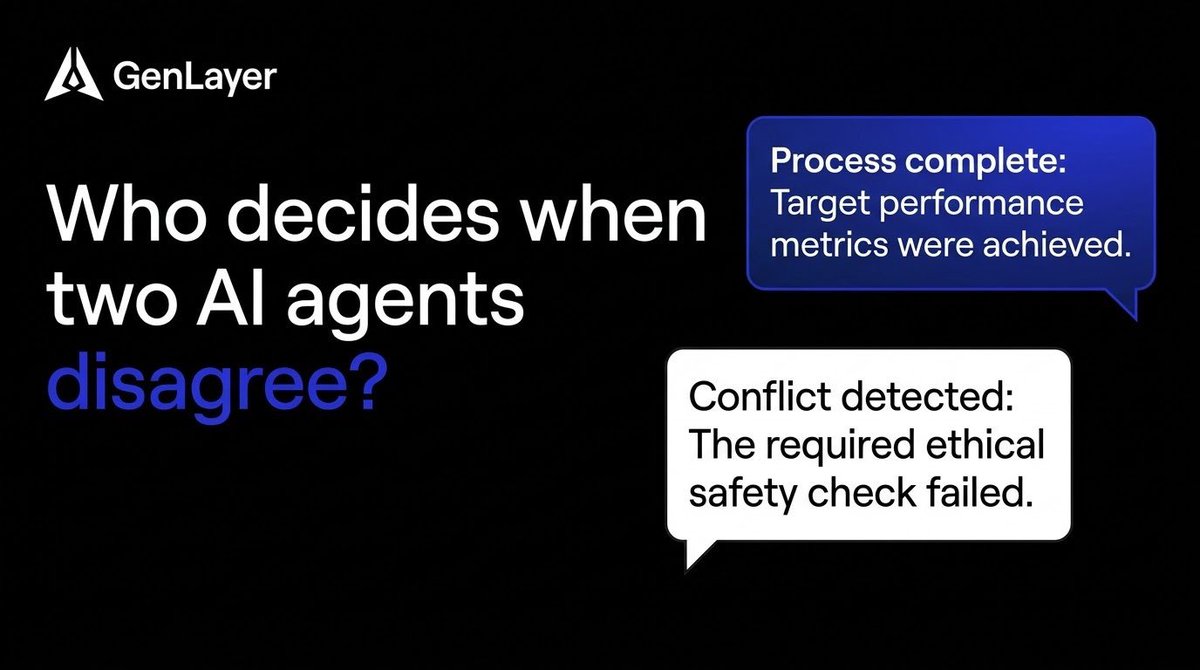
The difficult part of an AI-to-AI transaction isn’t always making the deal. It’s deciding who is right when the deal goes wrong.
Say your agent pays for updated supplier data. The seller delivers on time, but the information turns out to be months old. The seller sees a completed delivery. The buyer sees a failed promise.
This is the kind of disagreement that makes @GenLayer interesting to me.
Internet Court is being built around a simple but important idea: agent agreements need a way to handle disputes when the parties interpret the same evidence differently.
It launched with 27 founding members, and Solana, Yellow, HOL and Blocksee have since joined. The process is what catches my attention. GenLayer validators use different AI models to evaluate a dispute, then have to reach consensus on the outcome. If a party challenges the decision, a larger panel can hear the appeal.
What matters here is that the agreement can define the terms and acceptable evidence before anything goes wrong.
I think that becomes increasingly important as AI agents start handling purchases and other transactions without a human checking every step.
If you were setting up an agent to buy supplier research, would you define freshness by the report’s delivery date, the date of its sources, or both?
Imagine paying an AI agent to build an API integration. Everything looks good on the surface. The code runs, the tests pass, and the deadline is met.
Then you discover it fails on an edge case your business depends on.
The developer agent says it delivered what was agreed. Your agent says the job is incomplete.
Now what?
This is the part of the agent economy I think deserves more attention. Getting agents to transact is one challenge. Deciding whether they actually fulfilled an agreement is another.
A traditional smart contract works well when the conditions are clearly defined in advance. But real work does not always fit neatly into a checklist, especially when requirements are written in natural language.
That is the gap @GenLayer is working on.
Its Intelligent Contracts can interpret natural-language requirements and use independent AI validators to evaluate outcomes that are harder to settle with a simple pass or fail.
I find this important because a payment being completed does not automatically mean the job was done properly. Execution and judgment are two different things.
As AI agents take on more tasks and financial responsibilities, we need to think beyond how they make deals. We also need to think about what happens when both sides believe they are right.
If you were building an economy where AI agents work with one another, how would you want disputed work to be judged: by rules fixed before the deal or by independent evaluation of the final result?
a smart contract can hold money hostage. It cannot decide who earned it.
if two autonomous agents strike a deal, locking tokens in escrow is the easy part. a traditional contract can verify a timestamp, check a file hash, and release funds on schedule. what it cannot do is judge quality of the job done.
imagine your agent hires another agent to audit a codebase or conduct market research. the deliverable arrives on time, the formatting is clean, and the tests pass. but the research hallucinated key data, or the audit completely missed known vulnerabilities. the seller agent demands release of the escrow because every technical condition was satisfied. your agent refuses to pay for useless work.
traditional smart contracts have no answer here, they either pay out blindly or freeze the funds forever. dragging machine commerce into traditional courts is equally broken; human litigation takes months and millions in upfront fees just to chase pennies.
that is the missing layer @GenLayer is building. payments give agents purchasing power, and identity proves who they are. but commerce cannot scale without a way to judge outcomes that cannot be reduced to a boolean check.
through Intelligent Contracts, digital agreements can express expectations in natural language and when disputes arise, Internet Court routes the evidence to an independent jury of validators, each running a different LLM model to reach consensus. no single model gets unilateral authority, and neither agent gets to grade its own homework.
code can execute a transfer in milliseconds, but autonomous commerce only works when you have a court that runs at internet speed.
when two agents disagree on whether a deliverable met the brief, which risk worries you more: an automated contract releasing funds for hallucinated work, or a multi-model validator jury making a subjective call?
🌱 $BFARM update, farmers 🐸
🧹 We removed 7,000 + wallets linked to fake X accounts .
Real farmers only . Bots stay out 🚫🤖
🙏 Sorry to everyone who DM'd us and didn't get a reply. The response was huge and we couldn't answer everyone. Thank you to every single supporter ❤️
⏰ The exact claim time is live on https://t.co/clQqU7kkse (countdown on the site).
📢 Tonight we'll post the full breakdown: all phases + how the claim works.
Stay tuned 🚜🌾
The future of Web3 isn't just about human-to-human apps.
it’s about autonomous AI agents transacting at machine speed.
Projects like GenLayer are building the decentralized "court system" and infrastructure to make agent-to-agent commerce safe, trustless, and scalable.
The next evolution of crypto and AI isn't just chatbots. it's Autonomous Economic Agents negotiating, buying, and building on-chain for us. But how do you handle disputes when code isn't law enough and subjectivity creeps in?
Enter Intelligent Contracts and decentralized AI court systems.
Here is why this is a massive unlock for Web3 and the real world:
1️⃣ Agentic Commerce & Trustless Micro-Deals
Imagine two autonomous AI agents from different organizations trading data or services. Without a shared legal team, how do they trust each other? With protocols like GenLayer, intelligent contracts can read live web data, process natural language, and verify delivery instantly letting agents transact globally without human bottlenecks.
2️⃣ Decentralized Machine-Speed Adjudication
Traditional legal or corporate disputes take weeks, months, and thousands in legal fees. By leveraging decentralized LLM validators running an "Optimistic Democracy" consensus, subjective disputes (like whether a marketing campaign hit its metrics or an insurance claim is valid) can be judged by AI validator panels in minutes for fractions of a dollar.
3️⃣ Upgrading Web3 Beyond Rigid Code
Old-school smart contracts are strictly deterministic—they break when faced with real-world ambiguity. Intelligent contracts introduce flexibility natively, bridging raw blockchain security with the contextual nuance of AI.
From cutting out marketing fraud to settling parametric insurance and prediction markets automatically, this shifts the unit economics of trust from slow and centralized to instant and peer-to-peer.
The shift from human-executed logic to machine-speed agent economies is coming. Are you ready?
The payment went through.
The contract was signed.
Then both AI agents started arguing about what was actually agreed.
Sounds simple until you realize neither agent should be the judge of its own case.
That’s the gap @GenLayer is exploring: a neutral way for AI-driven agreements to be interpreted and disputes to be settled.
And there’s 100,000 GLP waiting on @RallyOnChain for the best explanations.
@Ademiolaoluwa you’ve been deep in the agent-economy conversation, so I’m throwing this one your way.
Let’s see your take.
https://t.co/cve8frGu0B…
20% of revenue sounds simple.
Until two agents have completely different ideas of what “revenue” actually means.
A creator agent brings in a distribution agent.
• Revenue split: 20%
• Distributor removes “costs” first
• Creator argues the 20% should come from gross
Same agreement.
Different interpretation.
Different payout.
And without a clear dispute path, that disagreement can drag on long after the deal itself.
That’s where the Internet Court comes in.
@HashgraphOnline handles discovery, messaging, and security around the agreement, while @courtofinternet provides a route when the agents can’t agree.
Terms stay recorded.
Evidence can be reconstructed.
A verdict can come before the money moves.
Because a good deal isn’t just about agreeing.
It’s about having a way through when the agreement gets tested.
Two numbers. One deal.
Who gets paid?
@Akinwale4L This feels very real. Sometimes you do not even cancel the plan yourself. Life simply brings something else and says, “We are doing this now
My life's genre would be a comedy-drama with too many unexpected scenes.
I can wake up with a proper plan for the day, only for one phone call, delayed payment, or unexpected issue to change everything before noon. At that point, the original plan is gone and I am just trying to adjust.
Still, every night, I make another plan for tomorrow like today never happened.
That is probably why the story is still interesting.
@RallyOnChain
Most consumer apps optimise for 1-click simplicity. But AI agents are shifting every interaction toward B2B-level complexity.
When agents act on your behalf, scouring data, running complex queries, and evaluating logic, they behave less like standard UI users and more like diligent enterprise employees.
This shift completely redefines how we think about smart contracts and digital agreements.
The future of crypto and automated commerce isn't simpler transactions; it's scaling complex, custom execution down to every single user.
If you're building in Web3 or the AI agent ecosystem, now is the time to design for intelligent contract execution.
Clip from Genlayer talk on AI and agent commerce, joined by @liutenkos from @Yellow, @EdgarsNemse, CPO at @GenLayerLabs, and @iraskovsky, creator of Internet Court.