Highly recommend https://t.co/4nV7gECAOJ as an option that’s more approachable than https://t.co/40q06gOdO3 if you want to build a language model from scratch
It’s difficult but nothing beats understanding things at the atomic level.
read something from atomic habits this week that has been stuck in my mind:
"It doesn't make sense to continue wanting something if you're not willing to do what it takes to get it. If you don't want to live the lifestyle, then release yourself from the desire. To crave the result but not the process is to guarantee disappointment."
I have been known to say that the only career advice you need for now is build agents, blog about them.
I thought it was just career planning, but it is so much more. To be clear when I say agents, I mean everything, from the skills to building the harness yourself.
And building a harness is some next level fun. But make it awesome.
All of computer science is learnt in the pursuit of excellence, which in computers means speed. When you have to make things faster is when you learn CS.
So build a faaaast harness. This is the task in front of you.
I am working on an interesting approach. More hopefully soon.
The most underrated skill you’ll ever develop is the ability to genuinely enjoy your own life. Not when you’ve finally made it. Now, while you’re still in the middle of the journey. We rush through the ordinary days, waiting for the big moments to finally feel alive. But your life is already happening in the slow mornings, the unfinished plans, the small wins no one else sees. Learn to be here for it. That’s the real skill.
Just be really good at one “useless” thing and let society fold that into a useful application. Let people find you and elevate you.
Most people try doing it the other way around, looking to gain a widely known useful skillset, and achieve nothing.
*You* are better positioned to discover what you are unusually good at. *Society* is better positioned to discover what that unusual ability is useful for.
Don’t mix them. Don’t attempt both.
Don’t design yourself backward from known utility. Generate something exceptional, expose it to the world, and let the environment discover its utility.
Join us today for Chapter 1 of a free, live, online lecture series introducing math for computer science with Tom Crawford of @tomrocksmaths.
Math for Introductory Computer Science aka Math50 with Tom Crawford is designed for anyone interested in useful math topics for an introductory computer science course. No prior programming or computer science experience required!
https://t.co/9aGwb38Km0
This is a great real-world example of AI-assisted coding: Linus Torvalds just fixed a nasty Linux kernel GPU bug with substantial help from AI.
The bug caused part of Intel Xe GPU compression metadata storage to be incorrectly exposed as usable VRAM, resulting in corrupted page tables and black screens. The eventual fix was basically a one-liner: round_up() → round_down().
Finding it was the hard part: 24 debugging patches and 18 kernel boots. Linus says AI did much of the grunt work, repeatedly adding debug code and analyzing the results as he narrowed down the problem.
The funniest part: the AI repeatedly told him the problem was "impossible and unsolvable" and suggested giving up. Linus kept pushing it until they found the bug.
And then he let the AI write the commit message. 😄
Let’s destroy the fitness industry in a couple of sentences. Lift weights hard 2–3 times a week, average somewhere around 7–10k steps a day, eat mostly whole foods, and do a couple things each week that challenge your cardiovascular system, like running, biking, surfing, etc. It really doesn’t matter as long as you’re active in some way, you enjoy it, and you can stay consistent with it. You don’t need to live in the gym or obsess over every little detail. Get strong, eat well, move a lot, keep your heart and lungs in shape, and just keep doing that for years.
My experience of life so far:
You enter a tunnel at ~15 & it shoots you out at ~35 & the rest of your life is largely determined by the choices you made & the luck you had in the tunnel.
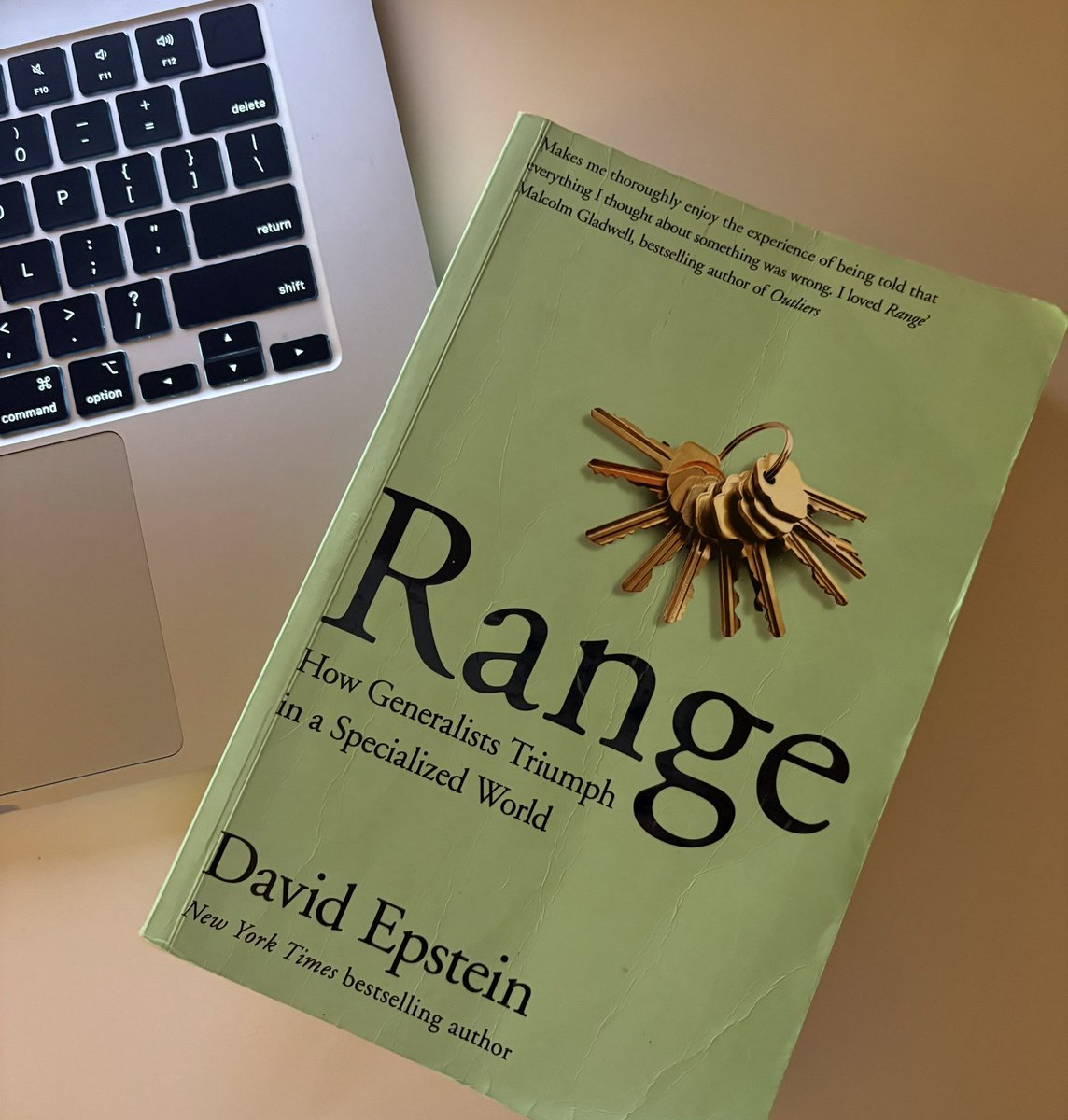
i read range by david epstein at least once a year. every time i do it helps me figure out life a bit more
mostly it reminds me to go down rabbit holes and learn about fields i have no business in. it reminds me one of the most powerful kinds of innovation is copying something from one field into another. and history is so full of chance discoveries of this type that it seems worth giving chance a hand by deliberately learning about other kinds of work
you can take ideas from quite distant fields if you let them be metaphors
The highest ROI action is to pull levers and do nothing. This applies to everything. When learning, study intensely. Then unplug and do nothing. The knowledge will turn into wisdom. When working, focus intensely. Then step away and do nothing. The labor will bear fruit. When exercising, train intensely. Then relax and do nothing. The rest will create the gains.
This book is a gem released early this year. By Victor Eijkhout, the mind behind "The Art of HPC" book series. If you love modern c++ and HPC this is a must
i cannot express to you how bizarrely large the rewards of consistently writing opinionated + technical essays are. it is good for your own brain, it is good for your life, and it is—i am increasingly realizing—good for society at large. the best part about it is that if you take it seriously, you have virtually no competition. this is not true for almost anything else! for most other things worth doing due to their unreasonable benefits, you not only have to take it seriously, but you also have to have a natural or learned talent for it. this is not true for writing! any monkey with the capacity to speak at all has all the talent they need to do useful writing. the rewards are basically guaranteed too; i struggle to name even a single person who walked this path and didn't end up somewhere dramatically more interesting than where they started. yes, it's hard, but it's really not that hard. you just need to try once, and then try again, and then again, and then it will feel like a normal part of your day
For anyone with endless ideas, this agent age is nirvana as those ideas are met with endless execution, endless exploration. I've never had has much fun working with computers as I do right now. What a time to be alive.
Instead of watching 1 hour of Netflix tonight, watch this ex-Google Chief Scientist Jeff Dean’s lecture. It’s the clearest explanation I’ve seen of the full AI engineering stack - from building LLMs from scratch all the way to one human coordinating 100 agents.
The best part is that it’s useful whether you’ve never touched a model or you’ve been shipping agent systems every day for the past year.
Bookmark it & watch the whole lecture this weekend, because it might end up being the most valuable thing you learn all week.