@anandmahindra This to me plus our athletes winning laurels, our badminton stars winning, every sportsperson winning is the best thing to happen to our country, not some #IPL tournament and hearing a man talking abt how he was hounded by the underworld - do we want sport to be entertainment?
Even in a bustling metropolis like Chennai, we see a beautiful miracle unfolding every year. Olive Ridley turtles come to Chennai beaches to nest every single year. This season, Chennai became Tamil Nadu’s largest nesting hub, protecting 74,143 eggs. What does it tell us ! The message is clear, wildlife can thrive in cities too, provided conservation is prioritised. This year across Tamil Nadu, 1,986 nests were protected, 2,29,668 eggs were conserved and 1,91,615 hatchlings were released into the sea through 52 hatcheries along the coast. Cuddalore protected 55,348 eggs and Nagapattinam 30,499, making this one of the strongest Olive Ridley conservation seasons in recent years. Most encouragingly, turtle mortality declined sharply from 1,575 last year to 786 this year a reduction of nearly 50 percent.
Behind these numbers lies an extraordinary partnership. Forest frontline staff, the Students Sea Turtle Conservation Network, @wii_india, researchers, volunteers, NGOs, the Fisheries Department, Indian Coast Guard, Marine Police and, most importantly, fishing communities worked together to protect these marine visitors. Conservation efforts included the distribution of 2,663 Turtle Excluder Devices (TEDs), 172 joint sea patrols, beach monitoring through the Turtle Guardian App, nest protection, clean-up drives and awareness programmes that reached over 23,000 fishermen. Satellite tagging of turtles has also helped us better understand their remarkable journeys. As this nesting season comes to a close, we bid farewell to these ancient travellers. The hatchlings released from our shores will now travel across vast oceans, only to return years later to the very same beaches where they were born. #WorldEnvironmentDay #Turtles #TNForest
@udaykotak Mr Kotak, as long as the nation is obsessed with politics and entertainment-cricket (read as IPL) as the front page headlines dont expect much out of it. Just ask your self how many ppl spoke about the Singapore Open win?
Diesel is the pinch point. Hormuz is only part of the story. And equity markets may be missing the bigger repricing ahead.
In the latest EA Forum podcast, @ea_amrita and @CommodMkt unpack one of the biggest market dislocations in energy and commodities right now.
Key takeaways:
- The market is still conflating a deficit with a shortage and until that shifts, prices may not fully reflect the underlying reality.
- Even if the Strait of Hormuz reopened tomorrow, long-dated oil still needs to reprice on the structural set-up.
- Jeff argues this could be the biggest repricing opportunity across the commodity complex.
- Meanwhile, equity markets are in “la la land”, having repriced the energy halo lower while overlooking the broader hard asset story.
- Diesel remains the critical pinch point, with implications that feed through the entire system.
Watch the full episode now: https://t.co/fi9ii0WEwR
Recorded on 8 May, this episode features Energy Aspects Founder and Director of Market Intelligence Dr Amrita Sen and Jeff Currie, Co-Chair at Abaxx Exchange, Co-Founder of 1947 Oil & Gas Plc and Non-executive Director at Energy Aspects.
EA Forum brings together leading voices in global commodities and macroeconomics, offering unique perspectives and in-depth analysis from both EA and external experts.
#EnergyAspects #EAForum #EnergyMarkets
My recent dialogue w/ Bridgewater Associates on how the Iran war and the race for AI are reshaping the global energy map (and the global economy) in a world where capital intensity, strategic competition and security concerns are rebalancing priorities. Listen 👇
Enjoyed a wide-ranging conversation with the one and only @monikahalan on how currency, interest rates, taxes and equities are interconnected, and shape savings, capital flows and the economy. We also discussed investing, regulation and market outlook. https://t.co/Z7GDOlfqAu
@scarletfu@tomkeene Congratulations Congratulations 🎉.. this will be informative for sure, though I hope Bloomberg Real Yield continues on another time slot. @business
Cut the act. Acting all cool and detached doesn't make you look like some hotshot trader.
You really call this 'being too emotional'? This is just a perfectly justified critique of Axios churning out absolute garbage.
You're not the only one who knows Barak is just a stenographer running a dictation machine.
We all know it, so stop acting like you've discovered some groundbreaking truth.
Everyone is losing their minds bc he's taking it way too far. That’s all.
#oott #iran
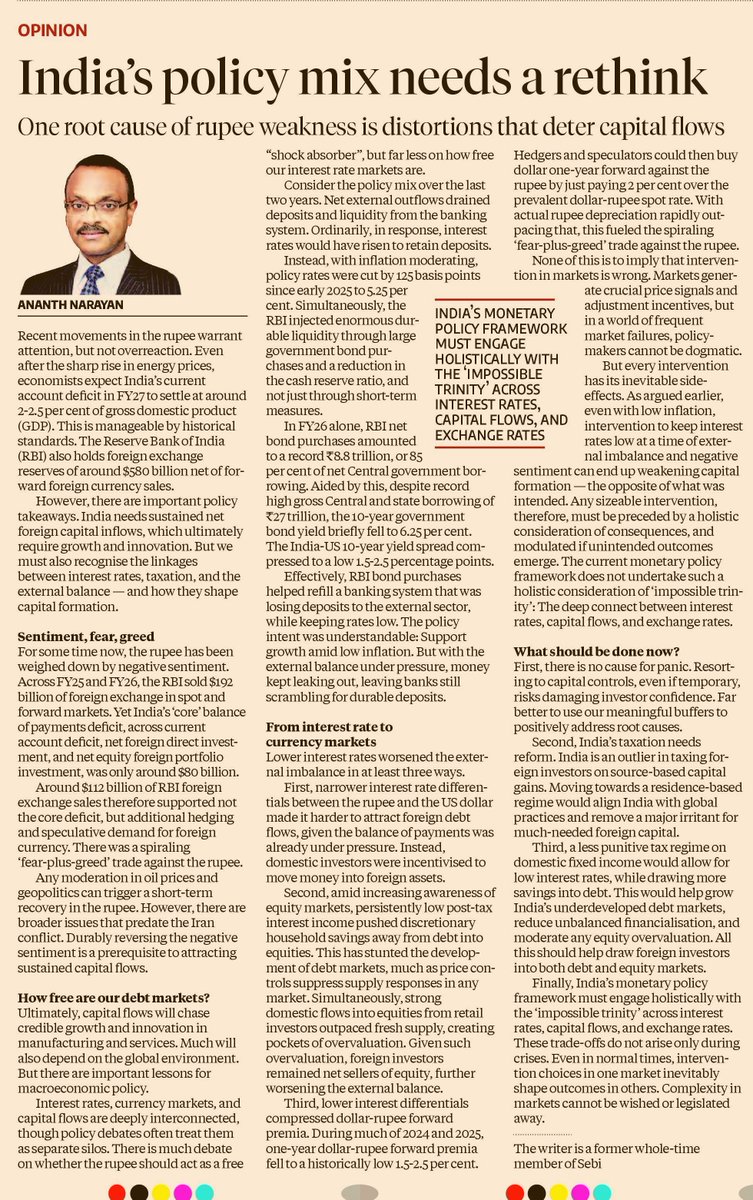
In my latest @bsindia piece, following an Indianomics discussion with @latha_venkatesh and Mridul Saggar, I argue that while sharpening and articulating India’s growth story is critical, policy and market distortions may also have amplified negative sentiment around the INR and deterred capital flows.
Key points:
• No cause for panic: INR weakness warrants attention, but India’s external deficits remain manageable and RBI's buffers are substantial.
• The deeper issue: India’s prolonged struggle to attract sustained net foreign capital amid persistent negative sentiment on the rupee.
• Policy silos: Interest rates, liquidity, taxation, capital flows, and currency markets are deeply interconnected, though policy debates often treat them in silos.
• Unintended consequences: Interventions to suppress interest rates, alongside tax frictions, may have unintentionally weakened capital inflows and lowered the cost of speculative positioning against the rupee.
• Distorted savings: Distortions in taxation and markets have also stunted debt market development, pushing discretionary savings disproportionately into equities.
• Navigating the Trinity: The answer is not avoiding intervention, but engaging more holistically with the “impossible trinity” linking interest rates, exchange rates, and capital flows.
• The structural fix: Rather than introducing capital controls or fresh distortions, responses should aim for deeper debt markets, balanced taxation, and a globally competitive framework for foreign capital.
The piece argues against both panic and rigid orthodoxy, in favour of a more integrated approach to monetary, currency, and fiscal policy.
https://t.co/ud4pLWvj2Q
In my latest @bsindia piece, following an Indianomics discussion with @latha_venkatesh and Mridul Saggar, I argue that while sharpening and articulating India’s growth story is critical, policy and market distortions may also have amplified negative sentiment around the INR and deterred capital flows.
Key points:
• No cause for panic: INR weakness warrants attention, but India’s external deficits remain manageable and RBI's buffers are substantial.
• The deeper issue: India’s prolonged struggle to attract sustained net foreign capital amid persistent negative sentiment on the rupee.
• Policy silos: Interest rates, liquidity, taxation, capital flows, and currency markets are deeply interconnected, though policy debates often treat them in silos.
• Unintended consequences: Interventions to suppress interest rates, alongside tax frictions, may have unintentionally weakened capital inflows and lowered the cost of speculative positioning against the rupee.
• Distorted savings: Distortions in taxation and markets have also stunted debt market development, pushing discretionary savings disproportionately into equities.
• Navigating the Trinity: The answer is not avoiding intervention, but engaging more holistically with the “impossible trinity” linking interest rates, exchange rates, and capital flows.
• The structural fix: Rather than introducing capital controls or fresh distortions, responses should aim for deeper debt markets, balanced taxation, and a globally competitive framework for foreign capital.
The piece argues against both panic and rigid orthodoxy, in favour of a more integrated approach to monetary, currency, and fiscal policy.
https://t.co/ud4pLWvj2Q
Climate change is everywhere, including in this season's Alphonso mangoes.
@AshwinM_ reports from Maharashtra's Alphonso mango belt on the impact climate vagaries have had on the crop and farmers.
Read here: https://t.co/0CMQAUJbdm