Roger Scruton on defending Western civilization. He nails it:
“I myself have obviously got into an awful lot of trouble through defending Western civilization. It seems a strange feature of our times that the more you’re disposed to defend it, the more you are regarded as some kind of narrow-minded bigot. But the people who make that accusation are the real ones with the narrow mind. They’re people who do not see exactly how large and comprehensive our civilization has been and still is.”
Replacing Churchill With a Puffin: The Quiet Erasure of Britain
The Bank of England has made its decision. Churchill goes. Turner goes. Jane Austen goes. Alan Turing goes. In their place, wildlife. A stoat, perhaps. A puffin. A hedgehog. The consultation found it popular. The anti-counterfeiting argument was sound. And so, without a parliamentary debate, without a public vote, without anyone in authority pausing to ask what it means to remove the faces of the people who built and saved this country from its own currency, it was quietly done. This is how erasure works. With a consultation and a press release.
Churchill's face on the five pound note is not decoration. It's a daily reminder that Britain has a history worth being proud of. That the people who shaped and defended this nation deserve to be remembered. And that national identity is something real. Hand over a fiver for a coffee and catch a glimpse of the man who stood between Western civilisation and Nazi conquest. The man who refused to negotiate when every pressure was on him to do so. The man who defined British resolve at its finest hour. Replace him with a puffin and you have made a statement about what Britain now thinks of itself. You have made it to every man, woman and child in the country. Without a debate. Without a vote. Without asking anyone.
That is the pattern. It's always quiet. It's always administrative. It's always defended on its own terms, as common sense, as progress, as a neutral technical decision. Statues fall to angry mobs and the establishment calls it a moment of reckoning. Street names are changed by council committees and it's called sensitivity. The curriculum is rewritten by academics and it's called balance. And now the currency is stripped of the faces that connect a people to their past, and it's called anti-counterfeiting policy.
Individually each decision is defensible. Cumulatively they form a pattern that is not accidental. The institutions entrusted with stewarding British identity have been captured by people who regard that identity as a problem to be managed rather than an inheritance to be protected. The long march through the institutions that began in the universities and the civil service fifty years ago has reached the point where it makes decisions about whose face appears on your money, and nobody with the power to stop it seems minded to try.
The consequences are not abstract. A population severed from its history, its symbols and its heroes loses the connective tissue of national identity. It cannot defend what it no longer recognises. It cannot demand loyalty to values it has been taught to be ashamed of. Lebanon's Christians believed their country was too civilised, too plural, too decent to fall. They were right about the decency. They were wrong about what decency alone can protect. Britain is making the same error by different means. You do not need armed factions to hollow out a nation. You need a Bank of England consultation, a university diversity committee, and fifty years of patience.
Churchill understood what was at stake when identity and resolve were under pressure. He said so, repeatedly, in language that would today be considered inflammatory by the very institutions that once celebrated him. The irony of removing his face from the currency of a country he saved, in an era when the threats he warned against have taken new forms, is apparently lost on the people who made that decision.
A stoat will never evoke what Churchill evoked. That is not sentiment. That is the point. The replacement of meaning with the merely decorative is not a neutral act. It's a statement about what a nation values, made quietly, by people who were not elected to make it, and cannot be held to account for having done so.
If we cannot defend the face on a banknote, we will not defend what that face represented. And the people dismantling it, piece by piece, consultation by consultation, know that perfectly well.
@Keir_Starmer Your promise of jam tomorrow is not the same as fixing it. You really don't have a clue. You should study how badly your socialist system has worked in the past. It was not for nothing that British Rail was privatised (although it was done in a silly way).
@KarlTurnerMP Glad to see that many replying here, unlike you, understand how organisations work. The railways will henceforth be at the back of the queue for investment - not shiny new lines, I mean basic maintenance and renewals.
Labour entered government and
⬇️hiked employers National Insurance
⬇️hiked the minimum wage
⬇️loaded new regulations on businesses
The result? Employers stopped hiring young people.
@Conservatives will listen to business, back more apprenticeships and reduce tax and red tape.
'These evil men deserve to be remembered in disgrace and dishonour'.
I add in last month's @TheCriticMag to the well-deserved chorus of praise for Antonia Senior's @Tonisenior superb "Stalin's Apostles".
In a nutshell: Blair, Starmer and Labour have been a disaster. We have a very poor calibre of politician in all parties. Fix your drains before choosing the wallpaper. In other words, sort out the economy, defence and the administration of law before splashing the cash. End of.
All Labour did was make private schools elite again
They cancelled scholarships, bursaries and summer holiday use of facilities for the community
Rich kids still go to private school, middle class kids don’t
I think on a personal level, the most interesting and also depressing aspect of very detailed study of WW2 administration of defence and industry in Britain, is seeing how exceptionally competent almost all of Britains administrators were.
You almost get cognitive dissonance just reading half the files, trying to work out how its even the same country we live in now which once produced these kinds of reports.
There is no doubt there has been a progressive, and disastrous collapse in the all round general collective intellectual capability of the civil service and defence administration in Britain over the last few decades.
Its possible to argue this is inevitable after the system was optimised by the white heat of war, and the dead wood was scattered to the four winds by virtue of necessity, but it doesnt change the fact that its almost impossible to reconcile the standards which were once taken for granted as a matter of national survival, with those we see today.
You can see it at every level, and even in my small town, talking to retired councillors, they cant believe the desperately poor standard of those currently doing the jobs they did 30 years ago.
How do you keep the best of your systems intact passing from wartime to peacetime ? Has anyone solved this question ?
Perhaps, as far as I can see from a brief search (this is not my specific area of historical study) Singapore is one example of the most valiant attempt, with some measure of sucess.
This has been discussed in "Meritocracy and the Singapore Political System." Asian Journal of Political Science. (link in comments), which describes the strict measures taken post independance in Singapore to introduce performance based merit in the Civil Service, and intensely rigid anti corruption laws.
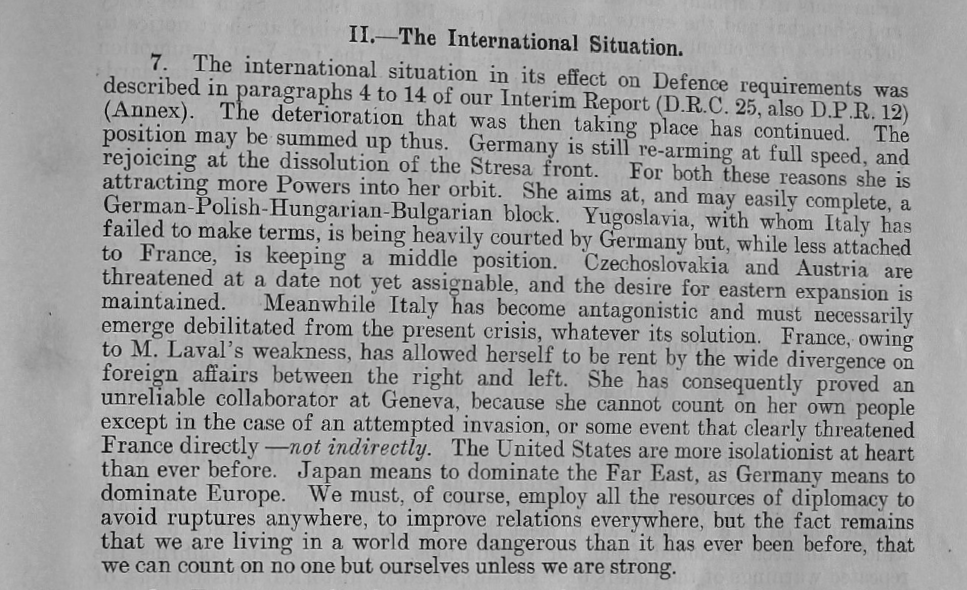
Letter below from 21st November 1935, Defence Requirements Sub-Comittee of the Committee of Imperial Defence - the CID, (Chamberlain presiding)
A year before, on the 8th October 1934, Chamberlain had been lambasted by Lord Hankey, for expanding the RAF by ten squadrons over and above that even recommended by the Defence Requirements committee.
Chamberlain suceeded in his push to expand the RAF at home as rapidly as possible. These meetings were however, all secret, and were not declassified until the 1970`s. The push for re-armament was not fully revealed to Germany, because the CID had agreed in 1934, that it would need five years to prepare for war with Germany, and that every diplomatic measure possible was to be taken until that date (1939) to avoid the outbreak of war with Germany.
It was then, after Chamberlains withdrawl from politics and death, taken as the established narrative that Britain had NOT begun large scale and direct preparations to defeat Germany before the beginning of Churchills tenure.
Only after the Committee of Imperial Defence files were declassified, covering what was really happening in British war planning in the 1930`s, that the truth became apparent. The established story of British stupidly and appeasement of totalitarianism before Churchill was Prime Minister, were utter nonsense - but, had been important to maintain the illusion of until 1939.
Some years ago (2017?) I had an increasingly bad tempered exchange on here about antisemitism in the Labour Party with a left wing firebrand otherwise unknown to me, one Sam Kriss (partly propped up by an unapologetic Leninist whom I’ll not do the honour of naming).
It was with some grim satisfaction that I later saw him cancelled on trumped up charges under the #MeToo 2.0 witch hunt.
So it is with something approaching the inverse of that (Happy Dissatisfaction?) that I have come to recognise him as probably the single most creative, original and vital presence on Substack for the last few years, one of a handful I pay for and actually read.
Link to his latest, a tirade against ubiquitous AI prose that is worth n+1 of Will Self’s, in the first reply. Free to read.
We're seeing huge numbers of people being punished for criticising Islam or Muslim cultural practices at @SpeechUnion. This is the number of new such requests for help we get each month.
Look what happens after Starmer comes to power. It's a 4x increase.
And that was before the new 'anti-Muslim hostility' definition.