Some laboratory facts about the oxidation of ingested (exogenous) carbohydrate (CHO) during exercise that need to be considered.
1. There is a time delay during which the oxidation ramps up during exercise. It takes about 90 minutes for maximum rates of about 1.8g/min to be achieved from the optimal ingested CHO solutions.
2. During the first hour of a 2 hour marathon one might predict average exogenous CHO oxidation rates of about 1g/min for a total of 60 g oxidized during the first hour. It may be more than this in persons who pre-load their intestine with a large CHO bolus as did Kejelcha prior to the London Marathon but it will not equal the average rate at which he ingested CHO during the race (~120g/hr). Thus after the first hour he will have accumulated a positive exogenous CHO balance of perhaps 60g.
2. During the second hour the average rate of exogenous CHO oxidation will be increased perhaps up to 1.5g/hr for a total oxidation during the second half of the race of 90g. But this is still less than the average rate of CHO ingestion (~120g/hr), leaving the athlete in a positive exogenous CHO balance of perhaps 90g.
3. From 90-120 minutes exogenous CHO oxidation rates remain at the peak value of about 1.8g/min. Thus after 90 minutes the athlete will be oxidizing ingested CHO at about 108g/min, close to the ingestion rate. Yet most are slowing down during this part of the race.
4. As most athletes ingesting CHO at this rate slow down in the final few km of the marathon race, their slowing cannot be because suddenly their rate of exogenous CHO oxidation has fallen below 1.8g/min. This indicates that the reason they slowed down is not because they have a "metabolic fuelling" problem. Perhaps the reason they ran fast in the earlier part of the race is also not because they had a superior fuelling strategy.
5. The obvious question is: What happens to the excess CHO ingested during exercise? And more importantly, if ingested CHO has to be taken in excess of requirement in order to run a sub-2hr marathon, why is this.
It's interesting that the CHO fuelling approach of Kejelcha (as advised by the Spanish company - Santamadre https://t.co/n1MRcgpbSB - directing his fuelling strategy) differs in many ways from the fuelling strategy adopted by the world record holder Sabastian Sawe, who is advised by the Swiss company, Maurten.
The Santamadre approach seems to be the ingestion of more gels (which produce much higher CHO concentrations in the mouth and stomach) which they refer to as a "CNS (central nervous system) fatigue blocker" designed to "help control muscle damage and reset fatigue. It was one of the key parts of our strategy, exactly as we have seen in the specific training sessions".
Is Santamadre hinting that perhaps it's discovered that high rates of CHO ingestion during marathon racing improves performance by effecting something other than the athlete's muscle energy metabolism, by "resetting fatigue"?
Considering all this, my colleague and co-autheor of the next edition of @LoreofRunning1, Dr Paul Laursen @PaulBLaursen has hypothesized that the repeated ingestion of highly concentrated CHO could activate a specific (well established but currently under-appreciated) neural pathway from brain to skeletal muscle that maintains skeletal muscle function during prolonged exercise. That is, that repeated CHO stimulation of the upper gastrointestinal tract activates CNS pathways that sustains muscle durability/resilience/fatigue resistance even as it should be developing during prolonged competition in elite athletes.
CNS fatigue blocking indeed! Except it's perhaps happening in the exercising muscles. Intriguing hypothesis.
@PaulBLaursen@PhilipPrins11@AKoutnik@sweatscience@Brady_H@BenBikmanPhD@theplews1@stevemagness@LoreofRunning1@zoeharcombe@bigfatsurprise@CarynZinn@grantsnz@TheNoakesF
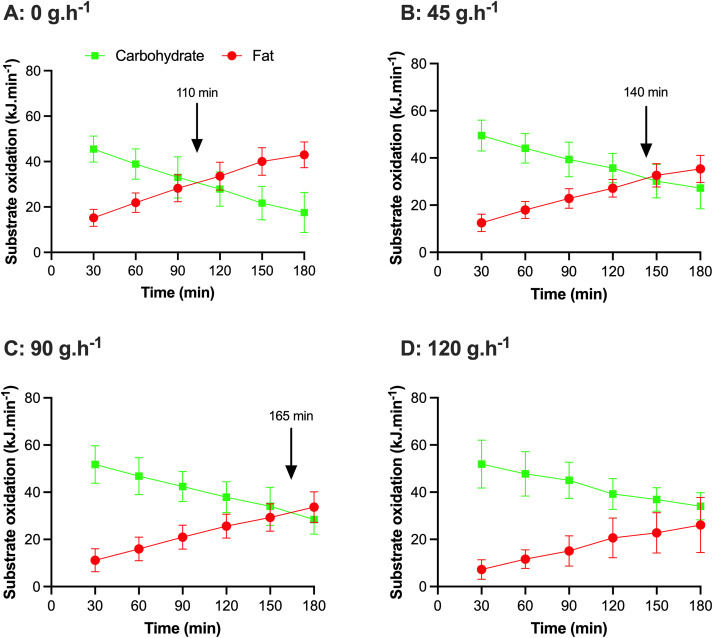
High-carb fueling delays the "crossover point" during endurance exercise - when carbs stop being the predominant fuel source due to glycogen depletion/low carb availability.
• With 0 grams/hour, this "switch" happens around ~2 hours.
• 45-90 grams/hour delays the crossover point by about 30-60 minutes.
• 120 grams+/hour prevents the crossover point from ever occurring. Carbs remain the predominant fuel source at this level of exogenous carb intake.
('From Metabolism to Medals.' Morton et al. 2026)
🗣️Luis Enrique: "Kylian tienes que marcar al central derecho, si no lo marcas no ganaremos, tienes que venir a AYUDAR, este es un partido jodido, necesitamos a TODOS, los CRACKS tienen que dar más ejemplo que los demás."
2 Champions seguidas 😭😭😭
@VictorIDX@cheadereuma@MartaMartitar Más construcción? A qué precios? O es que no has visto qué precios hay?
VPO? A 270.000€? Para los amiguitos de… como en Alicante?
Tras la histórica gesta de Sabastian Sawe, adidas lanza Chasing Sub2, un cortometraje documental que recoge el viaje humano, deportivo y tecnológico hacia el primer maratón sub‑dos horas oficial del mundo. https://t.co/StB4Sp1ewJ
@Xavi6777Moral@FUMATR0N ¿Todo ese análisis lo has hecho tú solito o con chatgpt? Por qué ese mismo rollo decían cuando subieron bastante el SMI y no veo muchos cierres…